
Commentary
The assassination of Charlie Kirk, a 31-year-old prominent figure in American conservatism, sent shockwaves far beyond the United States. While American reactions were predictably divided—tributes from the right and muted responses from the left—Europe’s response showed regional differences.
Notably, the European Parliament became a point of controversy when a request for a minute of silence by MEP Charlie Weimers was denied over a simple procedural matter that had been previously ignored, such as in 2020 following George Floyd’s death.
These differences highlight key political, cultural, and media variances across Europe. In the Nordic countries—Denmark, Finland, Iceland, Norway, and Sweden—reactions to Kirk’s murder were mostly subdued, emphasizing the tragedy of violence rather than Kirk’s legacy, and portraying the event as a distant American issue, with public figures calling for calm instead of outrage.
Coverage by major outlets such as Sweden’s Aftonbladet and Norway’s VG focused on the broader impacts on democratic discourse, with little of the emotional rallying seen elsewhere.
A former Danish prime minister said he was “deeply shocked,” but did not offer any broader political commentary. In Norway, still affected by Neo-Nazi Anders Breivik’s attack that killed 77 people in 2011, commentators prioritized de-escalation over division, and while Sweden experienced some more heated online debate, no large protests or parliamentary gestures occurred. Similarly, Finland’s response was mixed, and Iceland showed almost no public reaction.
Elsewhere in Europe, the response was more passionate and emotional. In the UK, the stronghold of the new wave of Western European populist conservatism led by Nigel Farage and his Reform Party, former Prime Ministers Boris Johnson and Liz Truss both condemned the murder. In France, the conservative National Rally (RN) leaders praised Kirk as a “martyr for free speech,” drawing parallels to the 2015 Charlie Hebdo attacks. Additionally, around 250 people gathered in Paris for a memorial where an RN spokesperson argued, “They were killed by the same bullet.”
Conservative groups across Southern Europe also took the opportunity to voice their reactions. Italy’s conservative Prime Minister Giorgia Meloni criticized her leftist opponents for “downplaying” the assassination and called it a “deep wound for democracy.”
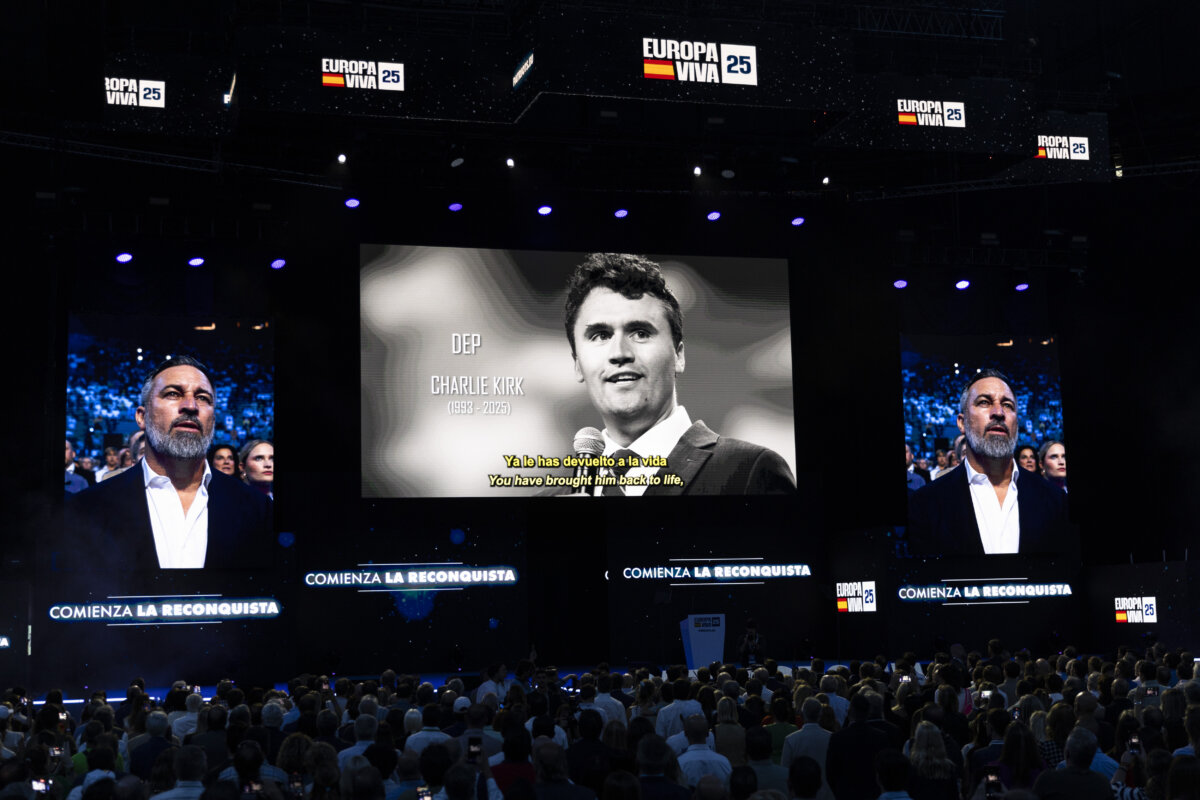
In Spain, the Vox party held a tribute in Madrid with videos and songs, accusing the leftist government of creating a “climate of hate.” And the leader of Portugal’s rising Chega party, André Ventura, warned of a shift from “arguing over ideas” to “hatred and murder.”
However, the strongest reactions came from Central Europe, which is one of Europe’s most conservative regions. Poland’s parliament, the Sejm, held a moment of silence, with members of parliament planning an exhibit on Kirk’s life and the opposition demanding that Antifa be classified as a terrorist organization. Meanwhile, Hungary’s Prime Minister Viktor Orbán, one of Europe’s few politicians openly supporting Donald Trump, blamed the murder on an “international hate campaign” against the political right.
This contrast between Nordic restraint and continental uproar is also measurable. Nordic reactions averaged fewer than 10 major news articles per country in the first week, compared to hundreds in countries such as Italy and the UK. Social media sentiment analysis also reveals that Nordic hashtags, such as #CharlieKirk, trend at low volumes and with neutral tones, whereas #KirkMartyr experienced a surge in Southern and Central Europe.
Several factors account for this divide.
First, political landscapes. Social democratic parties have long dominated Nordic politics, while the right has been marginalized, especially within elite circles that influence discourse. Therefore, Kirk was seen more as a controversial figure than a supporter of free speech.
Second, media landscapes. Nordic media markets are predominantly left-leaning public service companies that are often critical of conservative populist movements, including Donald Trump and the MAGA movement specifically.
Third, historical context. In Western, Southern, and Central Europe, right-wing ideology closely resembles Kirk’s own political battles. In contrast, most Nordic right-wing parties remain relatively moderate, even on issues such as mass migration and its socioeconomic effects.
Thus, the public in the Nordic region found it harder to directly connect with Kirk and his message compared to people elsewhere in Europe, where it fueled political divisions. How this will impact European politics in the long run remains uncertain, but it could increase political tensions across the continent.
Views expressed in this article are the opinions of the author and do not necessarily reflect the views of The Epoch Times.
 Friends Read Free
Copy
Facebook
Tweet
Friends Read Free
Copy
Facebook
Tweet