Commentary
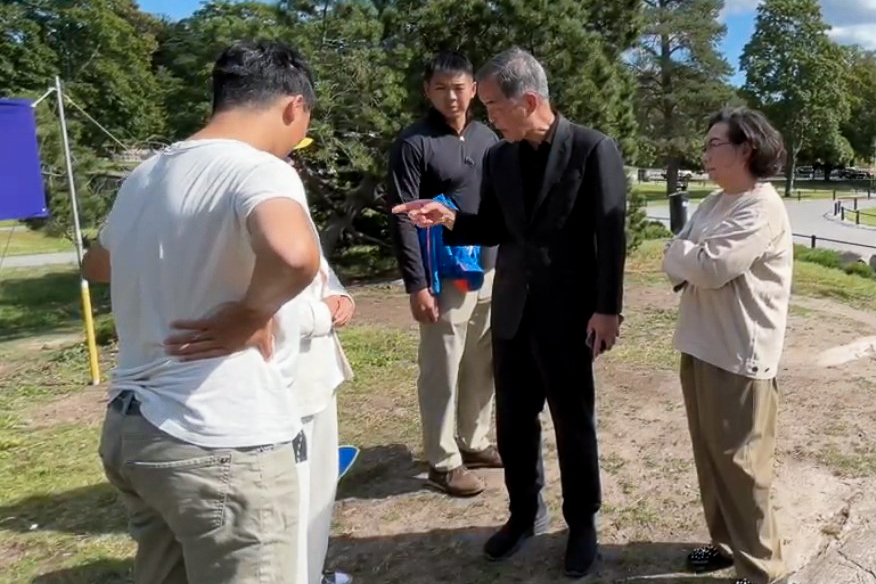
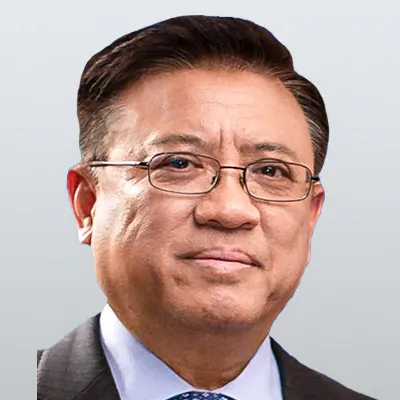
Former Hong Kong Chief Executive Leung Chun-ying—now a vice chair of the Chinese People’s Political Consultative Conference (CPPCC)—was recently caught on camera in Finland threatening Falun Gong practitioners, playing the role of a street-level enforcer for the Chinese Communist Party (CCP).
On Aug. 13, Leung confronted practitioners who were meditating in Helsinki’s Sibelius Park and gathering signatures for a human rights petition. In a video obtained by media outlets, he said, “Once we have your names, we can immediately check [using a surveillance database] when we go back, one by one.”
Leung and his wife also forcibly photographed the practitioners’ faces with their phones. Given China’s extensive police databases and advanced facial recognition systems, such images can be used to track dissidents and harass their families—a common tactic used against critics of the regime.

Although the CCP has long carried out such operations abroad, 2025 has seen a marked escalation. Falun Gong practitioners, Tibetans, Uyghurs, Hong Kong activists, and mainland dissidents have all reported harassment and intimidation worldwide.
Repression Orders From CCP’s Top Leader
As a vice chairman of the CPPCC, Leung’s behavior suggests that this transnational repression initiative originates from the top.
The CPPCC serves as the top watchdog of the regime’s united front work, with the United Front Work Department acting as the actual enforcer under its leadership. Its chairman is usually a standing member of the CCP’s Politburo, which is the decision-making body of the communist regime.
The CPPCC claims to be a “key mechanism” of the CCP’s united front work. It publicly aims to “adhere to the guidance of Xi Jinping Thought” and “uphold the leadership” of the CCP.
Leaked documents from the CCP are rare, but in 2024, the Falun Dafa Information Center obtained minutes from a secret meeting of the Ministry of Public Security held in June 2022. During this meeting, CCP leader Xi Jinping personally ordered an intensified suppression of Falun Gong overseas.
In 2025, rights group World Organization to Investigate the Persecution of Falun Gong also reported that Xi had given directives during the 2022 meeting to suppress Falun Gong on a global scale. Wang Huning, chairman of the CPPCC, was identified as the lead enforcer, with the Ministry of Public Security responsible for overseeing operations abroad. This report corroborates the earlier leaked information.
Why Did Leung Step Forward?
In the early years of the persecution, the CCP’s provincial and ministerial officials sometimes sought political favor by openly directing or participating in suppression operations. But later, after overseas lawsuits lodged by Falun Gong practitioners against visiting Chinese officials became more common, Beijing began to keep its senior cadres in the background. Since 2005, even the annual government work reports at the “Two Sessions” (a major political meeting) no longer explicitly mention Falun Gong, part of a deliberate effort to hide the campaign and shield senior officials from liability.
As vice chair of the CPPCC, a senior position in the CCP’s United Front system, Leung would have access to classified documents and directives. His decision to intimidate Falun Gong practitioners in Finland strongly suggests that he was acting under high-level orders.
Typically, front-line intimidation is carried out by low-level operatives, pro-CCP associations, or consular staff—or sometimes even diaspora leaders acting at Beijing’s request. The fact that a subnational-level leader such as Leung personally acted as a street enforcer is extraordinary.
As I see it, Leung perceived that the orders for this transnational repression came directly from Xi, which is why he acted in such a brazen manner, lacking diplomatic restraint. Leung’s action suggests two possible motives: He may be angling for more political favor by visibly aligning himself with Xi’s directives, which he has access to; or his actions reflect a deeper insecurity—an attempt to prove his loyalty in a system that historically has never fully trusted underground CCP members.
Why Is CCP Escalating Transnational Repression Now?
Why is Beijing escalating its transnational repression of Falun Gong at a time when it is beset with domestic and foreign policy crises?
History offers a grim parallel: Even in the final stages of World War II, Nazi Germany never stopped deporting Jews to concentration camps. The notorious Adolf Eichmann oversaw the transport of thousands of Hungarian Jews to their deaths in 1944, long after Germany’s defeat was assured.
For the CCP, the persecution of faith groups—especially Falun Gong—remains a core mission. As an atheist regime, it views the eradication of belief in the divine or God as central to its survival. Both its domestic control and its foreign affairs policies serve this core purpose.
Like a cancer, the CCP continues to expand its repression outward, even as it decays within.
Leung’s actions in Finland reveal not only the CCP’s determination to export its persecution, but also the direct role of high-ranking officials. Instead of hiding the campaign, he has exposed it further—drawing more scrutiny from governments and rights groups around the world.
Global Response
The U.S. Commission on International Religious Freedom highlighted the CCP’s global persecution of Falun Gong in its 2025 report, citing arrests and propaganda attacks. In June, the U.S. Congress held hearings on the trend of transnational repression and sanctions on Chinese entities.
Canada’s Conference of Defence Associations Institute released a threat assessment report in May that urged stronger protections for diaspora communities.
In June, the United Nations released its first guidance paper on transnational repression, urging member states to collaborate on a coordinated global response that provides robust protection for individuals at risk.
At this year’s G7 summit in Canada in mid-June, world leaders sounded the alarm over growing transnational repression. In a joint statement, they expressed deep concern about foreign governments going after dissidents overseas and vowed to work together to push back against the practice.
In July, British policy institute Chatham House issued a strategy paper stressing “a zero-tolerance approach to Chinese malign influence operations” amid the “ongoing Chinese transnational repression and influence operations” in the country.
Views expressed in this article are the opinions of the author and do not necessarily reflect the views of The Epoch Times.
 Friends Read Free
Copy
Facebook
Tweet
Friends Read Free
Copy
Facebook
Tweet