

Commentary
Help me work through an economics puzzle I have in my mind. It stems from my childhood.
When I was very young, my father worked as a teacher and administrator in a public school (this changed in my teenage years, when he became an academic). My mother took care of the household and the kids: the shopping, cooking, washing, cleaning, maintaining social contacts, holding dinner parties, dealing with the kids’ sports schedules, and medical issues.
They owned the home and two cars, and we took ample vacations. I cannot recall any material deprivation. Our neighborhood was nice. We always had clothes. Food was plentiful. Medical care was never an issue. Christmas was wonderful in its abundance, with presents everywhere. We had plenty of toys and vast fun and never thought of ourselves as lacking in anything.
Because Mom cared for the home and kids full-time, my father spent the weekends with us playing sports, teaching us music, and telling us stories, and we often went on weekend family trips because the domestic scene was in perfect shape. We spent nearly the whole of Sunday at church.
We were not alone. All my friends were in the same situation. I don’t recall rich or poor. This was true in my neighborhood, school, and at church. Some of this might be due to childhood perceptions, but it remains true that we had abundance on one income, the same as everyone else.
It’s shocking to think that nothing like this is possible today. That same family on one modest income would be struggling very hard and likely be on some kind of income support. There would obviously be no home to own. Even if one were inherited, such a single income could not afford the property taxes.
I’m bugged by these memories. They contrast with all the many reports—you hear them daily—that income has risen and prosperity has only grown since those bad old days. Decades have gone by with periodic recessions and inflation. But mostly, we are told, the trend has always been up: more money, more consumption, and more technology, which presumably means better lives.
In short, they say, you have nothing about which to complain!
If this is true, how is it that my modest one-income family lived well in those days but today would be considered poor? Indeed, it is shocking to think that the life of my childhood would be impossible today.
Something seems off about this, and so I took some time to think about what’s going on here.
Before digging through the data, let’s try a mental experiment. Let’s say you are a single man and work 30 hours at an office. You pull in $60,000 per year, enough to pay the bills but not enough to spend carelessly. The boss comes to you and says he has a big project that will require 50 to 60 hours per week. You will be paid $84,000, and you will get new benefits such as better health insurance.
Your time at work has gone up by 100 percent, but your salary is up by only 40 percent. The money is welcome, but the new work burdens, not so much. You have almost no time even to enjoy your new salary.
In reality, even though you have more money in the bank, your effective hourly pay has actually decreased by 30 percent!
You think hard and wonder if you should even accept this. The boss, however, makes it clear that accepting the deal is the only way to advance in the firm. You talk to friends about it. They all congratulate you on your wonderful raise.
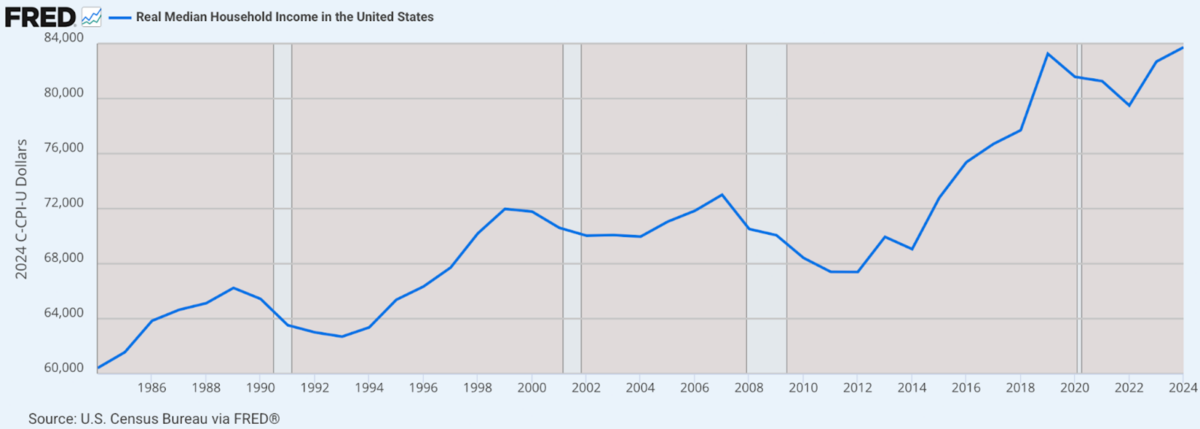
That story is essentially what has happened to the U.S. household over the past 50 years. On paper, it looks like more material abundance. Real median household income has marched upward.
In reality, the model home and family that I knew as a child is essentially gone.
Yes, income is up, but the choice to build a household with a single breadwinner is mostly unviable for people who have material aspirations.
Let’s look at the data. From 1984 to 2024, real median household income rose by 40 percent. But during these years, it became more typical than not that a single household would have two income streams (at least) rather than just one.
On paper, it looks like we are richer. In reality, your household income is lower considering all factors. Moreover, the additional income comes with new expenses and does come close to a doubling.
What the chart does not tell you is that the main reason for the rise in real household income is the shift toward more dual-income households, mostly driven by increased female labor force participation.
This was triggered by inflation in the 1970s, which dramatically reduced the purchasing power of the dollar, requiring new income streams to make up the difference. Adjusting for this affects how we interpret changes in standard of living or per-person economic well-being.
Extending the timeline back to 1976 gives us a fuller half-century view. It sharpens the contrast between household-level and individual-level income trends while reinforcing the role of shifting household composition and labor participation.
In 1976, real median household income was $68,000 to $70,000. In 2024, it was $83,730. This represents a real increase of roughly 20 percent to 23 percent. That’s much slower than the 38 percent to 40 percent rise from 1984 to 2024. In other words, including the inflation of the late 1970s, we see an even worse situation than what the charts tell us.
How can we sum this up? Adding another income stream to the household is a 100 percent rise in work expectations, but it has yielded only a 20-plus percent rise in material income. The effective pay per hour of work for the household has fallen by 40 percent to 50 percent!
In other words, the household is not richer but shockingly poorer.
At what cost? The costs are huge. The unpaid work my mother did caring for the household and kids now has to be crammed in on nights and weekends, leading to impossible stress. The luxurious weekends with my father have turned into a massive scramble to manage the household on Saturday and Sunday, leaving no time for anything else.
What’s more, this push to add an income to the household has largely tapped out possible gains. From 1976 to the peak, much of the household income rise came from this added labor input rather than big per-worker pay hikes. Post-2000, participation stabilized or declined somewhat (especially for men), and household income growth slowed. The “easy” gains from more dual earners are largely gone.
We are left with frenzied families struggling to pay the bills, which include the taxes plus child care, lawn services, and whatever other third parties we pay to do what husbands and wives used to do because they had time to do them. We have two people dealing with job stress rather than just one.
A key element of this I can recall from my youth. There were these pundits called feminists. They said women were being oppressed as housewives. The path to liberation was getting a job, obeying a boss, dealing with workplace stress, complying with company policy, and paying taxes.
How in the heck they convinced American women of this is one of the great mysteries of our time. But once inflation hit, it seemed like the only choice. The “feminists” were there to put a fancy gloss on new levels of professional servitude.
During this same period, no surprise, marriage itself has declined, and people are marrying later and later, if at all, while promiscuity in college years and early adulthood has become the norm.
This should not surprise anyone. When you rob the household of the benefits of the division of labor—one spouse does remunerative work to pay the bills and the other manages the domestic environment and kids—you dramatically undermine the rationale of the existence of the entire institution. To top it off, you cannot even buy a home.
The financial benefit of marriage with two incomes has risen far less than the financial benefit of remaining single. This is the big story of the past fifty years. The results should not surprise anyone. It has led to the unraveling of a life Americans once took for granted.
Economist friends of mine are forever trumpeting the huge gains in income over the past half-century and further pointing to the myriad gains in living standards that come with the digital revolution. I, too, like the internet, streaming music, and movies on demand. That’s great.
But what if we use a different metric, not just income data per person but issues like life quality that are commensurate to perpetuating the human race, to say nothing of inculcating faith, morality, and civilized standards of living in children? Here we get a different picture, one that is illustrative of incredible decay.
No question that the government has benefited from all these changes. This is not just due to the inflation, which lowers the burden of debt, of which government is the most indebted; it also has a whole new crop of people who pay taxes.
As for the household and family, it is another matter entirely. We have lost so much. Which would you choose? Marginal gains in individual income or secure families and domestic peace? This is not a question of data but a question of values.
Views expressed in this article are the opinions of the author and do not necessarily reflect the views of The Epoch Times.
 Friends Read Free
Copy
Facebook
Tweet
Friends Read Free
Copy
Facebook
Tweet