
Commentary
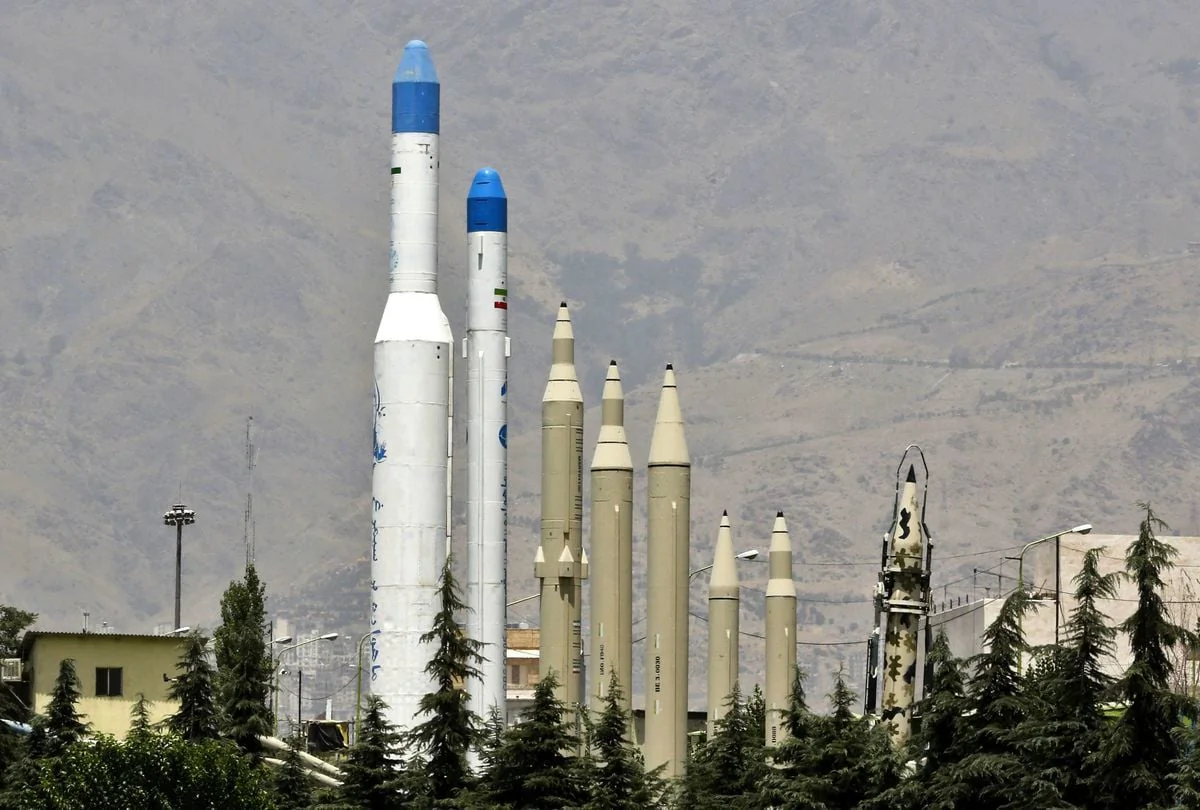
In July 1998, Iran fired what it called the Shahab-3. The launch looked, to most observers, like another step in Tehran’s long march toward regional reach. But analysts later pointed out a detail that should have landed like a warning flare: Iran’s test was essentially only the second known flight of the North Korean Nodong family—North Korea itself had reportedly flown it successfully just once before, in 1993. Iran wasn’t merely buying hardware; it was moving inside the development cycle of a partner state. That is what “reciprocal sharing” between Tehran and Pyongyang has meant for three decades: collapsing timelines, trading lessons, and turning sanctions pressure into a reason to cooperate.
The Early Deal: Missiles for Cash, Then Something More
The first phase was straightforward. During and after the Iran–Iraq War, Iran sought missile capabilities quickly. North Korea—isolated, militarized, and hungry for hard currency—sold Scud variants and associated support. Arms-control reporting notes Iranian officials acknowledging Scud purchases “from foreign countries like North Korea” in the 1980s, and U.S. intelligence assessments later describing continued “ballistic missile-related cooperation” from North Korean entities into the 2000s.
Over time, the relationship matured from shipments into infrastructure: maintenance, training, and iterative improvements. By the 1990s, North Korea was providing Nodong missiles and related assistance, and Iran’s Shahab-3 emerged as the most visible product of that lineage.
This matters because the central advantage of technology exchange is not “range on a brochure.” It is development efficiency. A state that gets access to another state’s test history—failures, fixes, workarounds—skips expensive dead ends. That is acceleration in its purest form.
What Reciprocity Looks Like Under Sanctions
Reciprocity is often misunderstood as symmetry: one side gives X, the other gives Y, and the ledger balances. The more consequential reality is feedback. North Korea has offered engineering heritage and a willingness to export. Iran has offered money, procurement pathways, and—crucially—an environment in which missiles, drones, and strike concepts are used, refined, and proliferated.
Iran’s own strategic logic for leaning on missiles and UAVs is well documented: lacking a modern air force, it emphasizes ballistic missiles, cruise missiles, and uninhabited aerial vehicles, while building what IISS describes as the region’s “largest and most diverse” missile arsenal and a record of providing these systems to outside forces.
When a system proliferates, the design does not stay frozen. Users adapt launch procedures, camouflage, basing concepts, decoys, and saturation tactics. That operational learning—what works against real defenses and what fails—can be as valuable as blueprints. The result is a partnership that can translate battlefield “lessons learned” into the next production run.
Nuclear Cooperation: Separate Question, Same Strategic Effect
A disciplined read has to separate missile cooperation—which is well supported in open reporting—from claims of direct nuclear trade between Tehran and Pyongyang, for which public evidence is thinner. A Congressional Research Service report on Iran–North Korea–Syria cooperation makes the point bluntly: missile technology cooperation between Iran and North Korea is “significant and meaningful,” while “no public evidence exists” of nuclear-related trade or cooperation between the two (as of that report’s publication).
That caveat does not reduce the threat posed by reciprocal sharing; it clarifies the mechanism. Missiles are the delivery backbone and the regional coercion tool. Even if nuclear cooperation were absent, sustained missile collaboration still multiplies risk—because it expands what each regime can hold at risk, and it improves survivability and penetration over time.
Why This Accelerates Both Threats at Once
Analysts sometimes talk about “two proliferation problems”—Iran over here, North Korea over there. The Tehran–Pyongyang channel turns that into one problem with two nodes.
First, it compresses time. Each side can leapfrog. If North Korea pushes a design forward, Iran inherits that maturity. If Iran demonstrates new operational methods—mass launches, mixed drone/missile strike packages, dispersed basing—that becomes a template others can study.
Second, it blunts sanctions. Sanctions work best when they isolate a program’s supply chains and slow iteration. A durable partner can offer alternate routes: components, machine tools, testing know-how, documentation, and the kind of “tacit knowledge” that is hard to interdict because it moves in people and training. The CRS’s broader discussion of cooperation and proliferation underscores the policy concern: networks create persistence even under pressure.
Third, it fuses theaters. A missile improvement born from Middle East contingencies can matter in Northeast Asia, and vice versa. That does not mean identical targeting; it means shared evolution in the tools of coercion.
Linking the Network to the Decision to Strike Iran
This is where the current military decision point enters. On Feb. 28, 2026, U.S. Central Command announced the launch of Operation Epic Fury, describing a campaign ordered by the president and aimed at dismantling key elements of Iran’s military capacity—explicitly including missile and drone launch sites, air defenses, command-and-control nodes, and military airfields.
AP reporting in the days that followed described strikes and escalation, including claims and assessments involving Iran’s nuclear infrastructure environment and the International Atomic Energy Agency’s warnings about risks near nuclear sites.
Whether one agrees with the choice to strike, the strategic logic is legible: if Iran is treated as a central engine in a larger capability ecosystem—one that shares, adapts, and learns with partners such as North Korea—then degrading Iran’s strike complex is framed as a way to slow an adversarial learning cycle, not merely punish a single state.
But the same logic also sets a hard boundary on what airstrikes can achieve. Facilities can be cratered. Stocks can be destroyed. The most durable commodity in reciprocal sharing is expertise—engineering judgment, production tricks, procurement relationships, and operational adaptation. If that connective tissue survives, acceleration can resume, sometimes faster than expected.
The Iran–North Korea relationship has endured because it is practical: a long-running exchange that converts isolation into collaboration. The strategic question after Epic Fury is whether the coalition that chose to strike can also sustain the less cinematic work—interdiction, financial pressure, export control enforcement, and intelligence cooperation—needed to keep “version three” from arriving as “version four,” in two regions at once.
Views expressed in this article are the opinions of the author and do not necessarily reflect the views of The Epoch Times.
 Friends Read Free
Copy
Facebook
Tweet
Friends Read Free
Copy
Facebook
Tweet