

Commentary
President Donald Trump has apparently made clear his desire that Americans return to the moon before the end of his term—January 2029—and beat China’s plan to get there by 2030.
This likely is why on Oct. 20, the acting administrator of NASA, Transportation Secretary Sean Duffy, said during a CNBC television interview: “The president and I want to get to the moon in this president’s term. … We’re gonna push this forward and win the second space race against the Chinese.”
Winning the simple race of returning Americans to the moon is well within the capabilities of the United States, but so is the far more consequential-for-humanity race for the moon, or securing a sufficient presence on the moon to ensure that China and its space ally Russia cannot deny lunar access to the United States and its 60-nation Artemis Accords coalition partners.
The Chinese Communist Party (CCP) is working furiously to build a militarily dominant lunar presence to enforce its ambitions to achieve political-economic-military hegemony on Earth. By denying them access to the moon and Mars, the democracies cannot, in extremis, leverage space resources to defeat the CCP hegemony.
In essence, the CCP seeks space hegemony to enforce Earth hegemony by turning the moon and then Mars into “prison doors” barring humanity’s escape from the CCP’s diktats.
Most recently, on Oct. 30, China Manned Space Engineering Office spokesman Zhang Jingbo stated, “Regarding the specific timeline, we remain steadfast in our goal of achieving a Chinese lunar landing by 2030.”
Zhang also stated, “Primary preliminary prototyping of key flight hardware, including the Long March-10 rocket, the Mengzhou spacecraft, the Lanyue lander, the Wangyu lunar extravehicular suit, and the Tansuo crewed lunar rover, has been completed.”
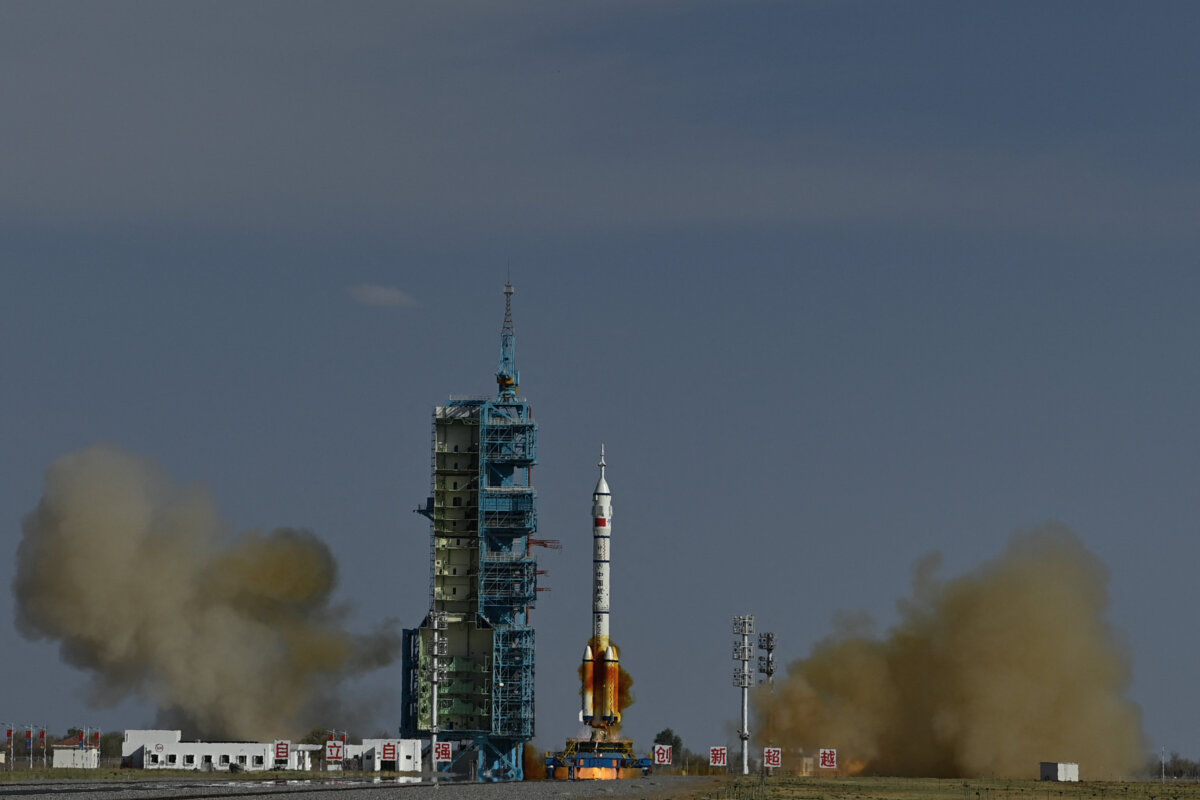
In 2026, China will likely start test flights of its new China Aerospace Science and Technology Corporation Long March-10 heavy space launch vehicle (SLV), two of which will be required to take the new Lanyue moon landing vehicle and then the new Mengzhou manned spaceship to dock in lunar orbit and transfer two crew members before Lanyue descends to the moon.
But Chinese sources are also clear regarding Beijing’s goals for occupying the moon. At a September 2024 conference of China’s Deep Space Exploration Laboratory, Wu Yanhua, chief designer of the major Chinese deep space exploration project, explained the following:
“A basic [moon base] model to be built by 2035 in the lunar south pole region, and an extended model to be built by about 2050. … Per the blueprint, the extended model will be a comprehensive lunar station network that utilizes the lunar orbit station as its central hub and the south pole station as its primary base, and it will include exploration nodes on the lunar equator and the far side of the moon.”
Wu also said: “The planned [China–Russia International Lunar Research Station] will be powered by solar, radioisotope, and nuclear generators. It will also include lunar-Earth and high-speed lunar surface communication networks, as well as lunar vehicles like a hopper, an unmanned long-range vehicle, and pressurized and unpressurized manned rovers.”
Chinese sources have also mentioned the possibility that China will build a small space station for lunar orbit, like the Artemis Program Gateway Space Station. These sources have also suggested that this lunar space station would be built at Earth-moon Lagrange Point-1 (EM-L1, between the Earth and moon), which would facilitate constant contact and resupply of Chinese moon bases.
Such an infrastructure on the moon, according to Wu, “will be capable of laying a foundation for manned landings on Mars in the future” and an “expandable, maintainable system capable of long-term robotic operations with short-term human participation.”
As the People’s Liberation Army controls all Chinese space activities, it is to be expected that the Chinese military will quickly use its expanding manned moon bases to secure cislunar space, or the region between the Earth and the moon, to counter current passive and future U.S. active military space assets, with an EM-L1 lunar space station ideally suited for denying access to the moon.
As such, it is indeed essential for the freedom and security of Americans and all democracies that NASA devise and implement a plan that fulfills Trump’s goal of returning Americans to the moon before China, and to win the race to build a dominant presence on the moon that gives the U.S. president options to deter and deny CCP attempts to dominate the moon.
This will be a principal task for aerial entrepreneur and commercial astronaut Jared Isaacman, whom Trump renominated on Nov. 4 to become the 15th Senate-confirmed NASA administrator.
In a move that will assist Isaacman’s leadership, apparently also at Trump’s request, on Oct. 20, Duffy announced that NASA would reopen competition for the contract to build the Human Landing System (HLS), the manned moon landing vehicle, for the Artemis III manned moon mission scheduled for 2027 or 2028.
The main reason for doing so was the determination that Elon Musk’s SpaceX Corporation, which won the HLS contract for Artemis III in 2021, was not meeting its goals to build the HLS in time for Artemis III.
Also on Oct. 20, Duffy stated he was open to solutions from SpaceX and from Jeff Bezos’s Blue Origin, saying: “Whatever one can get us there first to the moon, we’re gonna take. And if SpaceX is behind, but Blue Origin can do it before them, good on Blue Origin. But by the way, we also might have two companies, and that can get us back to the moon in 2028.”
Time constraints may dictate that Artemis III retain the current $2–$4 billion-per-mission NASA Space Launch System (SLS), which will only bring the manned Orion spaceship to lunar orbit. Still, the reopening of the HLS competition means that Isaacman has options to devise a far less expensive U.S. “architecture” for returning to and occupying the moon.
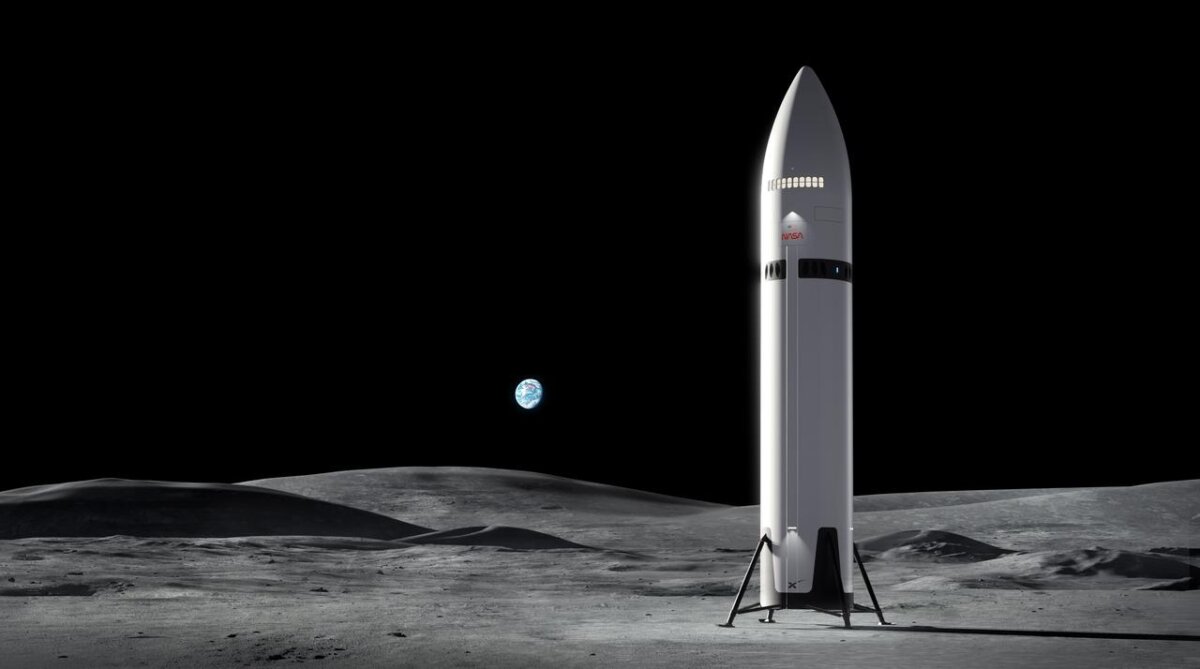
On Oct. 30, SpaceX responded to the controversy with a rare public update on its webpage that stated the following: “SpaceX’s HLS team has completed 49 milestones tied to developing the subsystems, infrastructure, and operations needed to land astronauts on the moon.
“Starship provides unmatched capability to explore the Moon. … Cargo variants of the Starship lander will be capable of landing up to 100 metric tons directly on the surface, including large payloads like unpressurized rovers, pressurized rovers, nuclear reactors, and lunar habitats.
“Starship continues to simultaneously be the fastest path to returning humans to the surface of the Moon and a core enabler of the Artemis program’s goal to establish a permanent, sustainable presence on the lunar surface.”
But with the successful second-mission first-stage recovery on Nov. 13 of Blue Origin’s New Glenn (NG-2) space launch vehicle, and the Nov. 20 announcement by Blue Origin that its NG-3 mission will have a more powerful second stage capable of moving 20 tons to the moon, NASA has options here.
Blue Origin’s NG-3 mission is scheduled for early 2026 and will transport the 21-ton unmanned Blue Moon Mk 1 moon landing vehicle on its “Pathfinder Mission” with the capability of taking 3 tons of cargo to the moon.
Blue Moon Mk 1 will be the predecessor to the larger Blue Moon Mk 2, which will be able to take 20 tons of cargo to the moon but may not be ready until the early 2030s.
However, if SpaceX is truly judged unable to meet a 2027 or 2028 goal, then there is the option to rapidly modify the Blue Moon Mk 1 to accommodate at least two astronauts, with the goal of putting Americans on the moon before 2029.
The Artemis III SLS could then take three astronauts in the Orion spaceship. However, at less cost, subsequent astronaut transport missions could be accomplished with the SpaceX Falcon Heavy and a moon-mission modified SpaceX Dragon manned spaceship.
But the United States’ ace up its sleeve will remain the SpaceX Starship-based HLS, or at least a dedicated and simpler cargo variant, which, with its ability to move 100 tons of lunar cargo, will ensure that the United States wins the race for the moon by creating multiple moon bases before China.
In addition, in 2021, a team from the International Space University in Strasbourg, France, proposed that Starship be developed into a horizontal moon base with a habitable volume 2.5 times that of the International Space Station.
Should China decide to deploy a small space station at EM-L1, then NASA will also have the option to rapidly deploy a similar version of the Gateway small lunar space station to enable the option of defeating any CCP “blockade” of the moon.
Gateway, initially designed to station reusable moon landing vehicles, can also support smaller, cheaper SLVs to transport humans to the moon and provide an option for rapid resupply and rescue missions.
In short, the United States has multiple options to win the race for the moon and to create a lunar and cislunar architecture to deter Chinese aggression in space.
Views expressed in this article are the opinions of the author and do not necessarily reflect the views of The Epoch Times.
 Friends Read Free
Copy
Facebook
Tweet
Friends Read Free
Copy
Facebook
Tweet