
Commentary
Profits among Chinese industrial companies picked up markedly in March. That month’s report showed earnings levels for the entire sector up by 16 percent from March 2025, bringing the first quarter’s growth up by 15.5 percent.
This is a big change from several months of weakness and the fastest growth since last September. Of course, these figures, produced by Beijing’s National Bureau of Statistics, cover only companies with revenues greater than 20 million yuan ($2.9 million). There is no telling at this point how smaller businesses have done. Even if small businesses have followed suit, there are at least three reasons to doubt that this news counts as the start of a new, positive trend.
Much of the surge reflects a one-time increase in producer prices—what Chinese statisticians call “factory-gate” prices. After more than three years of declining producer prices, this one-time increase allowed for an expansion of long-squeezed profit margins in certain sectors.
Since these producer price hikes clearly reflect the nearly 60 percent rise in oil and natural gas prices associated with the fighting in the Persian Gulf, Chinese producer prices and profit margins would seem to need further oil price hikes simply to sustain these new, wider profit margins, much less expand them further.
A second reason to doubt the sustainability of this expansion in profits is the clear evidence that revenues have not grown nearly as fast. Indeed, the 5 percent revenue growth recorded by Beijing’s National Bureau of Statistics effectively announces that the profit surge has little or nothing to do with any significant growth in demand, either for exports or within China’s domestic economy.
The uneven nature of the profit growth also suggests that the upward movement is far from durable. Consistent with the effect of oil price hikes, petroleum, coal, and other fuels saw the price of their products rise. Profits did not do as well because their costs also rose.
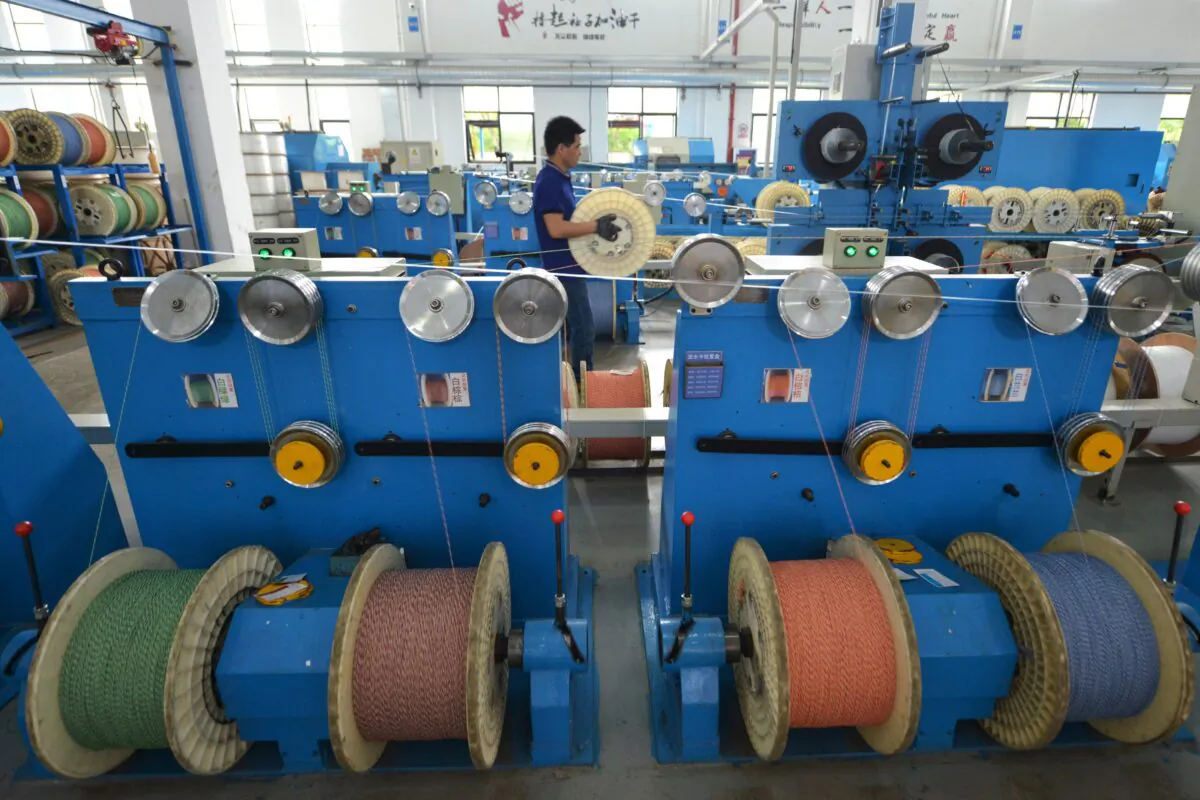
However, the price effect allowed them a marked turn into profitability from reporting losses for months. Of every industrial subcategory, optical fiber manufacturing did the best, showing a 336.8 percent increase over March 2025. This sector has consistently benefited from Beijing’s push in artificial intelligence and advanced semiconductors, but that link to official support alone suggests the artificial nature of the gain. Besides, the sector is too small to carry the entire industrial sector even if such profit growth persists.
Meanwhile, profits in autos, the power sector, and building materials, all tied to domestic demand, remained in negative territory.
Rather than fallout from a war or a very focused government push in technology, what China needs to change the profit picture in industry and throughout the economy is an impressive and sustainable growth in demand, and that seems less than likely. China, after all, continues to suffer from the lingering effects of the property crisis and a deep reluctance of the household sector to spend, not least because the property crisis continues to depress the value of owner-occupied real estate and so also the finances of everyday Chinese.
Although exports appeared to do well last year, the continued hostility to China trade shown by the United States raises serious questions about a repeat performance in 2026. Europe, which had distinguished itself as a major buyer of Chinese goods in 2025, began imposing trade restraints late last year.
What is more, Europe’s vulnerability to oil-supply constraints suggests that its economy will suffer, and with it, its demand for Chinese goods. The same can be said of the so-called global south, which took in many Chinese exports last year.
Beijing, no doubt, has embraced the surge in industrial profits as a sign of economic strength. There certainly is no reason to ignore it. However, those cheering need to realize that the rise in energy prices might have had an immediate positive effect on profit margins but that, in the longer term, the ill effects on economies will come into play. Besides this consideration, there are other ample reasons to question the sustainability of this improvement in profits, much less declare it a sign of the much-sought economic upturn.
Views expressed in this article are the opinions of the author and do not necessarily reflect the views of The Epoch Times.
 Friends Read Free
Copy
Facebook
Tweet
Friends Read Free
Copy
Facebook
Tweet