
Commentary
With the first of four scheduled summit meetings between President Donald Trump and Chinese Communist Party (CCP) leader Xi Jinping now in the rearview mirror, both sides publicly projected confidence. Beijing emphasized cooperation. Trump emphasized trade, markets, and “strong relationships.”
But beneath the diplomatic choreography lies a larger geopolitical reality: Xi has made Taiwan the central issue governing the future stability of U.S.–China relations.
Deals Over Ideology?
What’s more, Xi likely believes Trump can be persuaded to make a deal.
Trump’s foreign policy often leans more toward transactional than ideological priorities. Alliances, trade relationships, and security commitments are often viewed through the lens of leverage, economic return, and deal-making rather than long-term democratic solidarity.
That matters because Taiwan sits at the intersection of nearly every issue that at least some perceive Trump as caring most about: trade deficits, semiconductor dependence, rare-earth access, manufacturing, inflation, and economic stability.
These are arguably top priorities as the United States approaches politically critical elections, but not the only ones.
If NATO Can Be Downgraded, Why Not Taiwan?
If that’s the case, is a broader shift in U.S. foreign policy that favors pragmatism over alliance maintenance underway?
One could argue that, but not definitively.
It’s no secret that Trump has repeatedly questioned NATO commitments and openly warned that the United States may not defend allies that fail to meet defense spending commitments. He has also pushed European nations to assume far more responsibility for their own defense burden.
Whether supporters view it as realism or critics as abandonment, the message is unmistakable: Long-standing alliance systems are no longer untouchable, especially when the protected nations act against U.S. interests.
If the NATO Alliance in Europe can be downgraded from strategic partner to negotiable burden, is Taiwan’s position less secure?
For decades, American policymakers have framed Taiwan as part of a broader democratic security architecture in Asia. But does Trump think primarily in terms of transactional benefits?
Some may think so. But he also thinks in strategic terms.
Taiwan remains a core strategic ally of the United States, with massive arms deals that help the U.S. economy and keep the pressure on China.
Why would Trump, who understands power better than most presidents, cut Xi slack and hand over Taiwan?
Taiwan plays a significant role in the broader Asia-Pacific security strategy, which also involves Japan, South Korea, and the Philippines.
Giving up Taiwan would invalidate the whole U.S. Asian security plan. That’s not likely to happen.
Xi’s Red Line Is Taiwan
Xi has shown a similar tendency toward pragmatism by not directly challenging U.S. assertiveness in Panama, Venezuela, or Iran. The balance of power overwhelmingly favored Washington in each case.
But Taiwan is different.
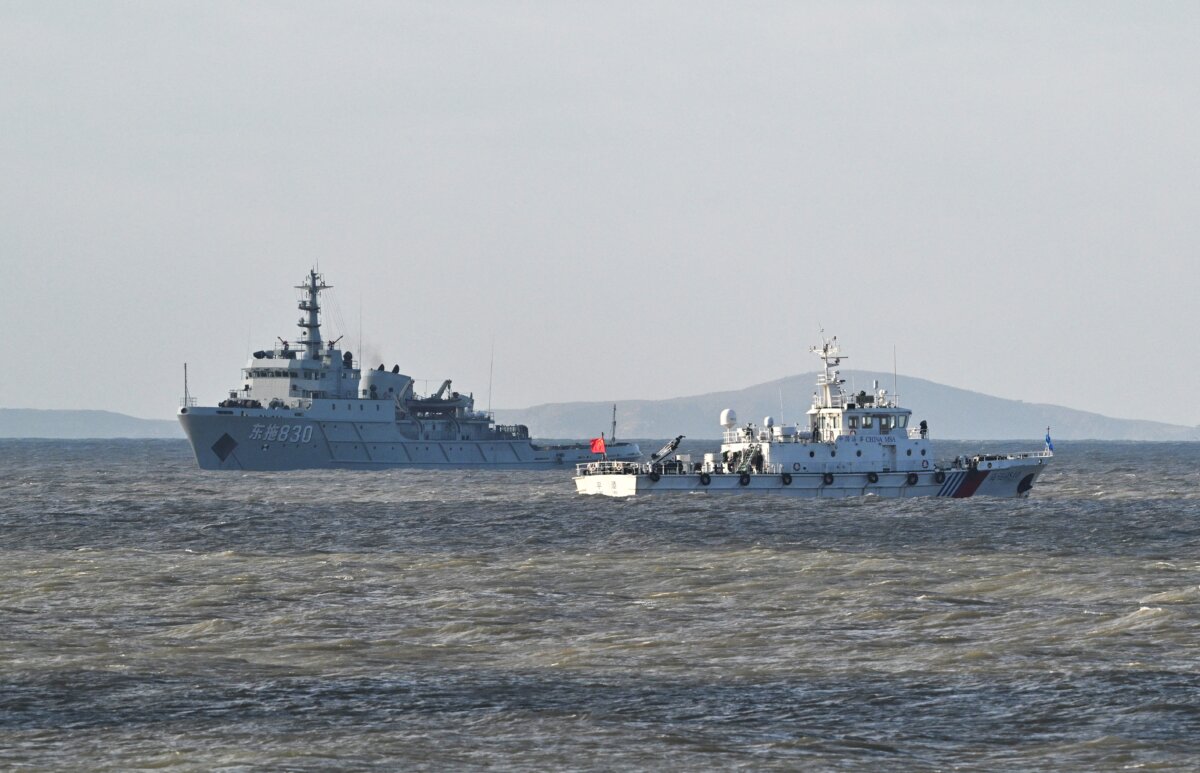
Xi has steadily elevated Taiwan from a regional dispute into the defining issue of his leadership era. At the 20th Communist Party Congress, he declared reunification essential to China’s “national rejuvenation” and refused to rule out the use of force. He has also built up the People’s Liberation Army Navy to the point of superiority over the U.S. Navy in the Western Pacific.
Xi reportedly told Trump that stable U.S.–China relations ultimately depend on Washington constraining support for Taipei.
Does Xi believe Trump may be susceptible to economic leverage? Why wouldn’t he?
After all, nearly every pressure point facing Washington intersects with China in some form and creates at least the possibility of a broader geopolitical bargain.
The Arms Delay Sent a Signal
What’s more, as an astute political strategist who’s reached the pinnacle of power in China, Xi undoubtedly studies signals carefully.
When it was recently reported that Taiwan faces a major backlog of undelivered U.S. weapons systems valued at nearly $14 billion, he could draw at least a few conclusions.
Official explanations cite supply chain bottlenecks or Ukraine-related production strain. Weapons delays, softer rhetoric, trade-focused summits, and reduced urgency could easily be viewed as signs of flexibility on Trump’s part.
Such hesitations may lead Beijing to think that time may now favor China. At the same time, however, as China’s economy falters and Taiwan continues to arm, time may not be on Beijing’s side.
The Semiconductor Question
Perhaps Xi thinks the clearest sign of Trump’s thinking lies in semiconductors. Trump has repeatedly pushed for advanced chip manufacturing to move from Taiwan to the United States. Officially, the rationale centers on economic security and reducing dependence on foreign supply chains.
But strategically, the implications could be far larger.
Taiwan’s geopolitical importance rests heavily on semiconductor dominance through Taiwan Semiconductor Manufacturing Co. (TSMC), the world’s most critical advanced chip producer, supplying 80 percent of high-performance chips.
TSMC has already announced plans to dramatically expand advanced chip production inside the United States, particularly in Arizona. The company has indicated that roughly 30 percent of its most advanced chips may eventually be manufactured in America.
If the United States successfully reduces dependence on Taiwan-based semiconductor production, would Washington feel less compelled to risk military confrontation with China over Taipei?
That may be the thinking in Beijing, but given that China’s military establishment was completely surprised by Trump’s actions in Venezuela, they’re unlikely to think that Trump would be so predictable.
Taiwan as Leverage?
None of this means Trump intends to abandon Taiwan outright.
Conventional wisdom says that geopolitics rarely changes through dramatic declarations alone. More often, it shifts incrementally through delayed commitments, recalibrated priorities, and changing definitions of strategic value.
But Trump is hardly conventional. Ask former Venezuelan leader Nicolás Maduro. The geopolitics in the Caribbean basin literally changed overnight.
Taiwan’s danger may come not from overt betrayal, but rather from a gradual transactional downgrade.
Xi understands that Trump seeks measurable victories in critical areas mentioned above that can directly affect the outcome of the midterm elections. He also knows that China is in a position to influence every one of those variables.
How much leverage does this give Beijing?
That remains to be seen.
Is American foreign policy shifting from principle-based alliances toward pure strategic bargaining?
Are democratic allies increasingly becoming negotiable assets within broader economic diplomacy?
Or are American security guarantees based on allies behaving like allies instead of supporting U.S. adversaries?
NATO is learning the answer to that question.
If Beijing thinks the United States can be manipulated so easily, it may find itself surprised by Trump once again.
Views expressed in this article are the opinions of the author and do not necessarily reflect the views of The Epoch Times.
 Friends Read Free
Copy
Facebook
Tweet
Friends Read Free
Copy
Facebook
Tweet