
Commentary
As U.S. President Donald Trump prepares for his delayed summit in Beijing with Chinese Communist Party (CCP) leader Xi Jinping, and as the United States and Israel strive to conclude the war against Iran’s terrorist Mullah regime, it is time to consider the role that China will be allowed to play in a post-terror Iran.
It is tempting to conclude that China should play no role in a post-war new-era Iran because Beijing was, on many levels, the handmaiden of the Iran war due to its decades of support for the Islamist terror regime.
But on the other hand, China is the major buyer of Iran’s oil—up to 90 percent in 2025, up from about 30 percent in 2013—and it will likely remain a major petroleum customer.
However, as it “paid” for the many predations of the Mullah regime, Beijing should also pay dearly to earn the confidence of future generations of free Iranians—but only through a conveyance that it does not fully control.
Even if the Iran war ends soon, it may take years to reveal the full extent of CCP aid and assistance to the radical Iranian regime and to its campaigns of repression, foreign terror, and nuclear missile building.
Between 2016 and 2026 alone, unofficial estimates hold that China purchased up to $250 billion worth of Iranian oil, and considering that Iranian national budgets have been between $40 billion and $50 billion, rough estimates are that oil sales to China may have provided up to half of Iran’s annual government spending.
Minus the oil revenues from China, it is unlikely that the Mullah regime could have afforded its vast “digital repression” of ubiquitous Chinese-made “smart city” surveillance cameras and networking-recognition software to locate and kill regime opponents.
After three weeks of war, one might conclude that the Iranian public’s reluctance to protest and even overthrow their Islamic terror regime may be in no small part due to fear of detection and reprisals enabled by the Chinese-made surveillance and location apparatus.
Minus the oil sales to China, it’s doubtful that Iran could have afforded to arm its proxies—Hamas, Hezbollah, and the Houthis—with sophisticated rockets and missiles. Nor could Tehran have afforded to fund much of Hamas’s horrific October 2023 attack and war against Israel.
Minus the oil sales to China, it may also be doubtful whether Iran could have afforded its 30-plus-year nuclear weapons program.
Iran apparently was very close to building its bombs; on March 2, Trump’s Iran negotiations envoy Steve Witkoff told Fox News’s Sean Hannity, “Both the Iranian negotiators said to us, directly, with, you know, no shame, that they controlled 460 kilograms of 60 percent [reprocessing strength], and they’re aware that that could make 11 nuclear bombs, and that was the beginning of their negotiating stance.”
This brazen disclosure by Iranian officials apparently helped convince Trump that a war against Iran was necessary to prevent its radical dictatorship from completing construction of the nuclear weapons that it could have used against Israel and the United States.
Minus the oil revenue from China, it is unlikely that Iran could have paid for its expansive ballistic missile, cruise missile, and long-range loitering attack drone programs.
As of March 19, Iran has launched a total of 1,300 ballistic missiles and 3,555 drones against Israel, the United Arab Emirates (UAE), Saudi Arabia, Jordan, Qatar, Oman, Turkey, and Cyprus, with more than 1,000 missiles and drones launched at the UAE alone.
It is also the case that Iran could not build its ballistic missile and drone arsenals without decades of access to Chinese engineering education, consulting, and access to Chinese-made navigation, engine, and direct guidance/targeting technology.
One can safely conclude that Iran’s missile terror campaign was paid for by the CCP, advanced because of Iran’s access to a wide variety of Chinese-made parts and Chinese-made rocket fuel precursors, and was then guided/targeted by China’s large constellation of surveillance and navigation satellites.
So begins the case regarding why the Chinese regime should be paying reparations to support the reconstruction of Iran, Israel, and the Gulf states damaged by Iran’s missile and drone strike campaign.
While any final estimate will have to wait until the conclusion of the Iran war hostilities to be determined, some estimates hold that reconstruction costs for Iran and the Gulf states could run from $500 billion to $1 trillion.
While it would be tempting to simply give Xi a bill, it is also important to create a regional mechanism to ensure ultimate control over China’s donations. What is to stop Beijing from steering its reparations in ways that re-empower remnants of the Islamist regime?
Perhaps the best way to get China’s money is to make clear to Xi that the Iran war was made possible by the CCP’s decades of support for a regime bent on terror against its own people, against Israel, and with nuclear weapons, against the world.
China, therefore, must pay a large part of the cost of rebuilding Iran and the countries attacked by Iran’s missile terror campaign, but in addition, there should be transparent control of Chinese-origin funds.
Beijing is sure to press for a reconstruction organization tied to the United Nations, which China effectively controls, thereby defeating the goals of political neutrality and transparency in preventing corruption.
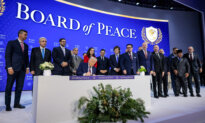
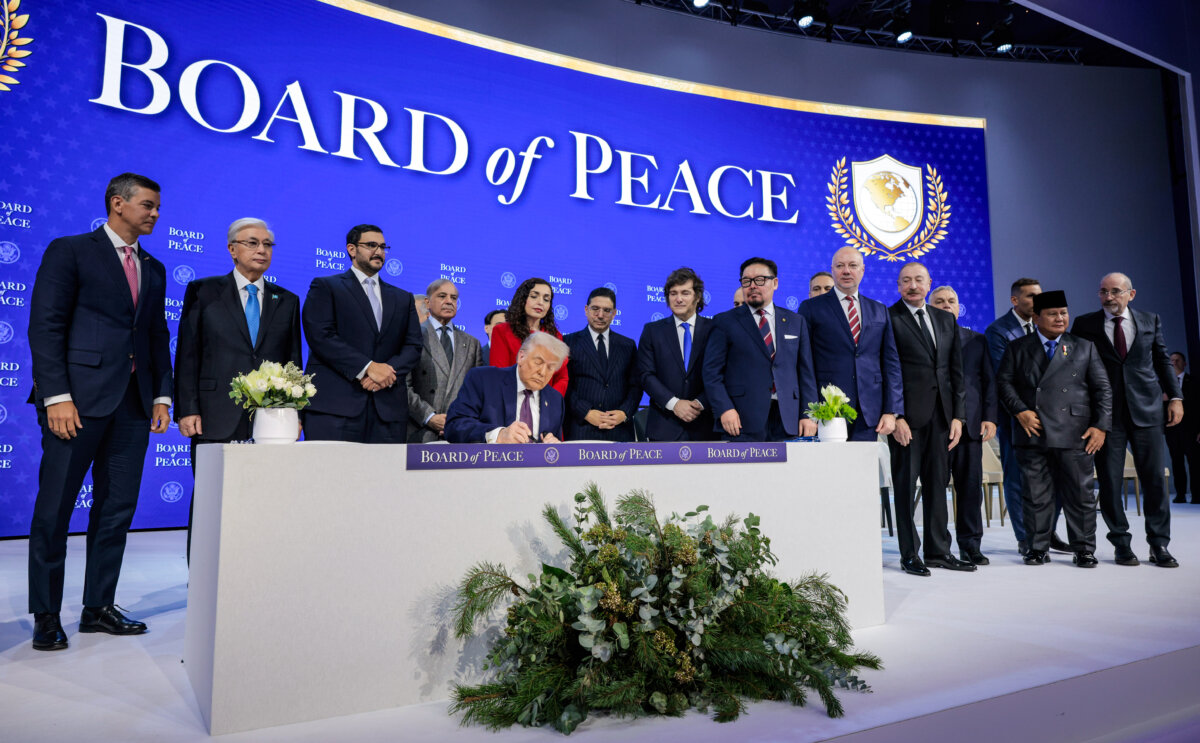
Instead, Washington and the Gulf states should insist that China’s reconstruction donations go through the new Board of Peace, chaired initially by Trump and with more than 25 member states, including Saudi Arabia, UAE, Qatar, Egypt, Pakistan, Turkey, Indonesia, Kazakhstan, and Uzbekistan—Islamic countries that would seek to ensure that reconstruction money is not wasted or siphoned off in corruption.
And how much should China be paying to the Board of Peace reconstruction task force?
An initial donation of $100 billion over five years would be a start.
While it will not fully compensate Iranians, Israelis, and Gulf state citizens for all of their suffering, it will go far to start the rebuilding of their societies.
But just as important, this exercise could provide an enduring lesson for the CCP: Its cynical enabling of client dictatorships, repression, and war henceforth will not be cost-free.
Views expressed in this article are the opinions of the author and do not necessarily reflect the views of The Epoch Times.
 Friends Read Free
Copy
Facebook
Tweet
Friends Read Free
Copy
Facebook
Tweet