
Commentary
In Canada’s rush to construct massive numbers of what are commonly referred to as “housing units,” we have abandoned the quaint notion that houses should be well-built, long-lasting, have some kind of identifiable architectural style, and be enjoyable to live in and to look at.
The most glaring example is the micro condo, tiny units in the sky as small as 300 square feet which have earned the apt nicknames of “shoeboxes” or even “dog crates.”
Fuelled almost entirely by domestic and foreign investor speculation, the micro condo market is in the midst of a protracted collapse, and thousands of these miniscule units now sit empty in Canada’s largest cities. It turns out not many Canadians are interested in the creative logistical manoeuvres needed to fit a family into a 300-square-foot box!
If Canadians disdain micro condos, what type of house do they want? A 2018 report by Sotheby’s International Realty found that 83 percent of young, urban family homeowners want a single-family detached house. A survey conducted by Wahi Realty earlier this year found that 81 percent of Canadians say a backyard is an important feature of a house.
So, most Canadians want a single-family house with a backyard. What is the market giving them? Endless numbers of apartments and condos. A report by the Aristotle Foundation released in March revealed that single-family detached houses fell from 61.8 percent of housing completions in 2000 to just 31.7 percent of completions in 2022.
This would be one thing if the low-rises and high-rises popping up everywhere in our major urban centres had a distinct character, like the red-brick Devenish Apartments built in Calgary’s pre-World War I construction boom. Hampton Court, a three-storey apartment built in the Arts and Crafts Tudor Revival style in Victoria dating from 1913, similarly bears testament to a period when Canadian cities were built with intentional charm and splendour.
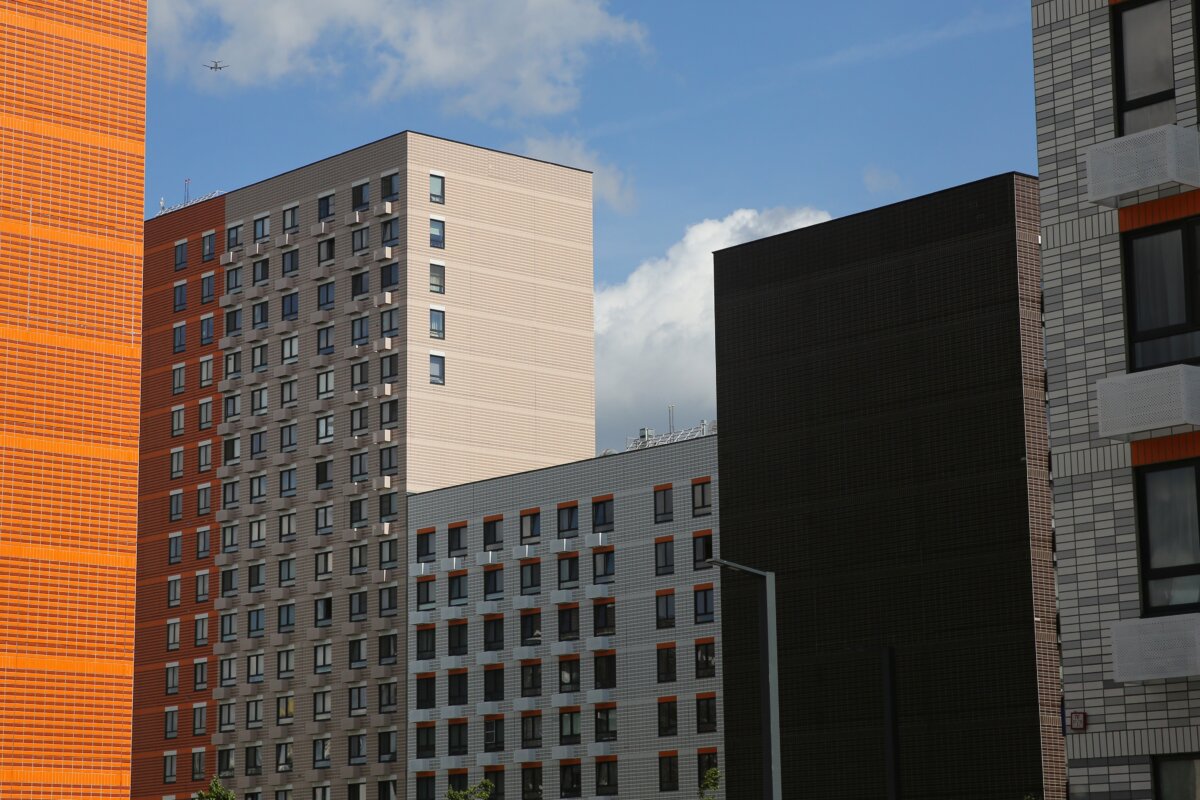
There are exceedingly few Hampton Courts and Devenish Apartments being built in 21st-century Canada. Most new apartment buildings are so banal and generic that they do not belong to any architectural style at all.
One common type is “5-over-1s”—buildings with “four or five wood-frame stories above a concrete podium” devoid of any stylistic flourish. In the architectural community, a colloquial term for these bland boxes is “fast-casual architecture.” Just as many fast food restaurants have ditched playful and interesting decor in favour of a homogenous, minimalist look (a trend also at play in Cracker Barrel’s notorious attempt to replace its historic logo), so too have housing developers replaced quality with mass production.
The change from beautiful to bland architecture is by no means limited to apartments and condos. It is also on jarring display in the new single-family housing developments being put up on the outskirts of cities like Calgary, Winnipeg, Toronto, and many more.
Since before Confederation, Canadian history has seen a wonderful array of single-family home styles; Neo-classic, Regency, Classic Revival, Gothic Revival, Italianate, and Queen Anne Revival, to name just a small sampling. Most cities have preserved at least some older neighbourhoods in which such architecture is visible for all to enjoy.
To be sure, there is no need to stick with these older styles just for the sake of it. Innovation grounded in respect for the past is the source of much genuine progress. The issue with new single-family housing developments is the same as apartment buildings—too often, they lack any style whatsoever.
What is politely called “tract housing,” and informally known as “cookie-cutter” or “ticky-tacky” housing, is so lacking in any detectable character that centuries from now, future generations will likely not consider these houses to be “heritage” architecture at all. That is, if these cheaply produced structures are still standing by then.
In the midst of all these convergent trends contributing to a new homogenous, bland Canadian architecture, the federal government is launching Build Canada Homes—a new agency tasked with dramatically boosting housing construction by focusing on prefabricated houses.
Ottawa’s new housing focus is part of a larger trend in which “prefab” is being pitched as the solution to Canada’s housing crisis. This line of thinking holds that the quickest way to build the millions of houses needed to accommodate the country’s population growth is to churn out components of houses in factories and assemble them onsite.
Prefab architecture was recently on display in Calgary as 56 modular units were craned into place in just 10 days to form a six-storey building with 84 studio apartments. If the prefab units envisioned by the federal government follow this model, Build Canada Homes does not bode well for the beauty of our cities.
The uglification of urban Canada can be reversed in two ways.
Firstly, it is crucial to limit the unsustainable immigration-driven population growth that has created the need for millions of new units to be rapidly built in the first place. When lightning-fast population growth creates a pressing need for endless new homes, quality is sacrificed in favour of quantity.
More fundamentally, all levels of government should pivot to encouraging the construction of livable, well-built houses (including the single-family homes preferred by Canadians) instead of simply churning out housing units. The well-being of families and the beauty of cities depend on it.
Views expressed in this article are the opinions of the author and do not necessarily reflect the views of The Epoch Times.
 Friends Read Free
Copy
Facebook
Tweet
Friends Read Free
Copy
Facebook
Tweet