
Commentary
When the United States delivered 31 M1A1 Abrams tanks to Ukraine in September 2023, the move was heralded as a potential turning point in Kyiv’s fight against Russia, with President Volodymyr Zelenskyy calling them a “game changer.”
The Abrams tanks, a symbol of American armored dominance, have dominated second- and third-tier militaries such as Iraq’s in the 1991 Gulf War, where superior tactics and training, combined with the Abrams’s advanced armor and fire control systems, allowed U.S forces to utterly dominate Iraqi armored forces. Yet, since their arrival in Ukraine, these “wonder weapons” have faltered badly. By July 2025, at least 22 of the tanks had been destroyed, damaged, abandoned, or captured. Some estimates place this number as high as 27. This outcome, far from shocking, was predictable, as expectations based on triumphs over weaker foes such as Iraq were wildly unrealistic.
In the Gulf War, well-led Abrams tanks, operated by superbly trained crews, decimated Iraqi-operated T-72s, leveraging air superiority, precise artillery, and robust logistics to create ideal conditions for success. Inferior Iraqi tank crew training and poor leadership, combined with older, severely outgunned T-72 tanks, boosted the Abrams’s legendary dominance. Similarly, in post-2003 Iraq and Afghanistan, it faced insurgents, reinforcing perceptions of invincibility.
These successes fueled optimism that the Abrams would dominate in Ukraine, with Zelenskyy touting their role in breaching Russian lines during the 2023 counteroffensive. However, Russia’s military, equipped with advanced drones and anti-tank guided missiles—the most powerful artillery in world and adaptive tactics—has proven a formidable foe, exposing the Abrams’s limitations in ways that second-tier militaries never could.
Some will point out that Ukraine did not receive the best Abrams tanks available as a reason that they failed to perform to expectations. The M1A1 SA variant supplied to Ukraine uses tungsten-fortified composite armor, a downgrade from the depleted uranium (DU) armor in U.S.-operated M1A2 SEPv2 and SEPv3 models. DU is superior overall to tungsten, but that superiority is best leveraged in head-to-head battles with tanks using their main guns. When facing the kind of threats common on the Ukrainian battlefield, the impact of DU-enhanced armor is far less than one might guess.
It turns out that the Abrams’s armor, whether DU or tungsten, offers little defense against the threats common on the Ukraine battlefield: artillery, anti-tank guided missiles, and Russia’s first-person view (FPV) drones. A direct strike or even a near miss by a large artillery round such as that fired by Russia’s 152mm guns destroys all tanks, DU enhanced armor or not. Shoulder-launched anti-tank guided missiles such as Russia’s 9M133 Kornet can easily penetrate an Abrams’s side and rear armor. FPV drones such as the Piranha-10, and Lancet loitering munitions, strike the tank’s thin roof armor, where neither material provides significant protection. Hence, even DU-equipped M1A2s would remain vulnerable to these top-down attacks, highlighting a vulnerability shared by pretty much all tanks.
Russia’s peer-level capabilities expose the uncomfortable fact that in many situations, U.S. Abrams tanks are just as vulnerable as less expensive, less resource-dependent tanks. Tank-on-tank main gun engagements, in which DU-enhanced armor shines, have proven rare as Russian T-72B3 and T-90M tanks use gun-fired 9M119M Refleks anti-tank missiles to outrange the Abrams’s main gun, as seen in one reported loss in March of 2024.
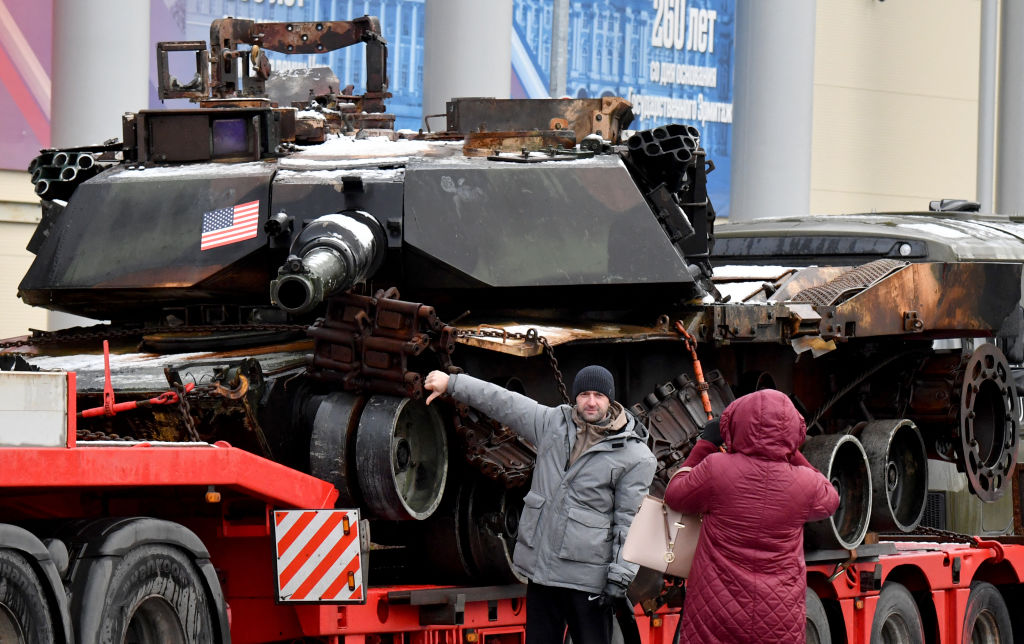
Russian tank-killer groups receive bounties for destroying and capturing Western tanks. For example, a reward of 5 million rubles (about $63,000) was offered for the first captured Abrams, making the Abrams a prime propaganda target. A captured Abrams tank displayed in Moscow in May 2024 underscored this focus, providing a boost for Russian morale while challenging the idea that Western-supplied equipment is invariably superior.
Tactical missteps, compounded by the logistical intensity of the Abrams, have exposed its vulnerabilities. Designed for NATO’s combined arms doctrine, it relies on air cover, artillery, and robust supply lines, as well as usually being able to benefit from superior situational awareness. In Ukraine, ammunition shortages, limited air support, and the M1A1’s maintenance-intensive nature—exacerbated by its 67-ton weight and high fuel consumption—left it exposed. Ukrainian crews noted that NATO would never deploy the Abrams in such conditions, hence its use in unsupported defensive roles against Russia’s fortified Surovikin Line—rife with mines, trenches, lethal artillery fire, and drones—was a recipe for disaster. Even a DU-armored Abrams would not be able to mitigate losses from poor tactics or inadequate logistics.
The expectation that the Abrams would replicate its Gulf War success ignored Russia’s parity in technology and tactics. Unlike Iraq’s antiquated forces, Russia deploys drones, advanced anti-tank guided missiles, pervasive battlefield surveillance, and electronic warfare, neutralizing the Abrams’s strengths. The tank’s losses, including four destroyed in a 12-day span in April 2024, reflect the harsh realities of peer-level warfare. Former U.S. National Security Adviser Jake Sullivan’s 2024 assessment that the Abrams was “not useful” on Ukraine’s drone-heavy battlefield underscores this shift. Even with DU armor, only a few losses from frontal anti-tank guided missile hits might have been avoided, leaving most losses because of drones, artillery, mines, and tactical errors as inevitable.
The Abrams’s failure in Ukraine is a stark reminder that the Western “wonder weapons” narrative may thrive against lesser foes but falls apart against true peer competitors. Expectations based on past triumphs over Iraq and other lesser foes were misguided, as Ukraine’s dynamic, rapidly evolving battlefield revealed that the M1 Abrams could not just roll over peer competitors. This outcome, far from surprising, highlights the need for a mindset that is willing to take into account that past success against vastly overmatched opponents may not be the best benchmark for predicting future weapon system effectiveness.
Views expressed in this article are the opinions of the author and do not necessarily reflect the views of The Epoch Times.
 Friends Read Free
Copy
Facebook
Tweet
Friends Read Free
Copy
Facebook
Tweet