Commentary
Several years ago, I stumbled across a film on Netflix called “Child 44.” I recall finding it morally troubling but oddly gripping—an unusually honest account of the rot at the heart of totalitarian regimes.
I was less happy to discover that most critics had dismissed the film as dull or confusing. Predictably, it disappeared from the Netflix archives faster than freedom of speech on a college campus.
I couldn’t help thinking that the cold reception to “Child 44” revealed something sinister about our present culture’s discomfort with inconvenient truths. The film didn’t attack capitalism, racism, or the other usual suspects in modern motion pictures—it indicted the lies of a socialist regime. Perhaps that made it a little too out-of-sync for progressive tastes. In an age when ideological sensitivity often outweighs artistic courage, the film’s disarming honesty may have hit too close to home.
Set amidst the paranoia of Stalin’s Russia, “Child 44” featured an investigator, Leo Demidov, who risked everything to solve a string of child murders. But his greatest obstacle wasn’t the killer—it was the state itself. Soviet officials insisted such crimes were impossible because the USSR was a socialist paradise. “There can be no murder in paradise,” one bureaucrat declared. To admit otherwise would have punctured the illusion that sustained the regime. It was a line that captured the psychological heart of Marxism—the subordination of truth to an ideological narrative.
The notion that there could be no murders in a socialist promised land was more than just a throw away line in a screen play. It captured a habit of mind that has defined Marxist systems from their birth: the elevation of doctrine over truth. In the Soviet Union, acknowledging famine, failure, or moral corruption was tantamount to treason. The Holodomor famine of the 1930s was denied; the Katyn massacre of Polish officers was blamed on the Germans; economic data were falsified to maintain the myth of progress.
Marxist regimes survive not through belief in truth, but through a strict insistence on deception. They simply can’t tolerate a dissident opinion. Alexander Solzhenitsyn’s powerful essay “Live Not By Lies’’ dated Feb. 12, 1974, was the last thing he was able to write in his native Russia before the secret police arrested him in his apartment and he was exiled to West Germany.
Tragically, such patterns of behavior did not disappear when the USSR was dismantled. The temptation to preserve a preferred narrative by denying reality has migrated westward, reborn in the cultural Marxism that now dominates much of Western intellectual life. Ours may be a “free” society, but the pressure to affirm politically convenient falsehoods has grown remarkably similar to the pressures that animated the old Marxist states.
Consider, for example, the American Russian-collusion story of 2016–2019. For years, respected media outlets and elected officials assured the U.S. public that Donald Trump’s campaign team had conspired with the Kremlin to steal the election. When the long-drawn-out Mueller Report found no evidence of collusion, the story should have collapsed. Yet it lived on, because it satisfied a moral need: to explain away an election outcome that many elites could not reconcile with their worldview. The conviction that there could be no legitimate victory for unprogressive “deplorables” in a just society became a Western echo of “there can be no murders in paradise.”
So untruths continue to overwhelm facts. Fictions are artfully maintained; cameras are carefully managed; dissenting journalists are accused of bad faith. Truth yields to loyalty. Legions of progressive influencers pretend not to see contradictions that would be recognized by a 12-year-old child.
Nowhere was the denial of reality more blatant than at America’s southern border in the years after the 2020 election. Millions of illegal crossings were being viewed on television, and entire cities struggled to absorb the influx. Yet the Department of Homeland Security continually declared that the border was “secure.” It was a linguistic illusion sustained by repetition, as if the utterance itself could make it so. The old Soviet bureaucrats would recognize the trick: when truth contradicts the narrative, redefine words until the narrative wins.
A similar pattern has emerged in discussions of urban crime. After the 2020 unrest, many progressive leaders insisted that “crime is under control” and that reports of rising violence were a “right-wing delusion.” In city after city, shopkeepers installed metal grates and residents fled, but the official rhetoric remained the same. Marxism taught its disciples that consciousness creates reality; if one repeats the correct slogans long enough, the world will conform.
The popular narrative of militant environmentalism has also veered from science into creed. For decades, green radicals and major news outlets have predicted that Arctic summer ice would vanish by specific years—2013, then 2016, then 2020. The ice receded to some extent, but a large part of it remained. This year researchers found that the Antarctic Ice Sheet (AIS) has shown signs of record-breaking growth—a remarkable reversal from what was predicted in previous years.
To note this is not to deny climate change; it is to object to the manipulation of truth for ideological drama. In the name of achieving “consensus” and suppressing “misinformation,” dissenting scientists are anathematized, much as Russian geneticists once were for questioning the evolutionary theories of Soviet biologist Trofim Lysenko. In that case, more than 3,000 mainstream biologists were dismissed, imprisoned, or executed in a Soviet campaign to suppress scientific opponents.
Today, we have another urban myth that has developed around the progressive defense of illegal immigration: that although migrants enter America unlawfully they are “sorely needed, hard-working, honest people.” Any concern about social or criminal costs is xenophobic. Some may indeed be hardworking—but evidence has shown that others are not. In fact, many are criminals. This distinction matters, but public media pressure forbids citizens from recognizing it.
In all of these cases, the ideological mechanism is the same. A progressive project defines what must be true for moral or political reasons; evidence is then filtered, massaged, or ignored to sustain the fiction. Those who challenge the illusion are treated as enemies of progress. The Soviet Union used to call them “wreckers.” Today, they are deemed to be “deniers,” “extremists,” “ultra-right,” or simply “MAGA.”
Václav Havel, the Czech dissident who lived under communism, described this condition as “living within a lie.” Citizens, he wrote, repeat the slogans they do not believe because the slogans have become a social currency. They conform outwardly to survive inwardly. The tragedy of our moment is that this same dynamic now thrives in American cities where no secret police compel it—only social fear, career risk, and ideological conformity.
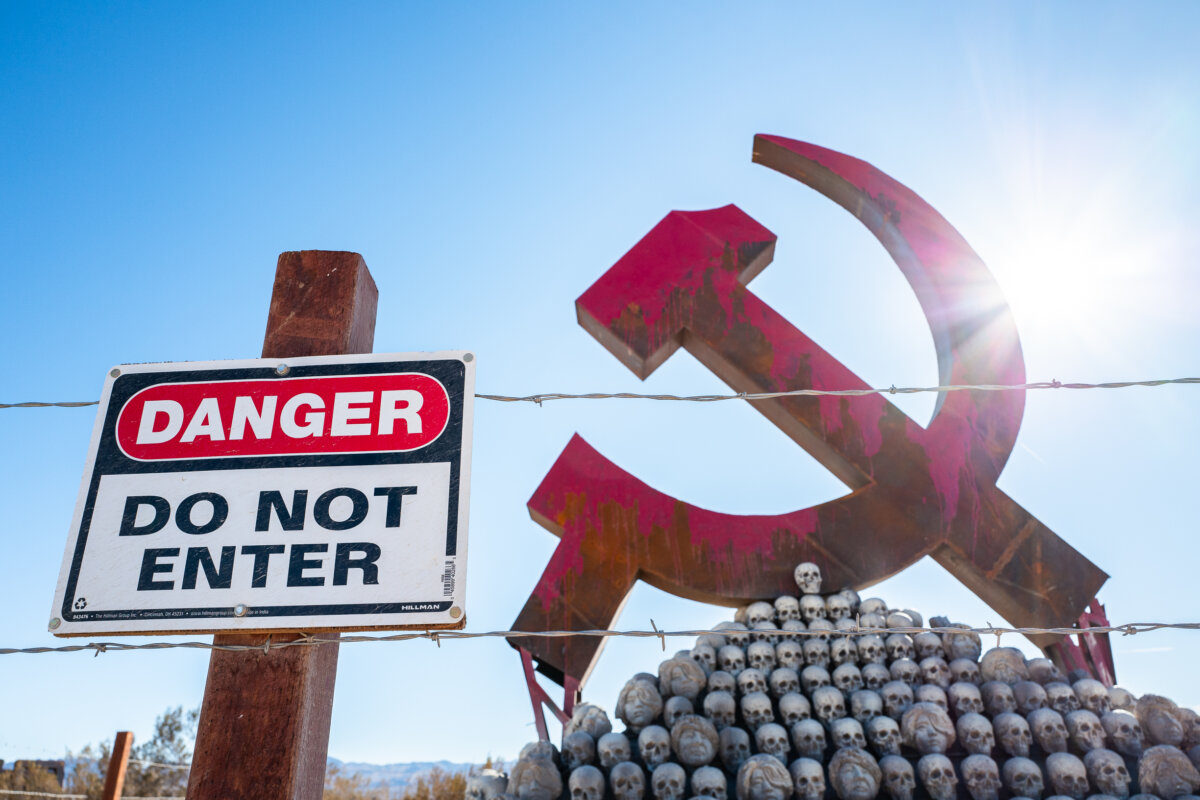
Truth should not be partisan. It is a precondition of liberty. When a culture begins to value ideological certainty over factual accuracy, when it demands obedience rather than inquiry, it inherits the spiritual cloak of Marxism minus only the hammer and sickle.
In “Child 44,” Leo Demidov finally exposed the murderer, but the real villain was the system that forbade the truth. We would do well to remember that lesson. The Marxist Utopia that insisted there could be “no murders in paradise” was finally crushed under the weight of its own inner contradictions.
William Brooks is a Canadian writer who contributes to The Epoch Times from Halifax, Nova Scotia. He is a senior fellow with the Frontier Centre for Public Policy.
Views expressed in this article are the opinions of the author and do not necessarily reflect the views of The Epoch Times.
 Friends Read Free
Copy
Facebook
Tweet
Friends Read Free
Copy
Facebook
Tweet