Commentary
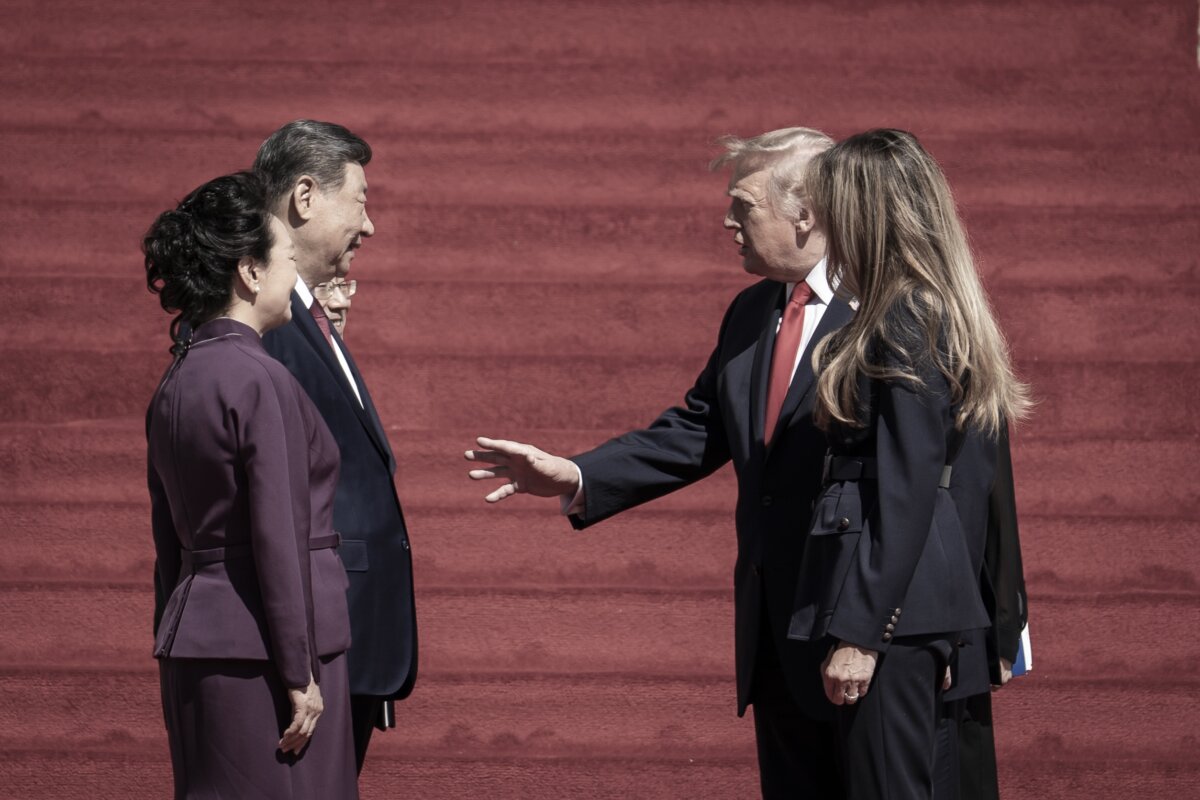
Chinese leader Xi Jinping obtained much of what he sought from his latest summit with U.S. President Donald Trump: ceremony, high-profile attention, and compelling imagery of the Chinese leader standing as an equal alongside the U.S. president.
What he failed to secure, however, was far more consequential—a commitment from Washington to alter its policy toward Taiwan.
While the summit revived two familiar instruments of Beijing’s soft power—panda diplomacy and large-scale youth exchanges—these measures cannot overcome the damage wrought by years of aggressive “wolf warrior” diplomacy.
Ultimately, high-level spectacle is no substitute for strategy, and ceremonial warmth will not alter the structural rivalry driving U.S.–China relations.
All the Ceremony, but Little Change
The summit concluded with all the ceremonial optics that Beijing could have hoped for. By greeting Xi at the airport, Trump broke with decades of presidential protocol—a gesture reserved in modern American history for rare moments, such as Dwight Eisenhower’s 1959 welcome of Soviet leader Nikita Khrushchev.
Xi received the prestige he desired, and Chinese state television captured the visual authority it needed. Within the Chinese Communist Party (CCP), demonstrating a close personal rapport with a U.S. president has long been treated as a premier foreign policy achievement—a tradition tracing back to Deng Xiaoping’s 1979 visit and Jiang Zemin’s 2002 trip to George W. Bush’s Texas ranch.
Yet history offers a sober lesson: Extraordinary hospitality does not signal a shift in fundamental interests. Eisenhower’s airport welcome to Khrushchev did not ultimately mitigate Cold War hostility.
I see the same limitation in the latest Trump–Xi summit. No amount of ceremony can change the broader direction of U.S.–China relations. Any fundamental improvement will require a much deeper change in Beijing’s strategy—particularly its long-standing view of the United States as its principal strategic rival.
Unfulfilled Goals on Taiwan
Beyond the optics, Xi’s chief objective was securing a formal shift in Washington’s Taiwan policy.
According to Chinese state media outlet Xinhua, Xi explicitly asked Trump to maintain what Beijing calls the “correct position of opposing Taiwan independence,” rather than simply the longstanding U.S. position of “not supporting Taiwan independence.”
Xi reportedly described this as the most important “red line” in U.S.–China relations.
This request highlights a recurring contradiction in Beijing’s messaging. Washington’s official “one China” policy has never declared opposition to Taiwanese independence; asking the United States to “maintain” a stance that it never held reflects diplomatic posturing that state media dutifully amplified.
Trump ultimately made no concessions, keeping the Taiwan issue deliberately ambiguous while leaving broader human rights concerns, such as the imprisonment of Hong Kong media mogul Jimmy Lai, unresolved.
Lai, the Hong Kong media tycoon and pro-democracy advocate who has been imprisoned by Beijing-backed authorities, has become a prominent symbol of the suppression of Hong Kong’s freedoms.
Maintaining peace and the status quo across the Taiwan Strait remains a vital interest shared by major global powers, including Japan, Australia, European nations, and key regional allies.
Xi thus departed the summit without the policy breakthrough he wanted most.
Pandas as a Barometer of US–China Relations
With policy concessions off the table, the summit’s most tangible outcome was the announcement that two giant pandas will be sent to the Atlanta Zoo.
The fate of China’s pandas has long mirrored the state of bilateral relations. During the initial phase from 1972 to the early 1980s—beginning with Zhou Enlai’s gift of Ling-Ling and Hsing-Hsing to the National Zoo following Richard Nixon’s visit—pandas served as diplomatic gifts to seal a rapprochement with the United States against the Soviet Union.
By the mid-1980s, as market integration deepened, Beijing shifted to short-term loans and, in 1994, established the long-term scientific research loan model.
In more recent years, the expiration of contracts and the return of pandas to China reflected a deteriorating relationship, coinciding with the CCP’s shift away from Deng’s principle of “hiding one’s strength and biding one’s time” to a more confrontational “wolf warrior” approach toward the United States.
The current willingness to return pandas to the United States underscores a reality: Beijing recognizes its growing need to stabilize relations with Washington, giving the United States little reason to offer major concessions in return.
Youth Diplomacy and Self-Defeating Soft Power
Xi also sought to rebuild civic ties by announcing an initiative to invite 100,000 young Americans to China for exchanges and study over the next five years.
This doubles a previous 2023 initiative aimed at bringing 50,000 American students to China, which reached its target ahead of schedule.
I see this as a classic example of United Front work: using seemingly friendly exchanges to cultivate the next generation of political and business leaders who are favorably disposed toward the CCP.
The strategy is not new. Large-scale invitations for foreign youth began during the early years of reform and opening.
In 1983, Hu Yaobang visited Japan and announced plans to invite 3,000 Japanese young people to China for a large friendship gathering. The event took place the following year, with Hu Jintao—then secretary of the Communist Youth League and chairman of the All-China Youth Federation—responsible for receiving the visitors.
In 2008, during the “Japan-China Year of Friendly Exchanges among Youth,” the two countries signed a memorandum under which roughly 4,000 young people would take part in officially organized exchanges each year for four years.
Even in 2025, when Japan–China relations had deteriorated significantly, the Chinese regime invited nearly 300 young Japanese people from different fields to visit Beijing, Shanghai, and Jingdezhen in Jiangxi Province.
Beijing often covers all or most of the costs, making the trips highly attractive to young participants. But at a time when China’s economy is struggling and youth employment remains weak, Xi is still willing to spend large sums on these programs.
Yet these charm offensives are continually undermined by Beijing’s own policies. In Japan, decades of goodwill generated by student exchanges were erased by state-sanctioned anti-Japanese nationalist campaigns, resulting in a widespread decay of pro-China sentiment across Japanese politics and society.
Beijing is repeating this pattern with the United States. While state media attribute the deterioration in relations to hostile forces in Washington, the CCP’s underlying view of the United States as its primary strategic rival remains unchanged. Neither reform nor opening up fundamentally altered this strategic posture; they merely helped obscure it for a time.
And neither panda diplomacy nor funded student exchanges can conceal the CCP’s long-term geopolitical ambitions.
Views expressed in this article are the opinions of the author and do not necessarily reflect the views of The Epoch Times.
 Friends Read Free
Copy
Facebook
Tweet
Friends Read Free
Copy
Facebook
Tweet