Commentary
Russia’s Poseidon torpedo, also known by NATO as Status-6 or Kanyon, represents a paradigm shift in strategic nuclear weaponry. Unveiled by Russian President Vladimir Putin in 2018, this intercontinental, nuclear-powered, nuclear-armed autonomous underwater vehicle is designed to bypass traditional missile defenses and deliver catastrophic destruction to coastal targets. As such, the Poseidon poses a significant new challenge to any country that it targets. And with a range of thousands of miles, and an ability to navigate to its target autonomously at depths of more than 3,000 feet, there are no known counters for it.
The Poseidon is a massive, nuclear-powered torpedo, measuring approximately 65.6 feet in length and 5.2 feet to 6.5 feet in diameter, with a weight of about 100 tons. Much larger than conventional torpedoes, it is effectively a hybrid of a torpedo and an autonomous underwater drone, equipped with a compact nuclear reactor that gives it an estimated range of roughly 6,200 miles. It can rest on the ocean for weeks, or even months, before being activated to attack coastal cities or naval facilities. With a reported top speed of 50 knots to 100 knots (57 mph to 115 mph), it is significantly faster than conventional submarines or torpedoes. And its ability to operate at depths greater than 3,000 feet makes it very difficult to detect with standard sonar systems.
The torpedo’s payload is its most intimidating feature. Estimates suggest that it carries a nuclear warhead with a yield of 2 megatons to 100 megatons, although recent analyses lean toward the lower end, about 2 megatons. This gives it a payload more than 100 times more powerful than the Hiroshima bomb’s 15 kilotons. Russian state media have suggested that the Poseidon could trigger a 500-meter-high radioactive tsunami. However, because of how quickly energy is dissipated underwater, such a result would be unlikely unless the Poseidon were detonated in a location with an underwater topography and bathymetry suitable to tsunami formation.
The Poseidon’s stealth features enhance its lethality. It reportedly employs a pump-jet propulsion system designed to mimic the acoustic signature of civilian ships, reducing its detectability. Additionally, its ability to operate autonomously or be remotely redirected allows it to loiter on the seabed in a “Skif” configuration, waiting for activation, further complicating preemptive detection.
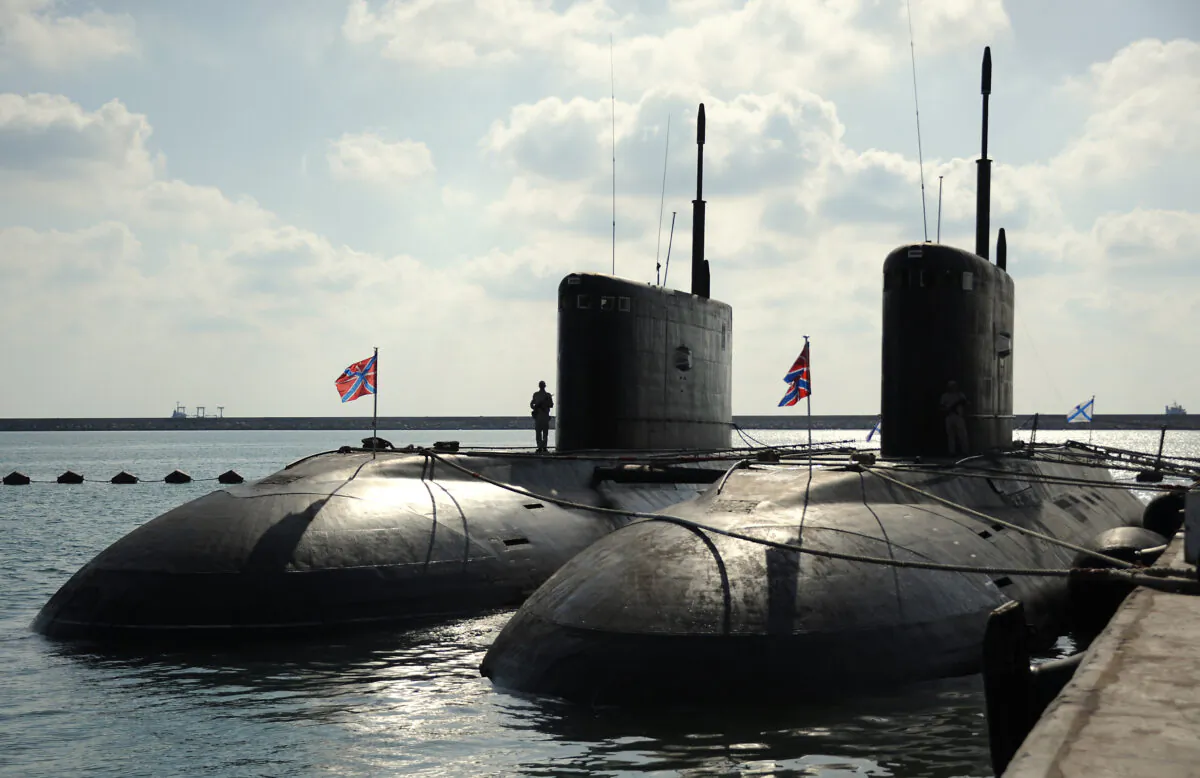
Russia has indicated that the Poseidon will be launched from specialized submarines such as the Belgorod (Project 09852) and Khabarovsk (Project 09851), each capable of carrying six to eight Poseidons. However, while Russia has been emphasizing super large submarines as being its launch platform, the Poseidon certainly could be carried by and launched by a wide variety of ships. For example, one of Russia’s many large nuclear-powered icebreakers could launch it while on patrol in the Arctic Circle, and with its huge range it could strike pretty much any city on the East Coast of the United States.
While it can execute nuclear strikes, it has no real ability to execute preemptive first strikes on other countries’ land-based nuclear weapons. As such, its role will likely be that of a second- or third-strike retaliatory weapon, intended to ensure Russia’s nuclear deterrence in the face of U.S. missile defense advancements. Its ability to target coastal cities such as New York City or Los Angeles with a multi-megaton warhead makes it a truly effective deterrent. The U.S. Naval Institute notes that a fully operational Poseidon could have a “strategic impact” by bypassing existing nuclear arms treaties and missile defense systems, which are primarily designed to counter ballistic missiles.
The torpedo’s deep-diving capability and high speed make it a unique threat. At 1,000 meters, it operates beyond the reach of most anti-submarine warfare systems, and its speed—potentially up to 70 knots—outpaces NATO torpedoes and submarines. Its nuclear propulsion allows it to be launched from remote locations, such as under Arctic ice, making it difficult to track from the point of deployment. While Russian claims of its “indestructibility” are certainly exaggerations, with no direct countermeasures for it at this time, the level of the threat it presents should not be underestimated.
The United States said in its Nuclear Posture Review in 2022 that Russia and China “continue to expand and diversify their nuclear capabilities, to include novel and destabilizing systems.”
“Russia is pursuing several novel nuclear-capable systems designed to hold the U.S. homeland or Allies and partners at risk,” the review states.
However, it remains a question just how much incremental retaliatory capability and deterrence it gives Russia above and beyond the thousands of megatons it can launch from land-based silos and submarines. The answer would seem to be not much, as the United States has zero chance of avoiding being completely destroyed should Russia launch an all-out nuclear strike with its existing intercontinental ballistic missiles. Of course, Russia would also be destroyed if the United States launched its land-based and submarine-based ballistic missiles at it.
Given the above, the Poseidon is just another reminder that a nuclear war is unwinnable and unthinkable. However, while the focus has been on the Poseidon’s role as a strategic nuclear weapon, overlooking the fact that it is actually a supersized torpedo that can carry enough conventional explosives to deal a lethal blow to most ships via a massive underwater explosion could end up being a mistake.
Hence, the Poseidon, along with being a notable technical achievement, and of incremental value as a retaliatory nuclear weapon, could end up making a more immediate impact as a supersized conventional torpedo capable of seriously damaging or sinking pretty much any ship.
Views expressed in this article are the opinions of the author and do not necessarily reflect the views of The Epoch Times.
 Friends Read Free
Copy
Facebook
Tweet
Friends Read Free
Copy
Facebook
Tweet