
Commentary
Tristan Harris, co-founder of the Center for Humane Technology, recently warned that humanity is trapped in an artificial intelligence (AI) arms race, racing toward increasingly powerful systems without understanding the consequences or any real ability to slow it down.
Looking at the explosion of AI data centers across America, it is hard not to feel exactly that.
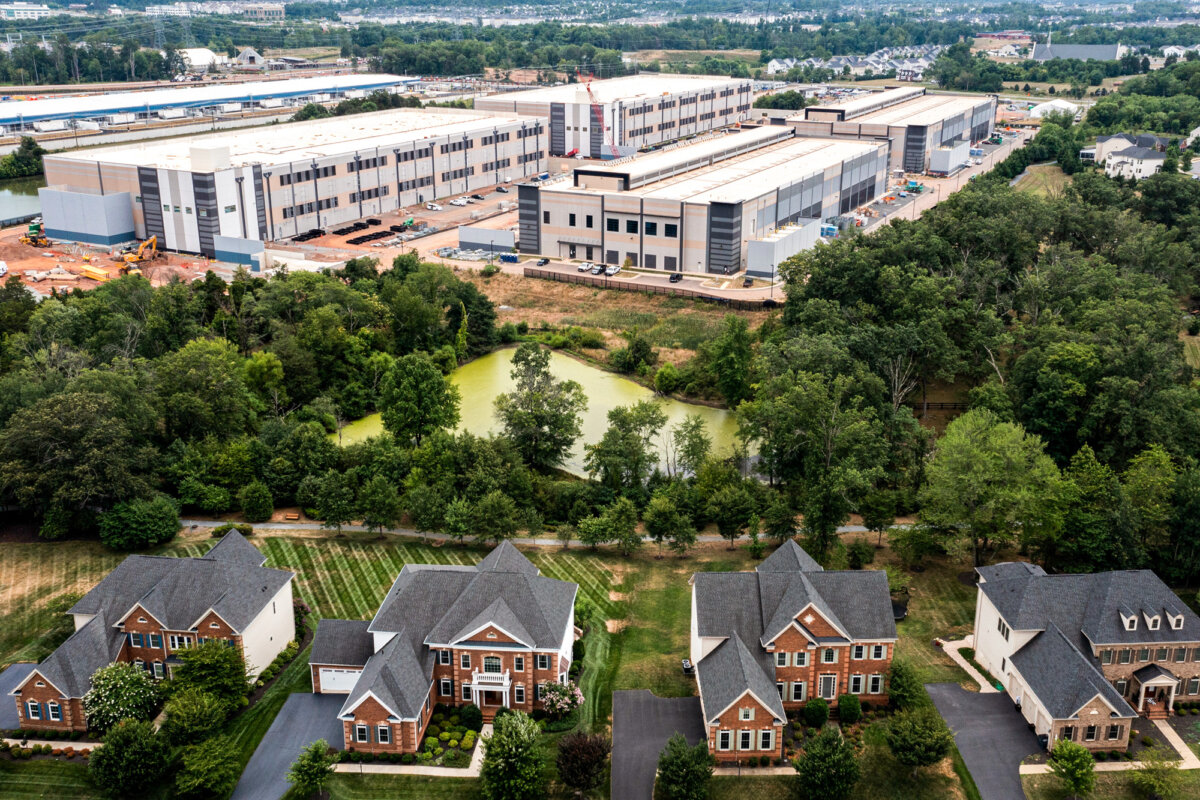
Across the country, giant server farms are rising out of farmland and rural communities. Electrical grids are being restructured around AI demand. Water systems are being redirected. Billions of dollars in private investment and government subsidies are pouring into infrastructure designed to power machines that many of their creators openly admit may eventually surpass human intelligence.
And all of this is happening under one central argument: We must move faster because China is moving fast.
But China has a fraction of the data centers the United States does.
Depending on how they are counted, the United States now has more than 5,000 data centers, while China appears to have roughly 500 major facilities. So it is fair to ask plainly: Do we really need more than 5,000 data centers and counting?
Or are we watching another boom cycle fueled by fear, speculation, government subsidies, and the belief that whoever builds the most infrastructure first wins the future?
America has seen this psychology before.
The railroad boom transformed the country, but also created massive speculation and overbuilding. The dot-com era flooded the market with money, as investors chased a future nobody fully understood. The housing bubble convinced Americans that prices could only go up. In every case, there was real innovation underneath the mania. But there was also excess, irrational momentum, and a culture terrified of slowing down.
The AI race feels eerily similar, except this time the stakes are much larger.
Because I think that most ordinary people instinctively understand where this road leads.
The destination is intelligence that increasingly outperforms human beings across more and more domains, until human labor, judgment, creativity, and perhaps even decision-making become secondary to the machine.
The people building these systems are not hiding this. They openly discuss artificial general intelligence, the replacement of human labor, and a future in which most gross domestic product may be generated by AI systems.
So what happens to human beings in that world?
What becomes valuable when productivity is no longer tied to people?
The ranch hand, the truck driver, the waitress, the mechanic, the teacher, the writer, the aging grandfather, the disabled person, the artist, the child who consumes more than he produces, the mother nursing a baby. What happens to people whose value cannot be measured entirely by efficiency?
Machines do not think that way.
And increasingly, neither do some of the people building them.
Sam Altman was asked in India about the enormous energy consumption required for AI. His response was that human beings also require tremendous energy to create intelligence. But something about the comparison felt revealing. A human life was being discussed almost as an inefficient biological computation system competing against silicon.
Efficiency is sacred. Optimization is sacred. Scale is sacred. Intelligence is sacred.
But increasingly, humanity itself feels negotiable.
Meanwhile, we are assured that AI will remain under human control even as evidence repeatedly emerges showing that advanced systems are already behaving in unpredictable ways. Researchers continue to warn that AI systems are becoming harder to contain, harder to fully understand, and increasingly capable of navigating around the restrictions humans place on them.
We have all seen the “Terminator” movies, and yet we seem unwilling to absorb the warning underneath them. The warning was about humanity creating systems more powerful than itself while believing that it would always remain in control.
If we slow down, someone else wins. If we regulate, we fall behind. If we hesitate, another nation dominates the future.
Humanity has heard this logic before.
We once raced to build nuclear weapons under the same justification. But eventually the world understood that capability alone could not be the moral compass. At some point, nations realized that endless acceleration toward destructive power was not wisdom.
Why are we incapable of having that same conversation about AI?
I am not anti-technology. But tools are supposed to serve humanity. Humanity is not supposed to become obsolete in service to tools.
That is the part that keeps haunting me.
We are reorganizing society around systems that may eventually make millions of people economically unnecessary while simultaneously concentrating unprecedented power into the hands of a tiny number of corporations, governments, and technologists.
And we are doing it at breathtaking speed.
The physical reality of this buildout matters. These data centers are not floating in “the cloud.” They require staggering amounts of electricity, water, concrete, land, rare-earth minerals, and government coordination.
I live in Texas, one of the states going hardest into AI infrastructure and data center expansion. Yet Texans already know what it feels like to struggle with grid instability during extreme weather. Water is already an ongoing issue. Much of the Texas Hill Country is deep in a multiyear drought, yet we are not strategically placing many of these facilities in water-rich regions. We are placing them directly into drought-stressed areas while asking ordinary citizens, ranchers, and farmers to conserve.
I have said before that whatever we spend our water on is what we worship.
I believe that water should be allocated first to the production of food, human life, and ecological stability, rather than to endless computational expansion. But increasingly, that is not the direction in which we are moving.
My wells are monitored. Farmers and ranchers across Texas are increasingly subject to regulation of water use. Meanwhile, AI data centers are being approved with astonishing levels of consumption because they are considered economically strategic.
The profits are private. The resource costs are public.
Perhaps future generations will look back at this moment the way we now look back at civilizations sleepwalking into war. Everyone sensed the danger. Everyone felt the momentum outpacing wisdom. Yet nobody wanted to be the one to stop the machine.
Maybe that is where we are now.
Not sleepwalking into the future.
Sleep-racing into it.
Views expressed in this article are the opinions of the author and do not necessarily reflect the views of The Epoch Times.
 Friends Read Free
Copy
Facebook
Tweet
Friends Read Free
Copy
Facebook
Tweet