
Commentary
In early October 2025, the Chinese Communist Party (CCP) announced that it would withhold its rare-earth minerals from the world via newly placed export controls. The changes will make the process more laborious, and the CCP will have more of a say over who gets what. The United States, for its part, seemed perplexed by China’s actions. U.S. President Donald Trump reacted with fury and shock at China’s move, writing that “it is impossible to believe that China would have taken such an action.” Eventually, the two sides came to a deal in which China would put the changes on pause—but only for a year.
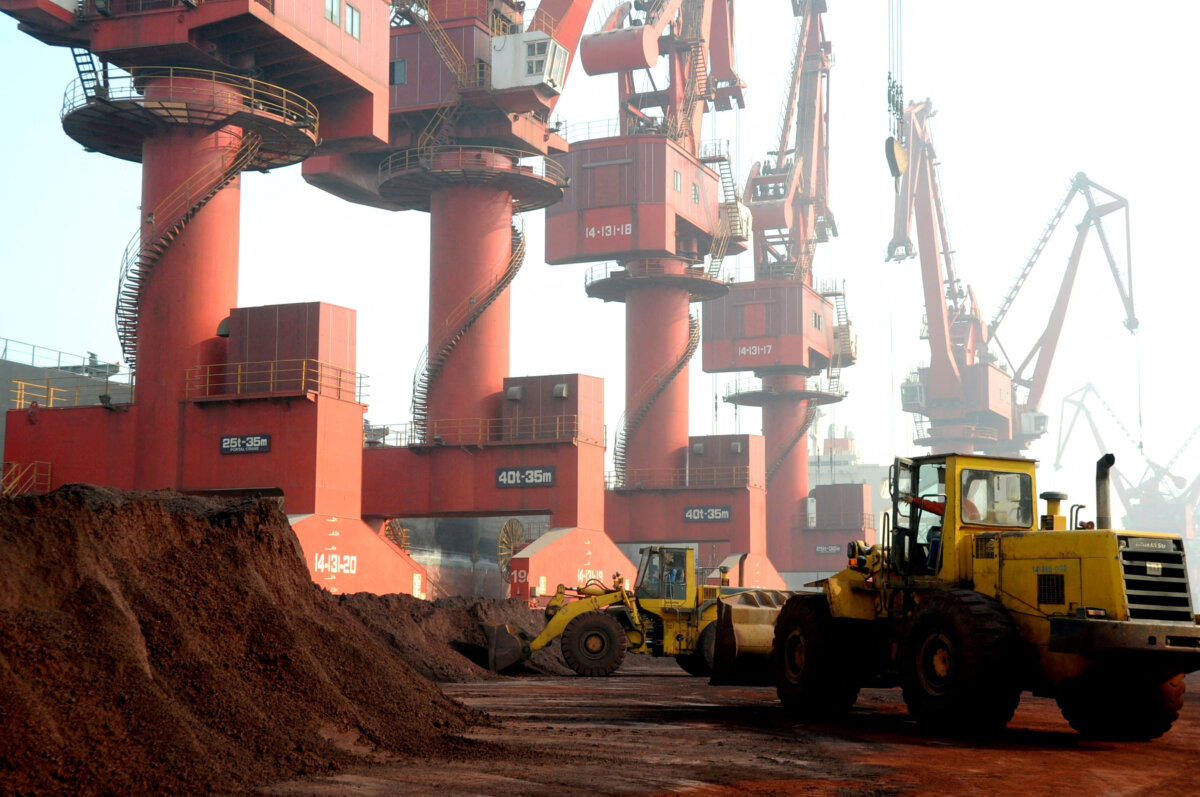
From a realism perspective, China’s move is completely reasonable. China has about 70 percent of all rare-earth minerals on the planet and upward of 80 percent of rare-earth mineral processing. As its economy does not revolve around rare earths, it does not desperately need to sell those minerals and can instead go forward with a drip-drip-drip, starving its adversaries while rewarding its allies. It is also in line with historical communist economic warfare, which always seeks to have an edge in its long-term battle to achieve worldwide communist domination.
From a U.S. perspective, this is a nightmare. Rare earths are crucial for almost all major electronics. And in the early 1990s, the United States was the dominant rare-earth supplier. But a misguided belief that opening markets to the CCP would produce a democratic China—and that the post-Cold War unipolar moment would never end—resulted in the U.S. government allowing China to purchase rare-earth mineral processing companies in the middle of that decade. But Beijing understood that it was not the end of history and that unipolarity would end. When multipolarity arrived, the CCP would have the world on a string.
Fast-forward to the mid-2020s. Multipolarity has arrived—and the CCP has the world on a string.
Or at least, it thinks it does. Because while the world needs it, the CCP’s strategy only works if the world continues to play by old rules, such as outsourcing and relying on China for practically everything. Just as the Soviet Union before it, Chinese communism can win only if the world plays by its rules.
As Trump administration officials have said outright, the world is now multipolar, meaning they recognize that we are in a new game, with new rules. But the CCP will still seek to use its communist ideology, combined with the country’s massive population and technical capabilities, to bend the new reality to its will.
Fortunately, there are signs that the United States is seeking to do likewise. Trump recently hosted the Australian prime minister and agreed to a rare-earths deal (while it does not have as many as China, the Land Down Under is still rich in rare earths), opening up alternatives to CCP dominance. And the Trump administration has pursued a robust tariff program, which hails almost directly from the multipolar world of former Presidents William McKinley and Theodore Roosevelt.
But these actions can go further. To undo the mistakes of the past few decades and end U.S. reliance on Chinese communism, there must be a sustained commitment, derived purely from national interest, to create a web of nations that wish to break the CCP’s hold over rare-earth markets.
Fortunately, the groundwork for action has been laid. The One Big Beautiful Bill encouraged domestic development in rare earths, and bilateral agreements signed with Australia, Japan, Malaysia, Thailand, and Cambodia have all resulted, at least partially, in agreements to develop and sell rare earths. The G7 itself has also launched a series of investments into rare-earth development. Congress, too, has gotten in on the action, with a series of pending bipartisan bills such as the Restoring American Mineral Security and the Minerals Security Partnership acts, which would require the government to secure U.S. rare-earth supply chains and coordinate efforts to economically box the CCP in.
Combined with updates to Trump’s United States-Mexico-Canada Agreement, we can also work with our allies in this hemisphere as well. Within the existing framework, we can increase supply chain transparency and boost processing and extraction capacity. This would boost domestic industry and competitiveness for the continent, where the main competitor is China, even in North America.
Forward-thinking plans such as these are essential—because so far, the deals that have been struck are just promises. They’re impressive deals, to be clear. But until the United States has the minerals in-hand, the government should not check that item off the to-do list.
The CCP has pursued its plan to dominate rare earths relentlessly, and it has pursued it with focus. The United States is starting the multipolar era as the most powerful country, but in rare earths, China has us beat. To secure this massive hole in our hull, the United States must likewise act relentlessly and with focus. This, at the beginning of multipolarity, is a test for the United States: Will it free itself from the Chinese communist yoke? Or will it remain a party to the CCP’s wishes?
The United States has networks of allies desiring to get out from under the CCP’s thumb. We should oblige them.
Views expressed in this article are the opinions of the author and do not necessarily reflect the views of The Epoch Times.
 Friends Read Free
Copy
Facebook
Tweet
Friends Read Free
Copy
Facebook
Tweet