
Commentary
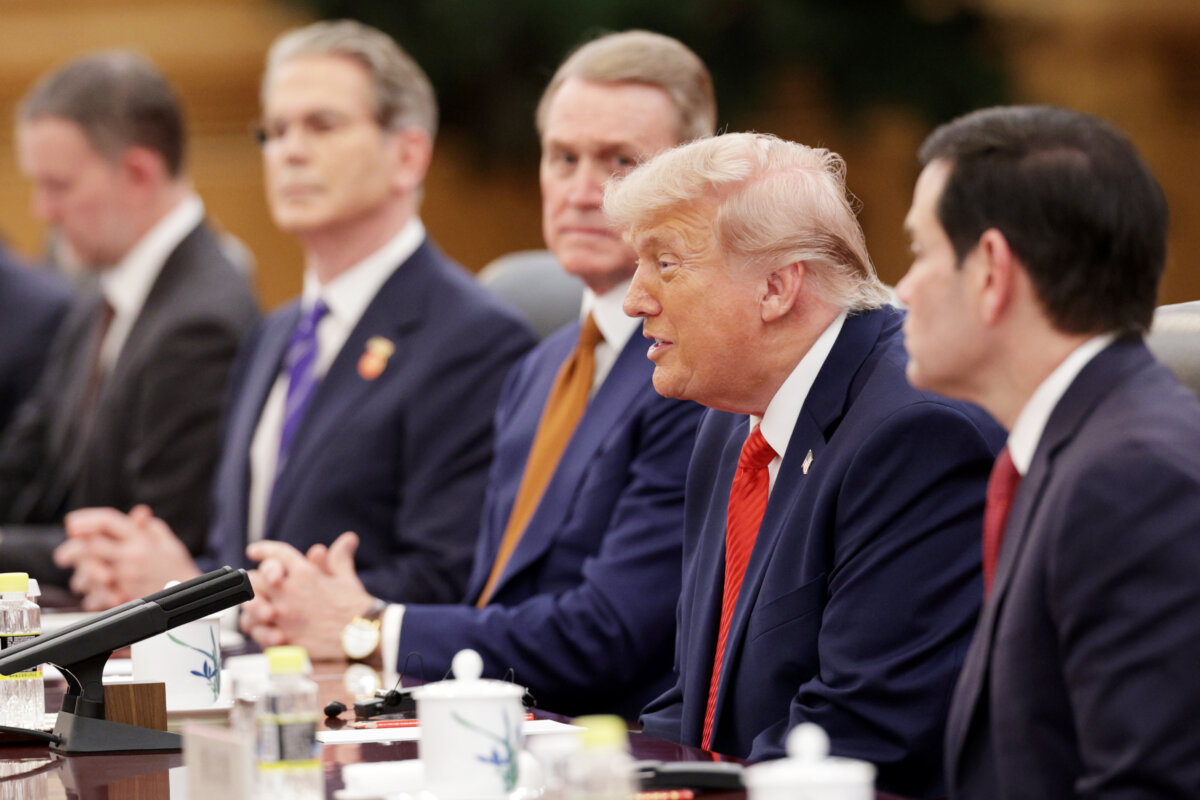
During their early summit meeting in Beijing on May 14, Chinese Communist Party (CCP) leader Xi Jinping introduced to U.S. President Donald Trump a new Chinese diplomatic euphemism, or doublespeak phrase, that appears reassuring but, in reality, masks the CCP’s long-standing ambition to dominate the United States and suppress freedom.
On that day, the Chinese side was quick to release its readout of that meeting in its usual effort to dominate the news cycle. As reported by Chinese state media outlet Xinhua:
“Xi Jinping emphasized that China is committed to the stable, healthy, and sustainable development of China-US relations. He stated that he and President Trump agreed to establish a ‘constructive strategic and stable relationship between China and the US’ as a new positioning for China-US relations, which will provide strategic guidance for China-US relations for the next three years and beyond.”
That same day, Xinhua was also quick to provide the first definition of “constructive strategic stability,” citing Chinese Ministry of Foreign Affairs spokesman Guo Jiakun as saying: “’Constructive strategic stability’ should encompass proactive stability based on cooperation, benign stability with moderate competition, routine stability with manageable differences, and lasting stability with a promising future.
“China is willing to work with the United States to translate the new positioning of China-US relations into concrete actions and jointly promote the stable, healthy, and sustainable development of China-US relations.”
This recalls Xi’s previous doublespeak relational concept shared with then-U.S. President Barack Obama in June 2013, that the United States should accept “a new model of major-country relations” based on no conflict, no confrontation, mutual respect, and win-win cooperation.
Both concepts seem benign but employ the common CCP diplomatic strategy of taking control of a relationship by convincing the other side to accept a set of Chinese-designed yet intentionally vague principles, which Beijing then progressively redefines to advance its goals while weakening the other side.
At any point in Xi’s tenure, he could have demonstrated his willingness to demonstrate “proactive stability … benign stability with moderate competition … [and] stable, healthy, and sustainable development of China-US relations.”
Xi could have pursued “moderate competition” in building the CCP People’s Liberation Army (PLA) into the largest military force in Asia, with its ongoing buildup of aircraft carrier battle groups, large amphibious invasion fleets, and large cargo aircraft, positioning it as a global power projection force.
As well, Xi could have chosen not to encourage or support Russia’s 2022 invasion of democratic Ukraine, either economically or with military technology. Having done so, Xi likely expects Russia to militarily support a CCP–PLA invasion of Taiwan.
When Xi became the CCP leader in 2012, he could have advanced “lasting stability” by reversing the decision of his predecessor, Hu Jintao, to provide nuclear weapons and missile technology to North Korea. Obama famously secured Hu’s participation in a February 2012 nonproliferation summit, in part by not exposing China’s first shipment of intercontinental ballistic missile-carrying 16-wheel trucks in late 2011.
Now, North Korea is on course to amass 50 or more intercontinental ballistic missiles by 2035, according to the U.S. Defense Intelligence Agency, which now makes more urgent and essential Trump’s plans to build a “Golden Dome” national missile defense.
Xi could have advanced “manageable differences” by reversing decades of the CCP’s refusal to engage in nuclear weapons transparency and reduction talks. Instead, he has presided over the PLA’s ongoing rush to achieve nuclear superiority over the United States.
Furthermore, Xi could have advanced “routine stability” by reversing Hu’s mid-2000s decision to begin turning Chinese-occupied reefs in the South China Sea into full-fledged air-naval-missile bases, and could have decided in the late 2010s not to use the PLA to terrorize the free and U.S.-aligned countries of Taiwan, the Philippines, and Japan.
And at the very summit where Xi proposed his new constructive strategic stability formulation, he also threatened Trump with war if the United States continues to sell the weapons to Taiwan that it desperately requires to deter a CCP–PLA invasion.
So the CCP does not appear to have any intention of seeking “strategic stability.” Its decades of military technology and economic support for the terrorist regime in Iran have enabled Iran’s proxy wars against Israel and advanced Iran’s nuclear weapons program to the point at which it forced the United States and Israel to initiate the current war against the Iranian regime.
The CCP would have used a nuclear-armed Iran to blackmail moderate Middle East states into diminishing strategic cooperation with Washington in favor of Beijing, and a China-assisted nuclear-armed North Korea stands ready to create chaos that would also assist a PLA invasion of Taiwan.
Looking to the future, even if the 23 million free people of Taiwan were to surrender their freedom tomorrow and submit to the yoke of a CCP dictatorship, that would not stop the CCP’s pursuit of global domination.
This goal was previewed by one of the CCP’s expert provocateurs, Victor Gao (Gao Zhikai)—a Yale Juris Doctor and former translator for the late CCP leader Deng Xiaoping—whose specialty is justifying to other countries why they should accept Chinese domination.
In the May 13, 2025, issue of the third-level state media outlet Guancha, one day before the summit in Beijing, Gao offered his latest pitch to persuade Americans to limit their power and accept greater CCP power.
To build “confidence” between the United States and China, Gao wants to “constrain” Washington by requiring it to notify Beijing when it sends U.S. military forces west of the 160-degree East Longitude line, effectively dividing the United States from its allies Australia, the Philippines, Japan, South Korea, and its partner Taiwan.
Gao also wants to constrain U.S. forces in the Indian Ocean region, requiring Washington to notify Beijing when it sends forces east of 75 degrees East Longitude, a line that rudely bisects India (a regular target for Gao’s insults) and that would keep the United States away from the strategic Strait of Malacca.
Gao would not be able to offer these provocations without CCP approval, but it is also the case that in 2009, a PLA general offered a similar division of the Pacific Ocean to former Commander of the U.S. Pacific Command Adm. Timothy J. Keating, who was quoted in the May 15, 2009, issue of the Indian Express as saying: “[The Chinese officer said:] You, the US, take Hawaii East and we, China, will take Hawaii West and the Indian Ocean.
“Then you will not need to come to the western Pacific and the Indian Ocean and we will not need to go to the Eastern Pacific. If anything happens there, you can let us know and if something happens here, we will let you know.”
The late, great U.S. Ambassador to China James Lilley would often quip, “The Chinese like to telegraph their punches,” as he also stressed their long historic development of deception.
So Xi offers “constructive strategic stability” with no indication that he is willing to limit the CCP’s ambition for global domination, while Gao confirms, of course, that the CCP wants the United States and its defense of freedom to go away.
Views expressed in this article are the opinions of the author and do not necessarily reflect the views of The Epoch Times.
 Friends Read Free
Copy
Facebook
Tweet
Friends Read Free
Copy
Facebook
Tweet