
Commentary
Melting ice in the Arctic and China’s rapidly growing number of icebreakers are making the Arctic north of Alaska and a 3,400-mile northern sea route (NSR) from Asia to Europe along Russia’s northern coast increasingly accessible from Chinese ports.
China’s navy has already operated near Alaska, and a U.S. Naval Institute piece warns that a Chinese submarine deployment to the Arctic is likely as soon as 2030.
While China’s strategic interests in maritime lanes through the Indian Ocean take priority over its Arctic aspirations, Beijing is still making significant headway in the waters of the far north. In August, China’s Sea Legend became the first shipping company to establish regular container service through the NSR.
The route bypasses two others: through the Red Sea, currently under attack by the Houthis, and by rail through Russia, which is at war. The NSR roughly halves the transit time between China and the UK, and it cuts a third off the time to Germany. The scheduled service is weekly from Ningbo and will dock in the UK, Germany, the Netherlands, and Poland.
Beijing’s goals in these countries are to export goods, exert political influence, and, arguably, fracture the NATO alliance. Because of higher risks such as ice and the lack of salvage and repair facilities near the NSR, China’s Arctic shipping is arguably of greater geopolitical than commercial value. The Sea Legend route is another puzzle piece in place for Beijing’s objective of expanding its Arctic and European presence.
China began scientific exploration of the Arctic in the 1990s. Since 2013, when a ship owned by China’s COSCO made the first successful NSR voyage from China to Europe and the Arctic Council admitted China as an observer nation, Beijing has increased its Polar interests.
In 2014, Beijing announced an objective to make China a “polar great power” by 2035, later revised to 2030. The regime issued an Arctic strategy paper in 2018 in which it calls itself a “near-Arctic state,” even though it is nowhere near the region.
The regime in China has no territorial claims to the Arctic yet, but its plan includes an Arctic corridor that it calls the “Polar Silk Road,” part of the Belt and Road Initiative, which entails extensive investment in countries across the Arctic that yield not only economic and scientific gains but also political influence, intelligence wins, and some military advantage from space research and satellite ground stations.
The Chinese Communist Party (CCP) is aware of global concerns about its economic and military expansion and seeks to pursue it in the Arctic as subtly as possible. The regime uses academic engagement, maritime transits, infrastructure investment, scientific cooperation, diplomatic agreements, and the reform of international regulatory regimes as wedges to advance its deeper economic and military objectives.
China engages in satellite launches into polar orbit, useful for surveillance and communications, natural gas investments, deep-sea Arctic diving, surveying for planned submarine transits, and subsea Arctic telecommunications cables.
The regime has pursued the acquisition of satellite ground stations, mineral concessions, energy refining, railroads, undersea tunnels, airports, and former military bases in the Arctic, including in Alaska, Canada, Iceland, Norway, Sweden, Finland, Denmark, and Russia. Many of the initiatives failed, but some persist today and can be called successful from at least a geopolitical perspective.
Admittedly cautious, Sino–Russian cooperation is China’s biggest Arctic accomplishment. The two countries will eventually be in more open Arctic competition, but because of Russia’s fiscal difficulties, Moscow is the most welcoming of China in the Arctic, notably in natural gas investments, exported through the Arctic via Russia’s shadow fleet, and joint undersea geological surveys potentially useful for rare-earth element mining. Moscow charges for its cooperation, including through investment requirements, icebreaker escort fees, and payment for space on Russian scientific vessels.
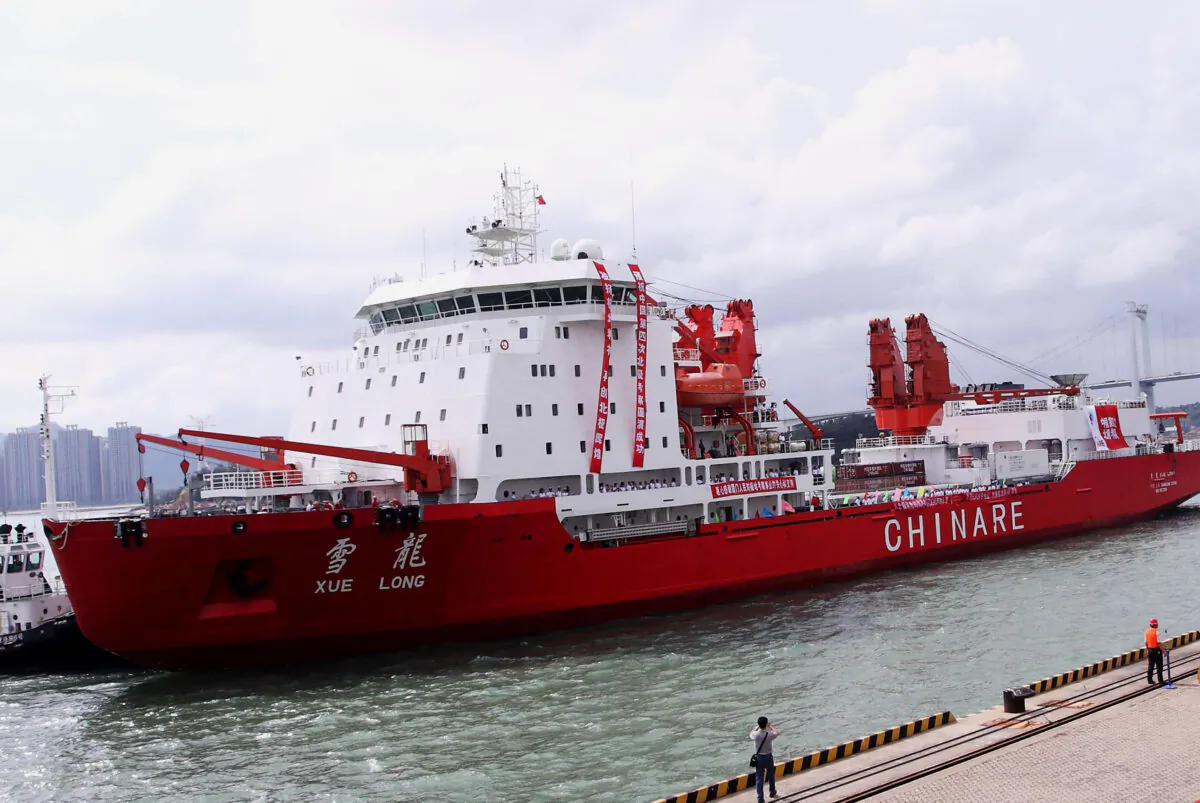
China may not need Russia for an icebreaker escort much longer. Seven years ago, China had just one icebreaker. Now it has at least four. A Chinese state-run research institute has proposed a design for China’s first nuclear-powered icebreaker. Compare China’s fleet with just three U.S. icebreakers, a slower production cycle, and no plans to go nuclear.
In August 2025, Beijing sent a group of five polar ships near Alaska. Chinese personnel are mapping the Arctic seabed and water conditions, including to the north and west of Alaska, a major sea route to the Arctic. China’s mapping will be key to its submarine operations and its ability to track enemy submarines, as well as critical in the event of war.
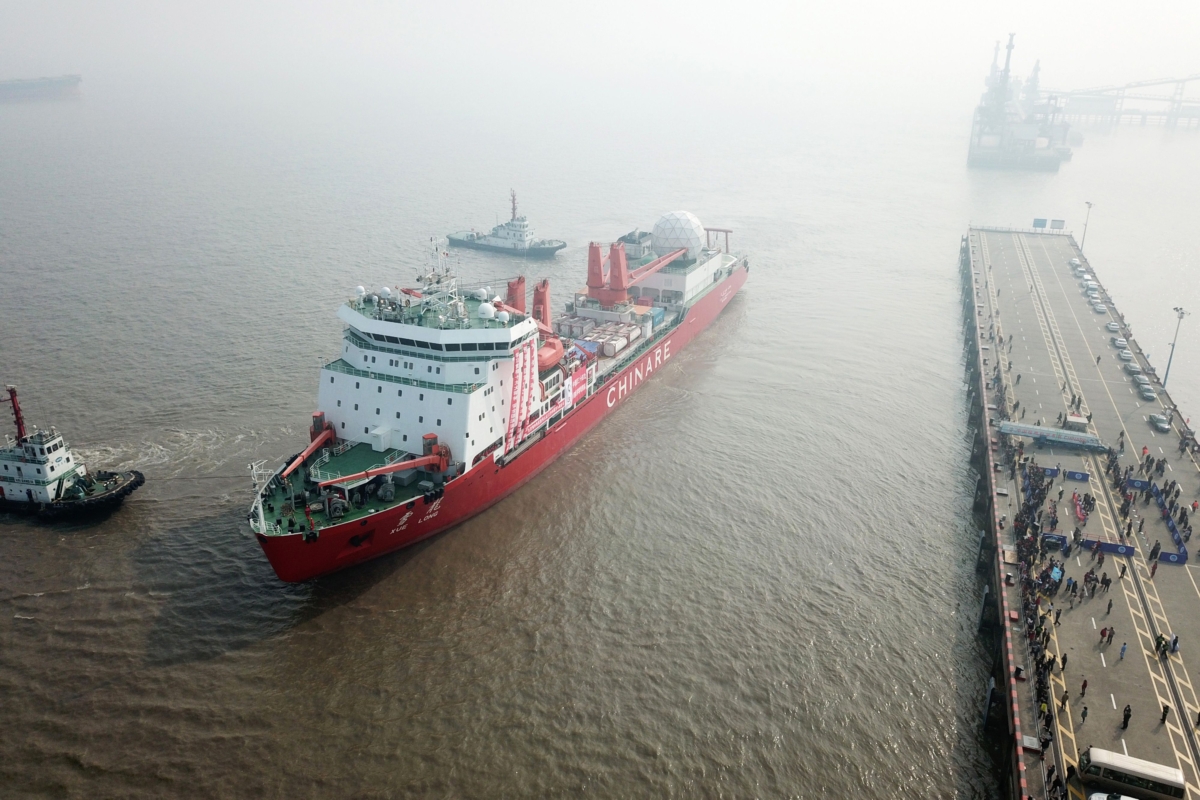
As the northern ice cap recedes and war in the Middle East increases risks along maritime routes that transit the Suez Canal and the Strait of Hormuz, the NSR, in particular, is getting more attention. Although the NSR is still blocked during winter—and subject to higher costs and more natural risks than conventional routes—ships can transit it during an increasing number of warm months, now starting as early as May and ending as late as November.
In addition to transits on the NSR, China maintains Arctic research or satellite stations in Svalbard, Norway; Karholl, Iceland; and Kiruna, Sweden. They research the gamut of Arctic subjects, but Svalbard covers “space physics,” Karholl “geophysics,” and Kiruna satellite operations. All have dual civilian-military applications.
Other Chinese initiatives in the Arctic were rejected or canceled because of growing pushback from the West, led by U.S. diplomacy. In 2016, Beijing sought to acquire a former U.S. military base in Greenland, and in 2018, it wanted to expand a group of airports on the island. The Danish government rejected both proposals, potentially at the urging of the United States. In 2020, Sweden declined to renew a contract with China that had given the country access to Swedish satellite ground station services worldwide, including in the Arctic.
Last year, Norway increased restrictions on China’s participation at its university on Svalbard in the Arctic and insisted on the removal of two stone lions from the Chinese research station’s entrance. The Svalbard Islands host the world’s northernmost town occupied year-round, bustling international research stations, and one Russian coal mine.
By the Svalbard Treaty of 1920, people from 49 signatory countries, including China and Russia, are allowed to live and work visa-free on the islands, but not to use them for “war-like purposes.” Yet China and Russia have tried to incrementally expand their rights to the islands. In 2004, a Chinese entity rented research facilities at Ny-Alesund and later erected nationalistic statues.
In 2024, 183 Chinese tourists visited Svalbard. About 100 of them, many in matching red jackets, visited the facility and engaged in coordinated Chinese flag waving for a CCP-style banner. One of the “tourists” wore a People’s Liberation Army (PLA) uniform with a PLA Ground Force patch. These are exactly the types of gray-zone activities that the PLA employs when it takes over neighboring territories, for example, in the Himalayas and the South China Sea.
The strategic nature of the Arctic—including for missile defense, submarine operations, signals intelligence, mining, and energy transport—raises the question whether the three democracies that host China’s facilities should cancel their permits.
Iceland and Sweden could do so rather simply, while Norway would have to do so within the limits of the Svalbard Treaty. Norway could arguably expropriate the property of authoritarian countries such as China with fair compensation, provided the expropriation was “on grounds of public utility.”
Containing the CCP is certainly of public utility to democracy and human rights around the world, given the CCP’s hegemonic ambitions.
As with Greenland, U.S. diplomacy has been at the forefront of efforts to encourage democracies to stop providing space for China’s Arctic ambitions. Finland, Denmark, Sweden, and Norway have all curtailed at least some of China’s Arctic activities because of its growing power, authoritarianism, and alliance with Russia. Norway and Sweden have done so, most significantly, by limiting China’s access to satellite facilities. A planned satellite station with Finland was also canceled in 2019.
Standing up to Beijing’s gray-zone operations in the Arctic is eminently possible and necessary. Arctic countries do not want their shared sea to become another South China Sea. Given the Chinese Communist Party’s global ambitions, its Arctic expansion knows no bounds other than those set by other countries. That means keeping China out of the Arctic until it gains political legitimacy by becoming a democracy.
Views expressed in this article are the opinions of the author and do not necessarily reflect the views of The Epoch Times.
 Friends Read Free
Copy
Facebook
Tweet
Friends Read Free
Copy
Facebook
Tweet