
Commentary
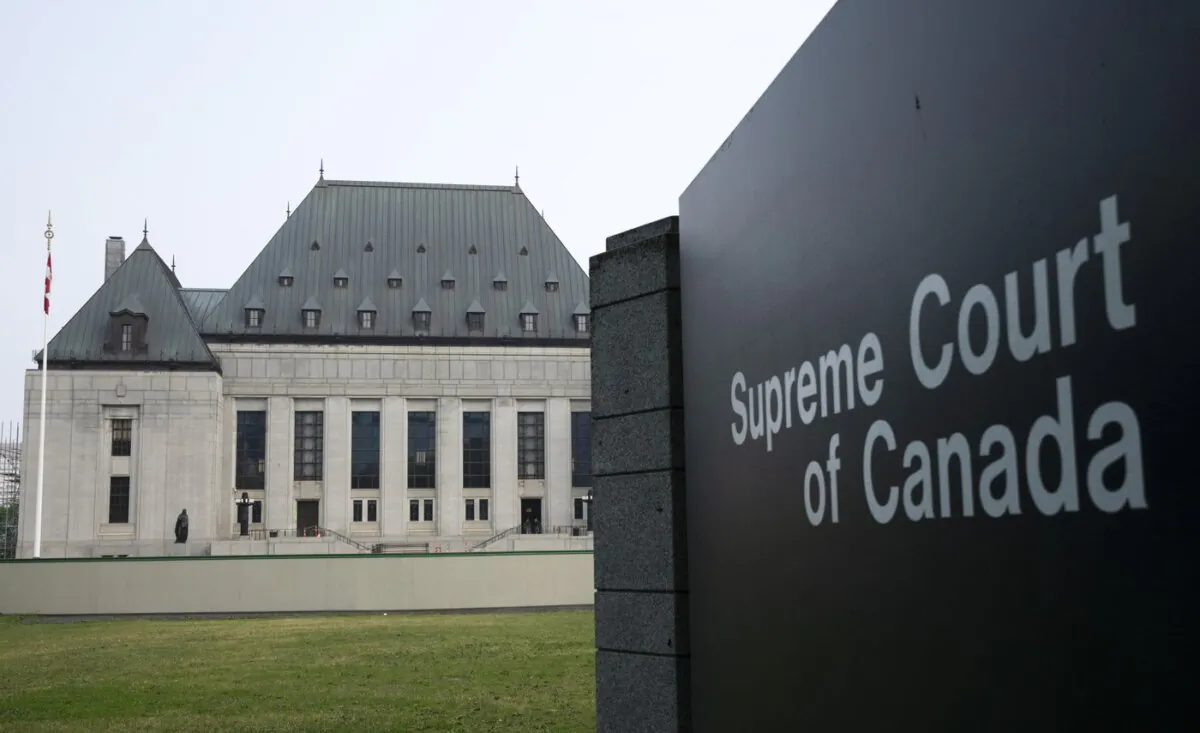
In 1985, R. v. Big M Drug Mart Ltd. was the first case heard by the Supreme Court of Canada (SCC) regarding the freedom of religion under the Charter of Rights and Freedoms.
The constitutional question before court was whether the Lord’s Day Act that went into force in 1907 infringed upon the freedom of conscience and religion guaranteed in the Charter. The Lord’s Day Act was a federal law to prohibit business activities on Sundays. In the Big M case, it was found to be unconstitutional by the SCC.
The Charter opens with these words:
“Whereas Canada is founded upon principles that recognize the supremacy of God and the rule of law:
“1. The Canadian Charter of Rights and Freedoms guarantees the rights and freedoms set out in it subject only to such reasonable limits prescribed by law as can be demonstrably justified in a free and democratic society.”
The Lord’s Day Act reflects God’s fourth Commandment given to Moses and His people: “Remember the Sabbath day by keeping it holy. Six days you shall labor and do all your work, but the seventh day is a sabbath to the Lord your God.” (Exodus 20:8-11)
If “God” in the opening words of the Charter refers to the God of the Bible—whose Commandments, including to rest on the Sabbath, are the foundation of all rights and freedoms set out in the Charter—it would seem very strange to find the Sabbath, protected in the Lord’s Day Act, could infringe on those very rights and freedoms.
I recently spoke with the Hon. Brian Peckford, former premier of Newfoundland and Labrador and the only living First Minister of the constitutional patriation process leading to the 1982 Constitution.
“The God in the Charter means the Judeo-Christian God,” he told me. “That was what the authors meant. I was one of them. All the First Ministers were of the Christian faith and took it as a given that our use of God meant the Judeo-Christian God. The First Ministers were quite clear on that at the time and did not think that it would be so abused as it is now.”
However, in the Big M case the SCC disagreed. Justice Dickson and five other justices concluded: “The evolution of Canada as a pluralistic, multicultural society, as well as the reference to ‘God’ rather than to an identifiably Christian conception of God can have no bearing either on the characterization of laws aimed at enforcing specifically Christian observances nor on the classification of such legislation as being within Parliament’s criminal law power.”
In other words, “God” is just some unknown god because the Charter did not say ”Christian God.”
But the SCC constantly interprets the Charter and supplements general words with detail. So the question becomes: Did the court overlook any evidence that “God” was, indeed, the “identifiably Christian conception of God.” Of course, it very much did.
First, the Lord’s Day Act had been the law for 78 years from 1907 until 1985 when the SCC struck it down in R. v Big M Drug Mart Ltd. The references to God in the Constitution Act of 1982 as well as in the Canadian Bill of Rights of 1960 could not have been to any God other than the Lord, a Christian God referenced in the Lord’s Day Act.
Second, there were numerous references to “God” in the Magna Carta, which is the source and foundation of Canada’s rule of law and human rights:
“John, by the grace of God King of England, … Know that before God, for the health of our soul and those of our ancestors and heirs, to the honour of God… That we have granted to God, and by this present charter have confirmed for us and our heirs in perpetuity, that the English Church shall be free, and shall have its rights undiminished, and its liberties unimpaired.”
King John was very much a Christian. Prior to the Magna Carta, John had surrendered his entire kingdom to Pope Innocent III. The rule of law is a Christian biblical value.
Third, to this end, the SCC could have consulted Sir Edward Coke’s 1602 reminder that the “rule of law” was the product of Christianity:
“For as in nature we see the infinite distinction of things proceed from some unity, as many flowers from one root, many rivers from one fountain, many arteries in the body man from one heart, so without question, Lex orta est cum mente divina [the law arose with the divine mind], and this admirable unity and consent in such diversity of things, proceeds only from God the fountain and founder of all good laws.”
Fourth, the Constitution Act was proclaimed in force by Elizabeth II. Her formal title, prescribed in the Royal Style and Titles Act of 1953, which appeared on all royal proclamations of Canada, was “Elizabeth the Second, by the Grace of God, of the United Kingdom, Canada and Her other Realms and Territories Queen, Head of the Commonwealth, Defender of the Faith.”
The “Defender of the Faith” is a long-standing title held by British monarchs, symbolizing their role as the Supreme Governor of the Church of England (Christian) and was originally granted to King Henry VIII by Pope Leo X in 1521 for defending Catholic doctrines.
Fifth, it’s only a short walk from the SCC to the Peace Tower, which has three Scripture verses etched in the concrete arch above its stained glass windows. Over the south window, facing Wellington Street, is Psalm 72:1: “Give the king thy judgments, O God, and thy righteousness to the king’s son.” Over the East window is Canada’s motto, taken from Psalm 72:8: “He shall have dominion also from sea to sea.” Over the west window is “Where there is no vision, the people perish,” from Proverbs 29:18.
Sixth, the SCC justices could alternatively have entered Peace Tower and read from 22 other biblical verses etched throughout.
Finally, the court could have reviewed Lord Atkin’s decision in the 1932 UK case Donoghue v. Stevenson, which established tort law throughout the commonwealth. Lord Atkin wrote, “The rule that you are to love your neighbour becomes in law, you must not injure your neighbour.” Tort law is, therefore, a manifestation of the commandment of Jesus in Mark 12:31: “Love your neighbor as yourself.”
It seems incomprehensible, then, that the SCC could have been unaware which “God” the Charter references. Of course, it was the God who gave us the rule of law and human rights, the God of our Monarchs, the God etched on our institutions, and, of course, the God of the Constitution’s framers.
Did the SCC not simply betray the Charter and God 40 years ago?
As a first-generation immigrant from China who, by the Grace of God, received my faith in Jesus Christ at 40 in Canada, I praise the Lord who blessed this nation with freedom. May God have mercy and forgive His wicked people (us all included), grant us His Grace, and lead Canada to repent and return to her glorious tradition and heritage: The principles that recognize the supremacy of God and the rule of law.
Views expressed in this article are the opinions of the author and do not necessarily reflect the views of The Epoch Times.
 Friends Read Free
Copy
Facebook
Tweet
Friends Read Free
Copy
Facebook
Tweet