
Commentary
The Iran war is disrupting the sanctioned oil supplies that underpin China’s low-cost manufacturing model, exposing deeper weaknesses in the country’s slowing economy.
U.S.–Israeli strikes on Kharg Island, Iran’s main oil export hub, have disrupted the oil flows that support a significant portion of China’s manufacturing cost structure. The Iranian regime derives most of its revenue from oil exports, and by 2025, it was selling approximately 80 percent to 90 percent of that oil to China.
China is the world’s largest crude oil importer, bringing in roughly 11.6 million barrels per day (bpd) in 2025. Of those imports, analysts estimate that approximately 2.6 million bpd consisted of discounted or sanctioned crude, including 1.38 million bpd from Iran and 389,000 bpd from Venezuela, roughly 17 percent of China’s total imports. By 2025, sanctioned crude from Iran, Russia, and Venezuela made up as much as 40 percent of all Chinese oil imports.
Beijing officially denies importing Iranian oil. China’s General Administration of Customs lists five countries—Russia, Saudi Arabia, Malaysia, Iraq, and Brazil—as accounting for 62 percent of crude oil imports in 2025, with Iran absent from the official record. Columbia University’s Center on Global Energy Policy exposed the deception through tanker tracking: China imports more “Malaysian” crude, 1.3 million bpd in 2025, than Malaysia actually produces, which was only 535,000 bpd in 2024.
Beijing’s manufacturing and export-led economy is supported by discounted oil. Iranian crude has traded at about $8 to $11 per barrel below Brent, and for Chinese independent refiners operating on thin margins, replacing Iranian oil with market-rate alternatives would translate into billions of dollars in additional annual costs. Cheaper energy lowers production costs for the manufacturing sector, supporting competitiveness.
This price advantage has become more consequential as China’s export sector faces mounting pressure. Net exports accounted for one-third of economic growth in 2025, the largest contribution since the late 1990s, but profit margins have collapsed. The share of loss-making companies in manufacturing doubled from 15 percent in 2018 to 30 percent in 2025.
China’s producer price index has declined continuously since October 2022, remaining between minus 2 percent and minus 3 percent for 38 months, even as industrial output increased. In November 2025, industrial profits fell by 13.1 percent year over year, wiping out nearly all profit gains made earlier in the year.
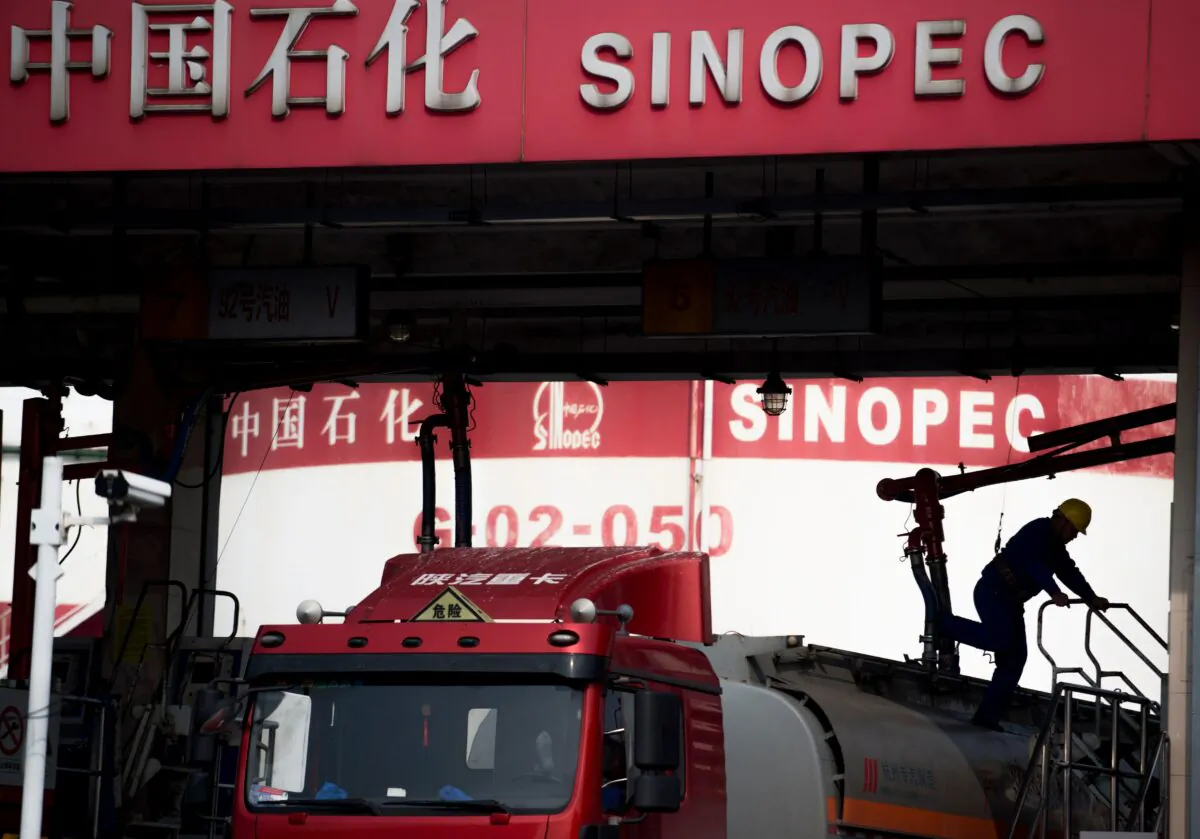
The economic pain from losing discounted barrels falls first and hardest on China’s independent refineries, known as “teapot” refineries. These smaller-scale processors are clustered in Shandong Province and built their operations around cheap sanctioned crude. Shandong’s independent refineries account for about 70 percent of China’s independent refining capacity and process roughly 1.3 million bpd of Iranian crude, making these discounted supplies central to their operations.
Teapot refiners account for about 20 percent of China’s total crude imports and, unlike major state-owned refiners, lack extensive strategic storage capacity and cannot easily absorb sudden feedstock disruptions.
The Venezuelan disruption demonstrated the pattern. In 2025, China imported 389,000 bpd of Venezuelan crude. As Washington tightened controls on shipping and targeted shadow fleet tankers, shipments to China were projected to fall by as much as 75 percent by early 2026. If Iranian flows are similarly curtailed, refinery run cuts and potential shutdowns are likely, which would tighten fuel supplies in domestic markets and push gasoline and diesel prices higher.
Research published in ScienceDirect quantified the impact of an oil shortage on Chinese gross domestic product: When the shortage rate reaches 25 percent, domestic crude oil prices rise by 121.2 percent, refined petroleum product prices rise by 67.8 percent, and gross domestic product declines by 0.7 percent, with losses accelerating as the shortage rate increases. The American Action Forum assessed that the conflicts in the Persian Gulf and the U.S. incursion into Venezuela in early 2026 have effectively cut off close to one-fifth of China’s oil supply.
China has buffers. As of January, China held an estimated 1.2 billion barrels of onshore crude stockpiles, representing approximately 108 days of import cover. An additional 50 million barrels of Iranian crude were stored or in transit offshore China and Malaysia as of early March. Those buffers buy time but do not resolve the underlying structural problem.
The more durable effect of sustained U.S. pressure on Iran and Venezuela is the erosion of the sanctions-discount ecosystem, raising transaction costs, narrowing spreads, and increasing volatility for marginal barrels. Market-rate replacements from Brazil, Canada, Iraq, or the Gulf would compress or eliminate the margins that make teapot operations viable.
For China, the loss of discounted barrels is a compounding cost arriving at a moment when the economy faces slowing growth, weakening manufacturer margins, and a sustained trade war with the United States.
Views expressed in this article are the opinions of the author and do not necessarily reflect the views of The Epoch Times.
 Friends Read Free
Copy
Facebook
Tweet
Friends Read Free
Copy
Facebook
Tweet