
Commentary
After losing several dogs on the ranch, my husband decided he wanted a hunting dog.
He found someone online selling Hungarian Vizsla puppies. The photographs showed two healthy female sisters, around 15 weeks old. He arranged to meet the seller in San Antonio, I believe, in a Costco parking lot.
Before the man even showed him the dog, my husband felt that something was wrong. The man immediately began asking for the money.
“May I see the puppy first?” my husband asked.
The man pulled out a tiny, fragile creature that looked nothing like the puppy in the photographs. She was limp, her little body slumped in his hands. There were no two healthy sisters. There was only this one sick dog.
“That isn’t the puppy from the pictures,” my husband said. “No, thank you.”
The man became frustrated and threw the puppy into the front seat of his vehicle as if she were trash.
Something in my husband softened. He asked whether the man would take less money because the puppy was clearly sick, severely undersized, and unlikely ever to become the hunting dog he had intended to buy. The man agreed.
That is how Chilla came to live at Sovereignty Ranch.
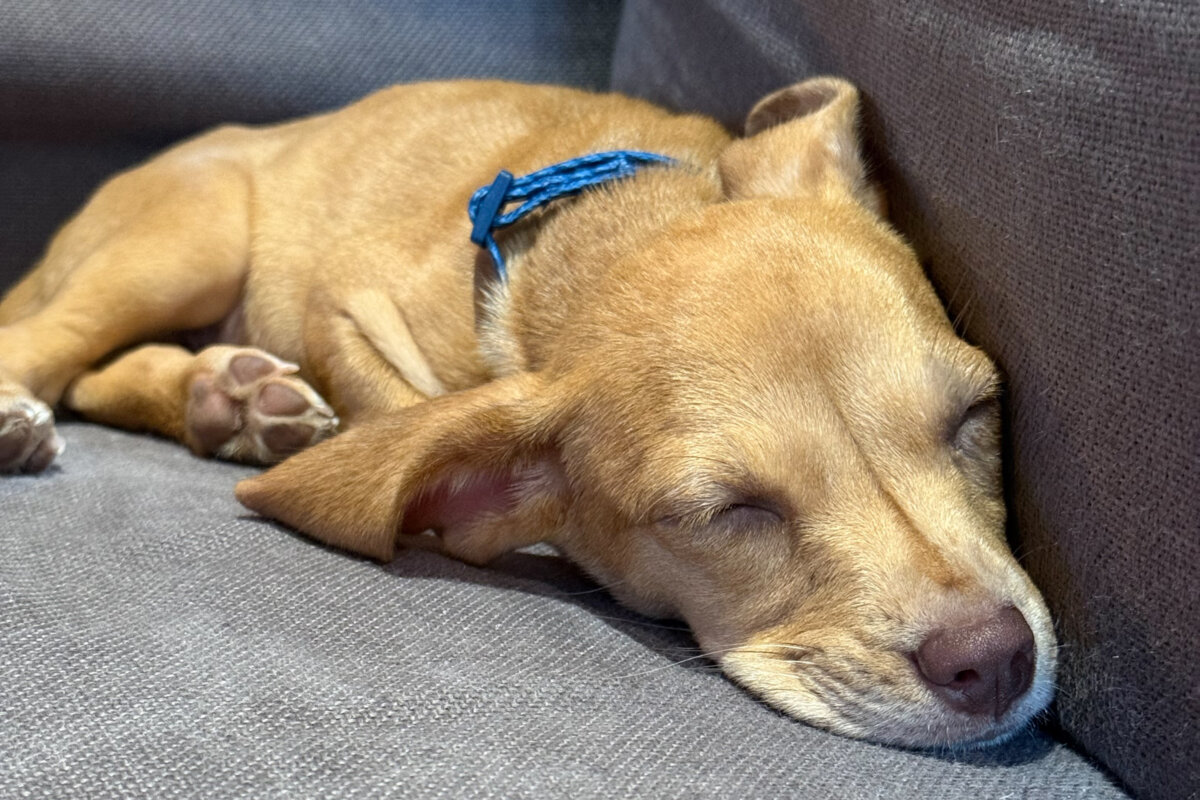
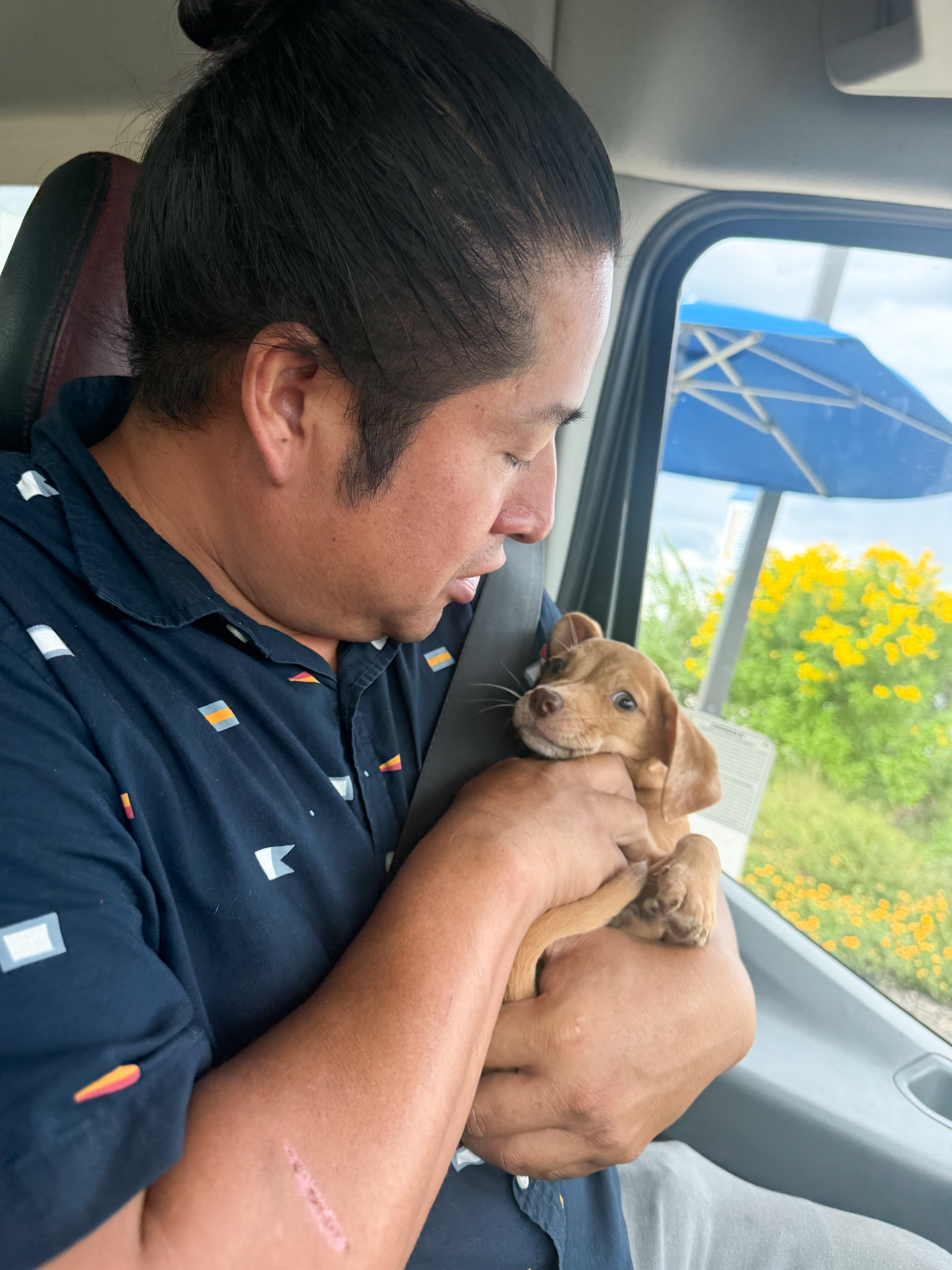 The sick puppy Mollie Engelhart’s husband, Elias, encountered and finally took home, instead of the healthy Hungarian Vizsla the seller claimed. (Courtesy of Mollie Engelhart)
Before leaving to get the puppies, my husband assured me that he would take care of everything. I would not be cleaning up after a puppy, getting up at night, or taking responsibility for another living thing.
I am not in the business of controlling my husband, so I did not try to stop him.
On his way home, he called me.
“They only had one puppy,” he said. Then there was a pause. “You’re going to be upset.”
That is never a promising beginning to a conversation.
“This puppy is very sick,” he continued. “I probably shouldn’t have paid for her, but I think she was going to die. Can you call the vet?”
Slightly resentfully, I called the veterinarian and made an appointment for that afternoon. As my husband drove home, it became clear that waiting even a few hours might be too long. The puppy had severe diarrhea. Her ribs and hip bones jutted through her skin. Both eyes were crusted with mucus, and she could barely hold her head up.
I called the clinic back and told them it was urgent. Then I loaded our children into the car and drove to the Bandera Veterinary Clinic with the puppy I had specifically said I could not take care of.
Chilla was supposedly around 14 weeks old, but she weighed less than 2 pounds. She was severely malnourished, infested with parasites, and tested positive for distemper. The veterinarian gave her less than a 50 percent chance of survival.
We brought her home with medication and began trying to keep her alive with bone broth, colostrum, and tiny amounts of puppy food. There was explosive diarrhea, vomiting, ruined towels, and sleepless nights. There were medicines to measure and meals to coax into a body that seemed hardly strong enough to digest them.
And there was resentment. My husband had promised that I would not have to care for this puppy, yet here I was doing exactly that.
At around 5 one morning, I found myself sitting on the porch waiting for Chilla to go to the bathroom. I was tired, overwhelmed, and frustrated. Somewhere in those dark early-morning hours, however, I realized that this was not really my husband’s fault.
He is good at training dogs. He understands discipline, structure, and boundaries. He can take a strong young dog around the ranch, teach it where it belongs and give it useful work. But caring for something tiny, fragile and nearly dead falls squarely into the territory of the nurturer. It calls for the mother.
And Chilla is not unique.
The men on this farm are strong and hardworking. They repair equipment, build fences, move livestock, pull calves and handle the physical demands of ranch life. But when there is an abandoned baby struggling to live, it almost always finds its way to me.
Many a morning, a baby goat has been brought to my front door, or a lamb already hovering at the edge of death. I have cared for kittens abandoned by their mother in an old truck and calves too weak to nurse.
Even my neighbor Chuck once arrived in the freezing cold of January carrying an abandoned calf. Chuck does not have a wife, and he understood that he was not the one most likely to save that baby.
Sometimes what is needed most is a nurturer.
Occasionally, my sister-in-law Sarah takes on one of these babies. But the vast majority come to me because I am the matriarch. I am the mother and the caregiver—not only for my children but, in many ways, for the farm itself. The hurt, the rejected, the premature, and the nearly dead find their way to my door.
Even with full-grown animals, the pattern remains. When a cow has mastitis or is struggling in labor, my husband is more than capable of treating her or pulling the calf. He knows what to do and is often better equipped to do it physically. Yet he will almost always call me on the radio and ask for a consult.
A consult from the nurturer.
He does not call because he thinks I necessarily know more than he does. He calls because he understands that I will look at birth, illness, and a struggling infant differently than he will. I notice different things and ask different questions. I think about warmth, nourishment, connection, and whether the mother and baby are responding to each other.
It is not that my way of seeing is better than his. It is that men and women are not interchangeable, and sometimes an animal survives because both ways of seeing were brought together.
My husband had expected to bring home a strong 15-week-old puppy that could follow him around the ranch and eventually learn to hunt. Instead, he brought home something smaller than a Chihuahua that could barely stand. The facts had changed.
He made me a promise based on the information he had at the time. When he arrived in that parking lot, reality was entirely different from what he had been told. He could have walked away and left that puppy slumped in the front seat beside a man who had just thrown her down like garbage. But something in him would not let him do it.
Saving her did not suddenly give my husband a new set of skills. His compassion made him bring Chilla home, but compassion did not transform him into the person best equipped to care for a critically ill infant animal. That part fell to me.
I could remain angry that he broke a promise, or I could recognize that he had not deliberately deceived me. Life changed between the promise and the moment it had to be fulfilled.
Marriage is full of moments like this. We make agreements based on the life we believe we will have. Then illness comes. A business fails. A child needs more than we expected. A parent grows old. An animal arrives half-dead in a Costco parking lot, and suddenly the original division of labor no longer works.
We can stand beside the wreckage of the agreement insisting, “But you promised,” or we can look at what is actually in front of us and ask, “Which one of us has what this moment requires?”
Right now, Chilla does not need structure, discipline, or hunting lessons. She needs warmth, nourishment, medicine, cuddling, and someone willing to sit on the porch with her at 5 in the morning. She needs what I know how to give. If she becomes strong enough, she will eventually need what my husband knows how to give.
Chilla is now approaching 3 pounds. Her ribs no longer jut sharply through her skin. The vomiting, conjunctivitis, and explosive diarrhea have stopped. The parasites are being treated, and for the first time, she is beginning to play.
I do not imagine she will ever become a hunting dog. I am not even sure she will become a proper farm dog. At the moment, she is about half the size of our cats. But perhaps hunting was never the work she came here to do.
Perhaps her work was to remind me that resentment grows when we hold people to promises made before reality revealed itself.
My husband is grateful that I am caring for the puppy even though I told him I could not. And I am grateful that I married a man whose heart would not allow him to leave a dying animal slumped in the front seat of a stranger’s car like a piece of trash.
Neither of us could have saved Chilla alone. His heart brought her home, and my hands are helping keep her alive.
Views expressed in this article are the opinions of the author and do not necessarily reflect the views of The Epoch Times.
 Friends Read Free
Copy
Facebook
Tweet
Friends Read Free
Copy
Facebook
Tweet