

Commentary
An interesting exchange in the Senate occurred between Robert F. Kennedy Jr. and Sen. Bernie Sanders (I-Vt.) over the contribution of vaccines to reducing disease mortality. RFK said an indisputable truth: “If you want to talk about why disease mortality disappeared in the 20th century, it was not vaccines. … Almost none of it was attributable to vaccination. It was attributable to hygiene, sewer plants, better water supplies, and engineering.”
This point is empirically indisputable. And yet the declaration comes as a shock for very odd reasons. Every medical student for decades and pretty much everyone else has been propagandized on this subject to the point that people are deeply confused. They have come to believe that health is something granted by shots and not by more traditional public health measures.
Apart from 19th-century smallpox vaccination, mass vaccination for a range of diseases only appeared in public life in the 1950s. Deaths from most diseases against which we were vaccinating had already fallen by 90 percent or more. In the case of measles, mortality had dropped to almost zero before vaccination came along in 1963.
All data indicate that the main contributors to improved public health were clean water, hygiene, cleaner food, and personal hygiene. Vaccination was later to the game and ended up grabbing all the credit in the public mind.
I’ve been reading through an excellent article that appeared in a 1999 issue of the Journal of the American Medical Association. It is one of the more extensive historical treatments around. It documents an astounding collapse in infectious disease mortality in the 20th century.
“Infectious disease mortality declined during the first 8 decades of the 20th century from 797 deaths per 100,000 in 1900 to 36 deaths per 100,000 in 1980,” it reads.
“From 1938 to 1952, the decline was particularly rapid, with mortality decreasing 8.2 percent per year. Pneumonia and influenza were responsible for the largest number of infectious disease deaths throughout the century. Tuberculosis caused almost as many deaths as pneumonia and influenza early in the century, but tuberculosis mortality dropped off sharply after 1945.”
Among the diseases that came to be all but fully controlled are typhoid fever, typhus fever, malaria, smallpox, measles, scarlet fever, pertussis, diphtheria, croup, influenza, miliary fever, asiatic cholera, dysentery, plague, yellow fever, leprosy, erysipelas, purulent infection, septicemia, glanders, anthrax, rabies, tetanus, mycoses, tuberculosis, rickets, syphilis, gonococcus infection, acute articular rheumatism, rheumatic fever, encephalitis, meningitis, acute poliomyelitis, otitis media, mastoiditis, acute endocarditis, acute bronchitis, bronchopneumonia, pneumonia, pleurisy, lung abscess, gangrene of the lung, diarrhea, enteritis, ankylostomiasis, intestinal parasites, appendicitis, infections of the kidney, typhlitis, hydatid tumor of the liver, puerperal septicemia, infections of the newborn, gangrene of the skin, furuncle, acute abscess, osteomyelitis, cellular immune deficiency, and AIDS.
The near end of infectious disease mortality is one of the great triumphs in all of human history. The answer as to why this happened traces to the ghastly realities of the 19th century, the century of infectious disease. Demographics were changing too quickly in Europe, the United States, and the UK for the physical infrastructure to keep up. The streets were filled with horse manure, and sewer systems were extremely primitive. The poor in the cities lived in horrid conditions, swimming in disease and filth.
We often hear about how life spans increased dramatically from the mid-19th century to the mid-20th century, from an average age of 30 to 65. And that is true. But what these broad figures do not tell you is that if you survived the crucial turning points of age 5, age 15, and age 20, you would live to exactly the same age as people do now. So, yes, overall, life expectancy for everyone is way up, but people who made it past youth have long lived to the same age we do now.
Nearly the entire “hockey stick” curve of life expectancy—and this applies to income and gross domestic product per capita too—is traceable to the improvement in child and youth mortality. Indeed, the improvements here account for 70 to 80 percent of the change in life expectancy as a whole. In other words, we are looking at something of a statistical illusion. Once the child mortality problem was fixed, everything else took care of itself.
And why did that change? The streets were cleaned up. The water supply was improved. Sanitation became functional. The food was fresher, and here, refrigeration made a massive difference. And personal hygiene itself dramatically improved. Once antibiotics came along in the 1930s to fix the rest, we were off to the races in population, health, and overall income and life improvements.
Why am I explaining this? Because so many people in various subfields want desperately to credit something other than improvements in basic public infrastructure. The economists want to credit “capitalism” as if capital accumulation alone deserves credit. That’s part of the story but not the core of it. And champions of the welfare state and regulation said it was government that did it. That’s not true either.
The vaccine industry itself wants us to credit the shots. But there is no evidence for this.
If you have any doubts about this and want to read the proof in excruciating detail, I suggest “Turtles All the Way Down” by two anonymous authors reportedly from Israeli epidemiological circles. Sadly, the way things are today, they could not sign their book.
They summarize their argument this way: “Historical evidence uncovered in the second half of the 20th century shows, clearly and unequivocally, that the narrative of ‘life-saving vaccines’ is largely fictitious. As it turns out, vaccines played only a limited role in reducing the burden of infectious disease in modern times.”
The book offers all the charts you need.
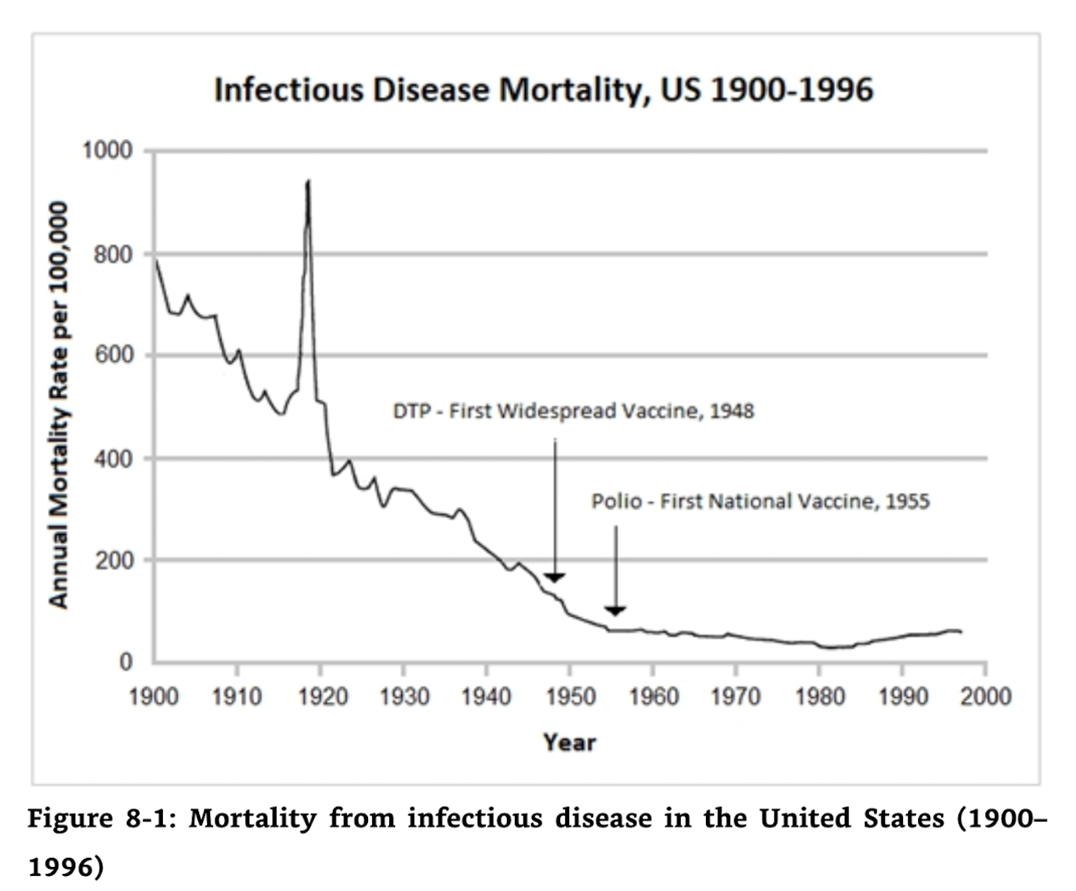
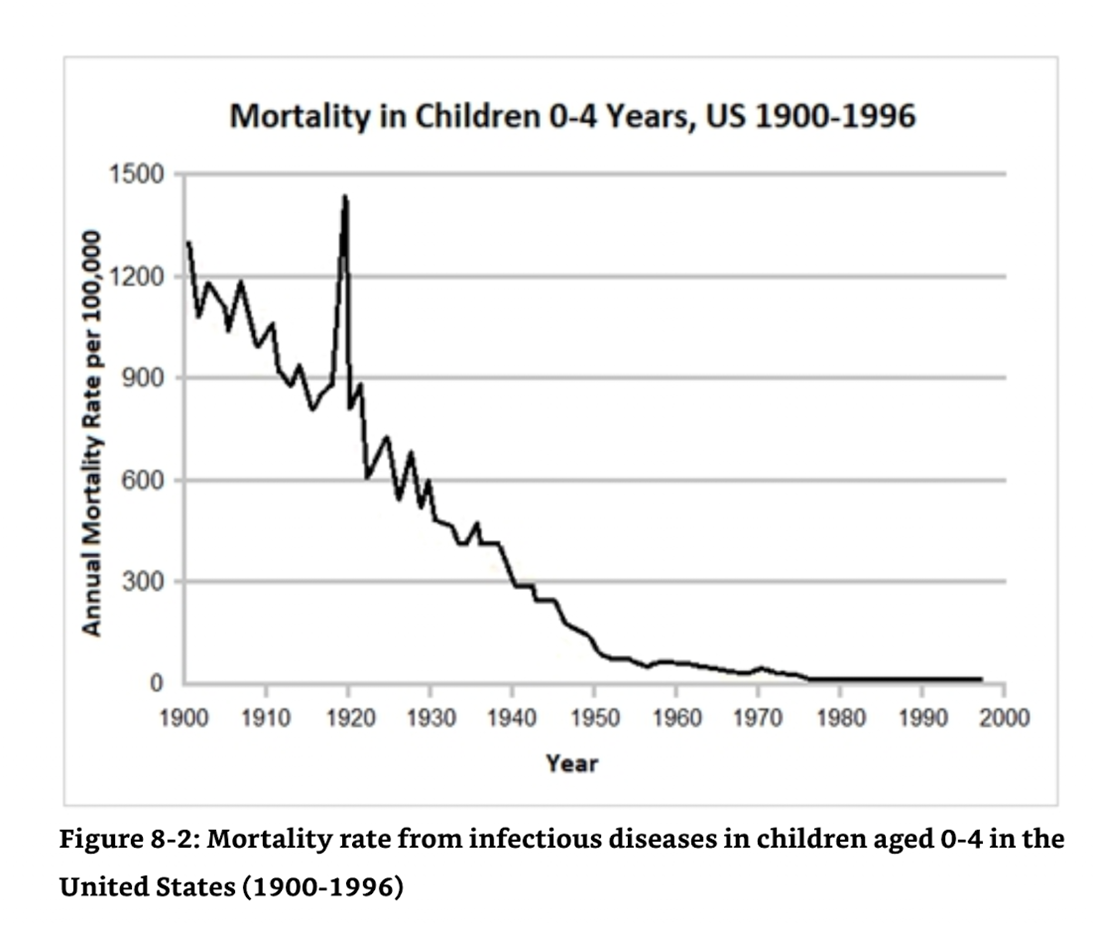
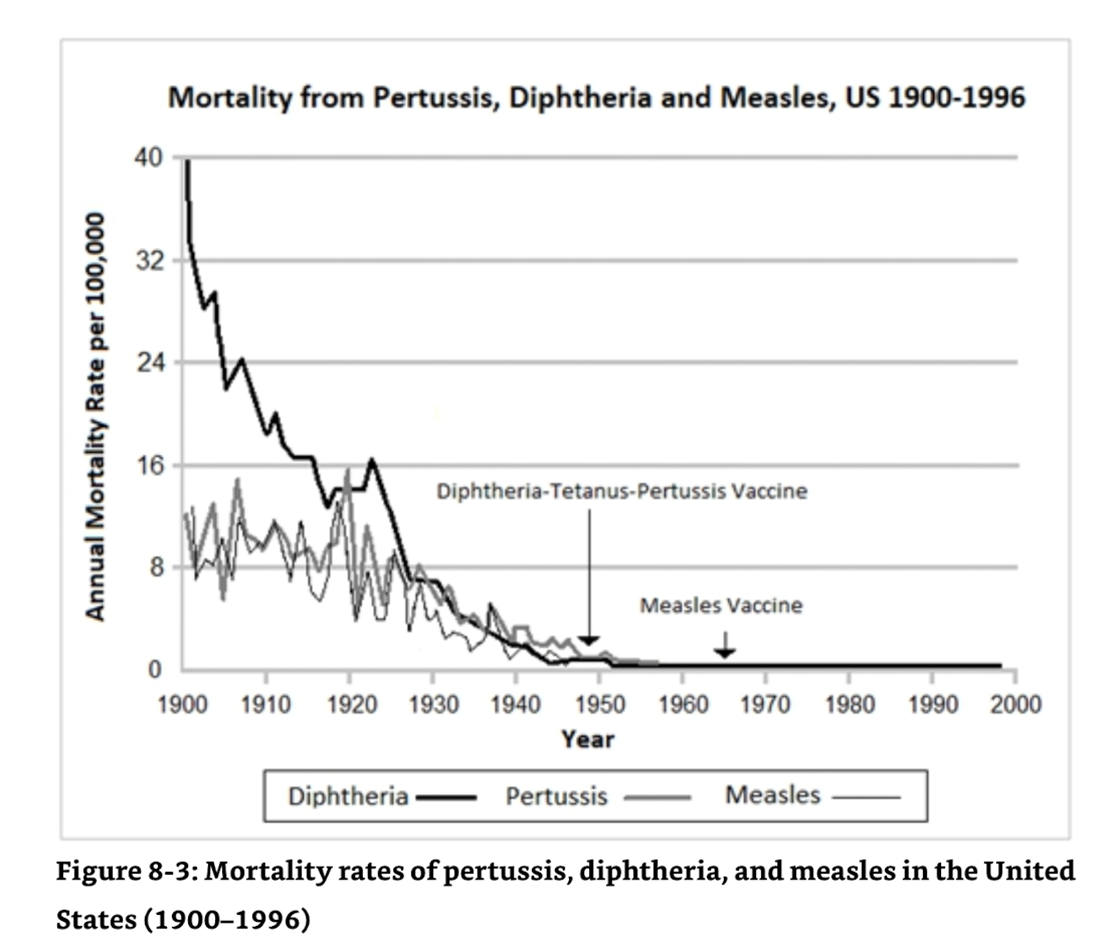
There is no problem in granting that vaccines made some difference, perhaps accounting for 1 to 5 percent of the remainder of decline (although discerning causation is tricky). But the rest is attributable to living cleaner lives not surrounded by the worst of the microbial kingdom in our homes and neighborhoods. This is what changed everything.
There is another factor at work here that the brilliant epidemiologist Sunetra Gupta emphasizes. The age of travel really gained steam at the same time, mixing up populations from all over the world and causing a time of universal exposure to pathogens never encountered before.
The Great War undoubtedly contributed to the 1918 flu pandemic, which spread without the aid of antibiotics to deal with it. But that exposure also upgraded immune systems to a level of sophistication never before achieved in the history of humanity. And here we have the unheralded hero of this story: the immune system itself, which is capable of remarkable miracles in scaling.
In our own time and recently, we’ve seen efforts to disparage the immune system that God gave us in favor of shots made in labs. But this claim was never plausible. There is no technology made in a lab that can compare with the brilliance of nature as a protective and healing device. Once humanity found its way toward cleaning up its common spaces, reinventing good sewage and clean water, and discovering the importance of personal hygiene, the immune system took care of the rest.
The conquest of infectious disease is one of the greatest stories rarely told. Our main problems today trace to chronic disease that is not infectious but rather a consequence of what we do to ourselves. Herein we find tragedy, proof that humankind has always been its own worst enemy. The path toward making America healthy again is not through the lab or through government but through changes we make in our own lives. Here, Kennedy is wholly correct.
Views expressed in this article are the opinions of the author and do not necessarily reflect the views of The Epoch Times.
 Friends Read Free
Copy
Facebook
Tweet
Friends Read Free
Copy
Facebook
Tweet