
Commentary
Most of the world has grown used to speaking of Moscow and Beijing in the same breath. “The axis of autocracy,” “no limits partnership,” etc. That picture is tidy, and partially wrong.
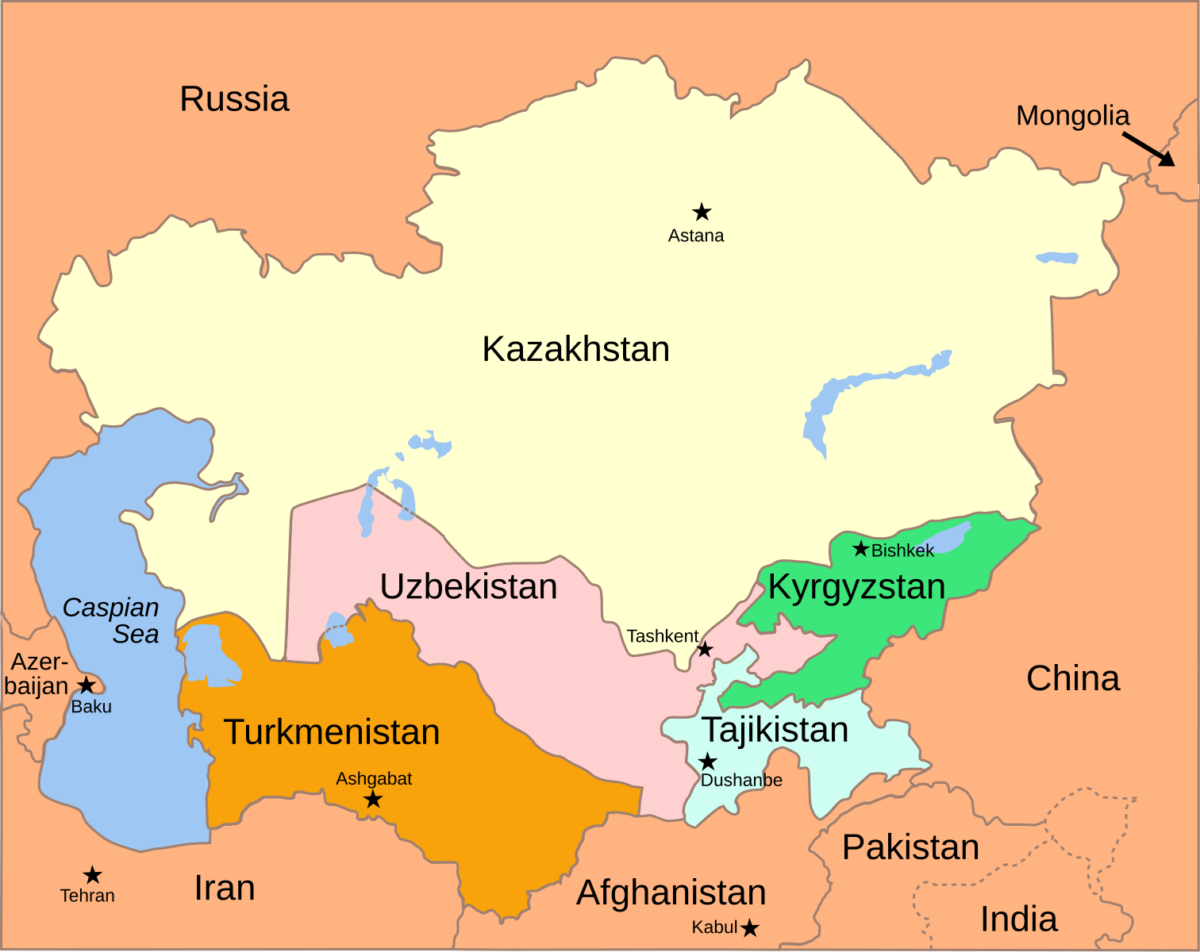
There is no better place to see this than Kazakhstan—a country too few outsiders can locate precisely, yet one that sits in the center of Eurasia, with the longest continuous land border in the world with Russia, at 7,600 kilometers (4,700 miles), and an equally sensitive frontier with the province of Xinjiang, China.
Kazakhstan History and Context
It is the world’s largest landlocked state, ninth biggest by area, and sits on 2 percent of global oil, produces more than 40 percent of the world’s uranium, and has deposits of almost every metal that green technologies need. East-west Belt and Road rail lines all the way to Europe (which bypass Russia) and north-south pipelines all cross it.
It had a traumatic time during the Soviet Union’s reign. In the 1930s, Stalin’s collectivization starved a third of all ethnic Kazakhs to death—one of the worst demographic catastrophes of the century, (percentage-wise). Government-sponsored migration into Kazakhstan turned Kazakhs into a minority in their own country by the 1970s. From 1949 to 1989, the USSR detonated 456 nuclear devices at Semipalatinsk in the northeast, exposing 1.5 million–2 million people to fallout without ever issuing a warning. Villagers were not evacuated; some were deliberately studied as living data points. Across the border, in Xinjiang, China did the same at Lop Nur: 45 tests, 22 in the atmosphere, over lands occupied by Uyghurs and ethnic Kazakhs.
When Kazakhstan became independent in December 1991, it inherited two lessons: Never again be a laboratory for a distant capital, and never again trust a single great power that shares a border. The foreign policy that emerged, multi-vector diplomacy, or eternal balancing, is not branding. In their mind, it is survival.
Russia and China Vie for Influence
Russia still supplies half of Kazakhstan’s electricity, moves 80 percent of its oil exports, and keeps northern cities warm in winter. When protests threatened to topple the government in January 2022, Russian-led troops flew in within hours. Moscow’s message is: You will always need us. China, meanwhile, has become Kazakhstan’s largest trading partner and poured investments that surged by more than 400 percent in the first half of 2025 alone. Every kilometer of new railway, every pipeline, binds the economies tighter. Beijing’s message is quieter but no less clear: The future runs through us.
These are not complementary pressures, but contradictory ones. Russian leverage is blunt—cut the power, close the pipeline, and rattle the northern provinces where ethnic Russians still dominate. Chinese leverage is deeper—build the infrastructure, finance the mines, and 20 years later, the country is inside your orbit. Basically, both countries are using their usual playbooks. Kazakhstan wants to be bound to neither.
There is another issue with China’s policies in Xinjiang, which emphasize tight political control, coercive labor programs, evidence of forced organ harvesting, etc., since they directly affect approximately 1.5 million to 1.8 million ethnic Kazakhs residing in China, many of whom have family ties across the border. This places Kazakhstan in a delicate position, balancing its growing economic dependence on China against domestic pressure to address the treatment of its people.
This is why the supposed Russia–China monolith fractures the moment you step onto the Kazakh steppe. Every Chinese freight train that bypasses Russian gauges erodes Moscow’s transit fees. Chinese mineral projects dilute Russian control, and Chinese capital offers an alternative to Russian leverage. Russia watches China penetrate what it still considers its strategic depth; China watches Russia cling to privileges it can no longer afford to grant. Kazakhstan plays them off against each other—and against a third “suitor” that has only recently returned to the table: the United States.
Washington Steps Up Its Game
Washington spent the first 30 years after the Cold War treating Central Asia as an afterthought—besides Afghanistan, some energy deals, and little more. That changed fast after 2022. Three realities collided: Russia weaponized energy and borders, China’s Belt and Road Initiative turned Kazakhstan into the keystone of Eurasian land transport, and the race to secure non-Chinese critical minerals became an existential priority.
Suddenly, Kazakhstan’s capital, Astana, is hosting C5+1 summits, Eurasian leaders are invited to the White House to sign uranium contracts with U.S. firms, and U.S. development finance circles the Trans-Caspian Middle Corridor—the one route from China to Europe that deliberately avoids both Russia and the Malacca Strait.
From Kazakhstan’s point of view, the United States is the only one of the three giants that it does not share a border with, nor does it have territorial nostalgia, nor does it demand ideological conformity or silence about Xinjiang. It is the only partner that strengthens Kazakh sovereignty simply by existing as an alternative.
None of this necessarily means Kazakhstan is “pivoting West.” Multi-vector diplomacy is not a phase; it is the operating system, for now. Astana seems intent on still buying Russian gas and building Chinese railways, while selling uranium to U.S. reactors—all while making sure no single pipe, rail, or contract can choke the country. The goal is optionality.
Positive Lessons to Be Applied
And therein lies the deeper lesson that Western policymakers still struggle with. Empires that have touched the steppe—from the Qing and the Russians to the Soviets—have always faced the same choice: Treat the frontier as a colony to be extracted and disciplined, or treat it as a partner to be courted and respected. The second path is harder, slower, and infinitely more durable. The Tang emperor Taizong understood this in the seventh century when he recruited Turkic generals into the highest ranks and married his daughters into steppe clans. Modern Beijing and Moscow have largely forgotten it.
Kazakhstan has not. Its leaders know exactly what happens when a great power decides a peripheral people are expendable: the famine, the fallout, the camps, and the cancers that appear two generations later. They also believe that the surest way to keep that history from repeating is to make themselves indispensable to everyone and subordinate to no one.
If the United States plays its cards with the patience and respect that the steppe has always rewarded, it will find in Astana not just a supplier of minerals and transit routes, but a reliable long-term partner, and a place that exposes the fault lines between Russia and the Chinese Communist Party.
Views expressed in this article are the opinions of the author and do not necessarily reflect the views of The Epoch Times.
 Friends Read Free
Copy
Facebook
Tweet
Friends Read Free
Copy
Facebook
Tweet