
Commentary
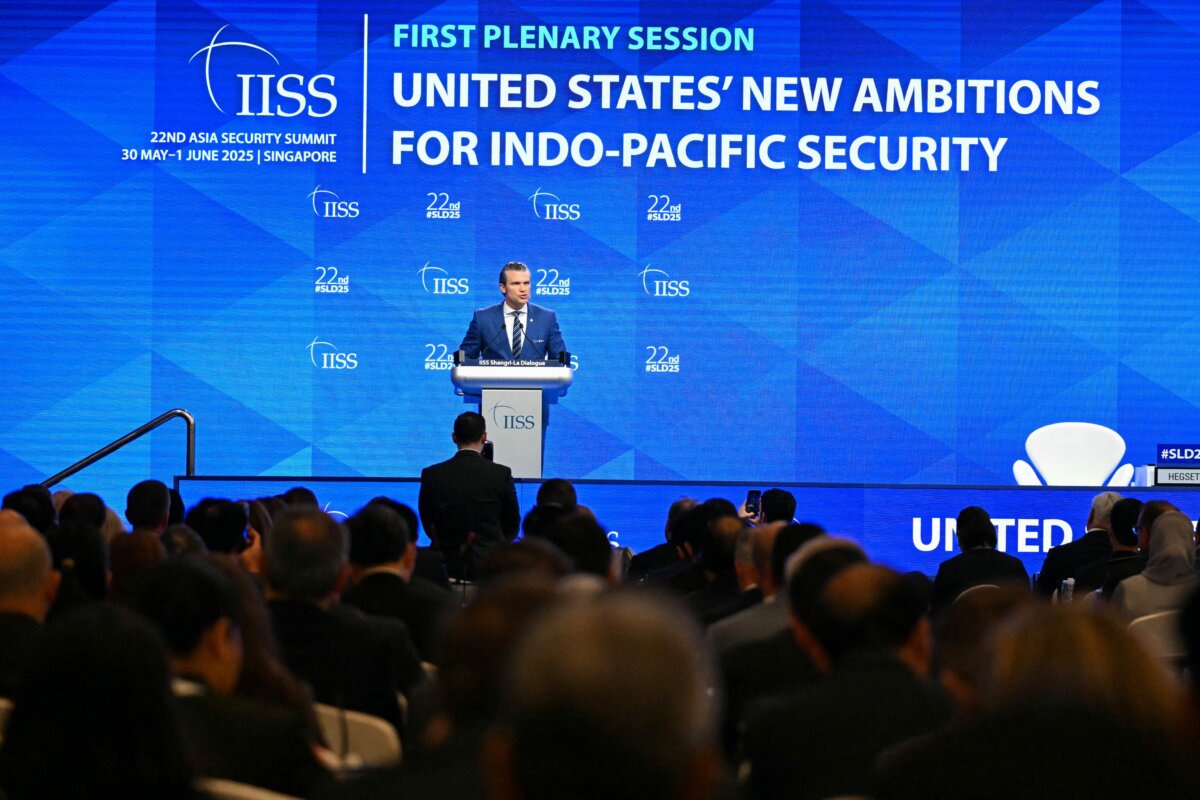
When U.S. War Secretary Pete Hegseth spoke in Singapore during the May 2025 Shangri-La Dialogue, his words carried the blunt clarity of the Trump era: “We do not seek conflict with communist China … but we will not be pushed out of this critical region.” That line now echoes in the 2025 National Security Strategy (NSS). The Indo-Pacific is still described as a central theater of competition with Beijing, but it no longer sits at the heart of U.S. grand strategy. That mantle has shifted back to the Western Hemisphere. For INDOPACOM, that is not a minor adjustment—it is a strategic downgrade, wrapped in continuity.
Continuity and Change Across Three NSS Documents
Across three administrations—President Donald Trump’s in 2017, President Joe Biden’s in 2022, and Trump’s again in 2025—the scaffolding of U.S. strategy barely moves. Each NSS pledges to protect the American people, sustain prosperity, preserve peace through strength, and project U.S. influence. The pillars are stable; the center of gravity is not.
Trump’s 2017 NSS mainstreamed the “free and open Indo-Pacific” frame, casting the region as a contest between free and repressive visions of world order. China was labeled a revisionist power, using infrastructure projects and militarized outposts in the South China Sea to erode sovereignty and push the United States out.
Biden’s 2022 NSS elevated the Indo-Pacific from important to existential, calling it “the epicenter of 21st century geopolitics” and naming China the “most consequential geopolitical challenge.” His strategy leaned into networks—treaty allies, the Quad, AUKUS, ASEAN “centrality”—and linked Europe’s security with Asia’s. It also addressed U.S. interests in the Taiwan Strait more explicitly than before.
Trump’s 2025 NSS keeps the Indo-Pacific on the page but moves it down the list. The first substantive item is the Western Hemisphere, framed as a “Trump Corollary” to the Monroe Doctrine. Only then does the document turn to halting economic damage from foreign actors while keeping the Indo-Pacific free and open. The Asia chapter—titled “Win the Economic Future, Prevent Military Confrontation”—frames the region less as an ideological battleground and more as an economic one, where supply chains decide the balance of power.
From Systems Clash to Supply Chains
The storyline shifts across the three documents. In 2017, China was cast as a revisionist power, with emphasis on military access and alliance reassurance.
By 2022, the competition broadened into a system-wide rivalry between authoritarian and democratic models, with Biden’s “invest, align, compete” logic.
By 2025, the aperture narrows again. The NSS reads less like a crusade against authoritarianism and more like an industrial policy plus deterrence brief. It details how Chinese exports have shifted toward low- and middle-income countries, how Beijing has locked in supply chains, and how Washington intends to use tariffs, reindustrialization, and technology controls to rebalance the economic scales.
Allies and Burden-Sharing
For allies and partners, the tonal pivot matters less than the budgetary one. All three strategies highlight alliances as strategic assets. The 2017 NSS called allies “critical” to sustaining a favorable balance of power. Biden’s 2022 document went further, describing alliances and partnerships as the United States’ “unmatched advantage.” Trump’s 2025 NSS keeps the alliance language but adds blunt burden-sharing demands. Hegseth has been direct: Indo-Pacific allies must boost defense spending or risk losing privileged access to U.S. technology and defense sales.
The analogy is simple: The United States is still coming to dinner, still ordering the main course, and still picking up a big piece of the tab—but the days of covering the entire bill are over. Japan’s historic defense build-up, Australia’s long-term AUKUS commitments, and the Philippines’ expanded basing agreements all reflect this reality.
Regional Responses
The regional responses to Washington’s recalibration are telling. In Tokyo, the government has embarked on a historic defense build-up, committing to spend about 2 percent of gross domestic product on defense and acquiring counter-strike capabilities. This is not just about deterring China; it is also about hedging against the possibility of a more conditional U.S. security guarantee. Domestic debates in Japan reflect unease about the financial burden, but the strategic consensus is clear: Tokyo cannot afford to rely solely on Washington’s umbrella.
Australia has doubled down on AUKUS, despite domestic concerns about cost and sovereignty. The decision to invest decades of resources into nuclear-powered submarines and a defense industrial base reflects Canberra’s calculation that staying in the U.S.-led club is worth the political and economic strain. Critics in Australia point to ballooning costs and questions about whether the submarines will arrive in time to matter, but the government has judged that the alliance premium outweighs the risks.
The Philippines has revived and expanded the Enhanced Defense Cooperation Agreement, opening nine bases—including sites close to Taiwan and the South China Sea—to U.S. access. Manila has quietly upgraded facilities with U.S. funding, but it has also kept lines open to Beijing. Philippine President Ferdinand Marcos Jr. has emphasized that while the Philippines values its alliance with Washington, it cannot afford to sever economic ties with China. This balancing act underscores the hedging behavior that the 2025 NSS invites: closer alignment with Washington on basing and technology but continued engagement with Beijing to avoid overdependence on a single partner.
India, meanwhile, continues to deepen its role in the Quad and expand defense cooperation with the United States, but New Delhi remains cautious about being drawn into a binary confrontation. India’s strategic culture prizes autonomy, and while it welcomes U.S. technology transfers and joint exercises, it also maintains robust economic ties with China. The 2025 NSS’s emphasis on transactional partnerships accounts for India’s instinct to keep its options open and removes the stigma that Indian Prime Minister Narendra Modi is not supportive of U.S. goals.
Implications for INDOPACOM
For INDOPACOM planners, the through line is clear: The command remains the main theater for long-term competition with China, but the political guidance has shifted—from global leadership to systemic rivalry to bounded economic and military competition. Freedom of navigation remains bipartisan and durable. Neither Trump nor Biden backed away from presence operations in the South China Sea or around Taiwan, even as Chinese military activity grew more aggressive.
The economic flank is now central. Deterrence will be judged not just by ships and bases but by whether supply chains can withstand coercion. Alliances are moving from “nice to have” to “indispensable force multipliers,” but under more transactional conditions. And for China, the message is mixed: The United States insists that it does not seek war or regime change, but AUKUS, the Quad, expanded basing in the Philippines, and tighter technology controls all constrain Beijing’s options.
The Paradox Ahead
The paradox is stark. INDOPACOM must keep the Indo-Pacific free and open while Washington tells the world its first strategic priority lies closer to home. Ships and bases still matter—but wallets and factories may matter even more.
Views expressed in this article are the opinions of the author and do not necessarily reflect the views of The Epoch Times.
 Friends Read Free
Copy
Facebook
Tweet
Friends Read Free
Copy
Facebook
Tweet