
Commentary
Why are tax-funded public institutions such as schools and universities promoting purported social justice activism to employees and students? Is the goal of this activism geared toward enhancing society, or is it used to disrupt and divide Americans? Unions also board the grievance wagon that transcends their role as negotiators for better benefits and working conditions. Many educators and union officials tend to create a false narrative that all minority groups are oppressed victims rather than authors of their own destinies. This is what President George W. Bush called the “soft bigotry of low expectations.”
California and a few other states spend far more than the national average on per-pupil spending in the public schools. However, the educational outcomes are dismal with rampant absenteeism, excessive screen time, and underwater test scores in the core subjects. Yet spending increases continue despite declining enrollment in most of the large districts.
Unbelievably, two school districts (LAUSD and Anaheim USD) actually wash laundry for students’ families. Is that where our taxes are going? What’s next? Housing for students? More parents are opting for charter and private schools as they aren’t receiving a better bang for their taxpayer bucks.
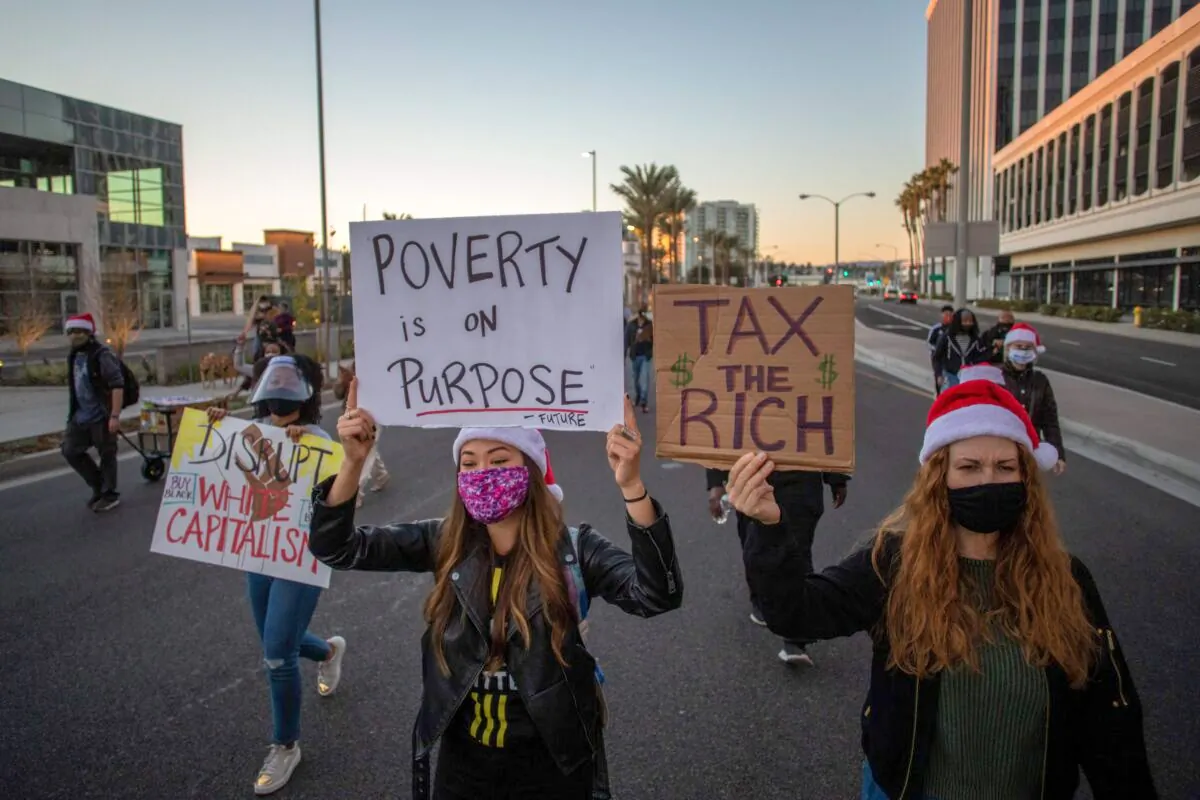
What are all these underperforming schools imparting to students? It appears as if too much time is spent on diluting subjects with a fixation on America’s flaws rather than its many virtues. An emphasis on diversity, equity, and inclusion minus intellectual diversity continues. Students are encouraged to ditch school and act as social justice warriors against capitalism, law enforcement agencies, and people of faith. Ironically, these “warriors” benefit from the blessings of the free market at the same time as they assail prosperity and ordered liberty.
Yet these developing minds don’t understand the nuances of domestic and foreign issues. If most adults have a tough time absorbing the complexities of issues, visualize the challenge this presents to students in the K–12 grades. Most well-funded protests are based on disinformation and passions rather than logical reasoning. When reporters ask the protesters about the meaning of their chants, most can’t deliver cogent reasons that pass the smell test. Perhaps they merely want to participate in the flavor-of-the-month demonstration.
Why are many college professors and public school teachers primarily pushing a socialist-leaning political agenda? Are they oblivious to the colossal contradictions and failures of Marxism for more than a century? Students shouldn’t be exposed to a particular agenda or be nudged to think a certain way. Students are supposed to learn critical thinking skills as they move through school and, in the higher grades, learn debating skills that cover the intricacies of specific issues from all perspectives.
Far too many “educators” and students believe that freedom includes infringing on the rights of the public. They occupy campus buildings, public spaces, and streets during protests that often devolve into violent confrontations. This is similar to shouting fire in a crowded theater when there is no fire or perhaps tilting at windmills. They ought to realize that liberty and security go hand in hand. You can’t have one without the other. What is a better type of activism?
Productive Activism
There is a better form of activism that hews much closer to America’s enduring facts and traditions that work for the greatest number of people. First, it’s unnecessary to promote a particular political agenda in the classroom, especially those that distort the truth by conflating American democracy with authoritarian governance systems. Students deserve a rigorous education that includes civics and moral education that doesn’t favor one religion over another. Moral education is universal in nature.
Next, reading, studying, working, and writing are positive forms of activism. Twelve years ago, Mississippi’s public education was ranked at the bottom nationally. In 2025, it had risen to 16th because of improved academic standards, teacher training, and the restoration of phonics (an early foundation of the science of reading) into elementary school. The Mississippi miracle didn’t occur in an instant, but required concerted efforts by districts, parents, students, and teachers. California schools could learn lessons about merit from this notable turnaround.
Third, although the First Amendment right to protest is protected, lawless bullying is not protected. Students at all levels must learn this clear distinction in order to develop character traits that lead to self-governance and personal responsibility for their behavior. Peaceful protests for an array of causes are often necessary in a pluralist democracy of competing interests. Indeed, more, not fewer, conversations are needed to resolve differences. It’s likely that our common humanity is greater than we think.
Instead of tearing down society, constructive activism seeks to strengthen the bonds that hold civilization together. The American Dream depends on it.
Views expressed in this article are the opinions of the author and do not necessarily reflect the views of The Epoch Times.
 Friends Read Free
Copy
Facebook
Tweet
Friends Read Free
Copy
Facebook
Tweet