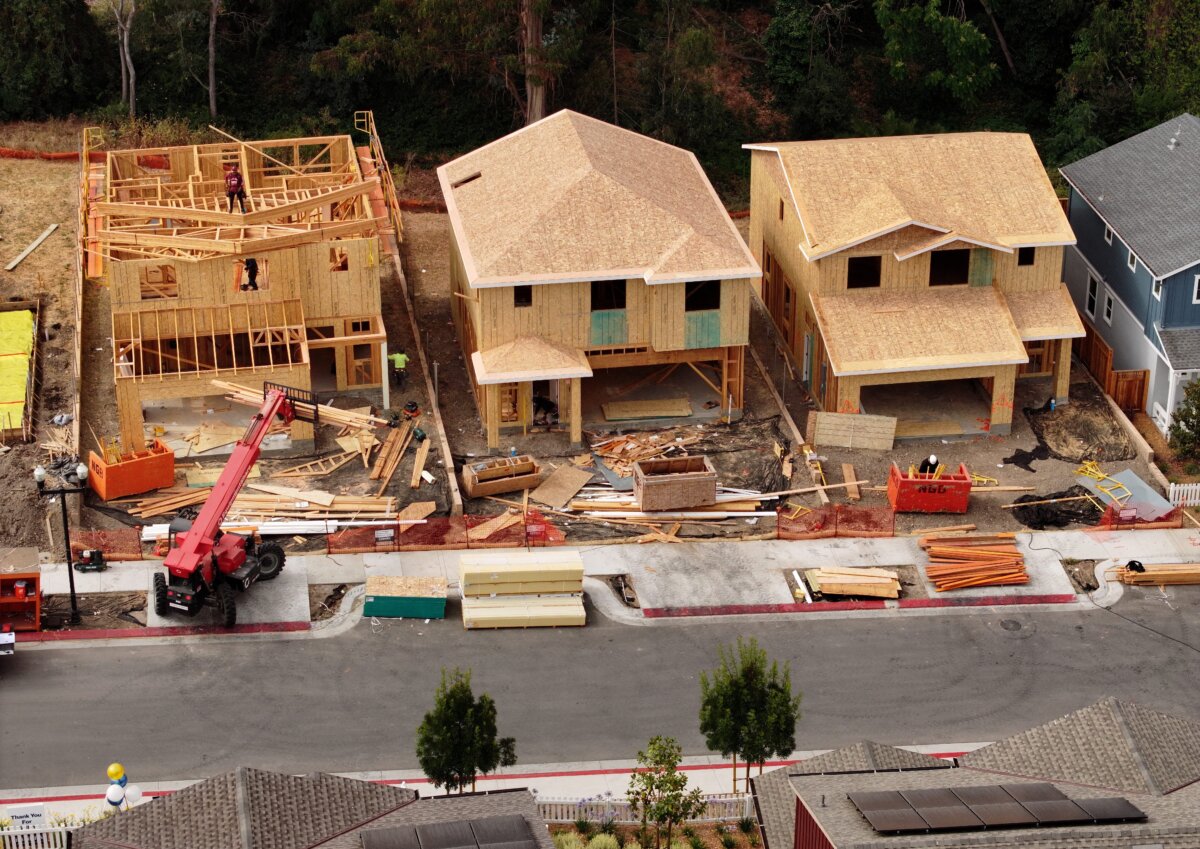

The relentless rise in America’s home prices appears to be cooling and even shifting into reverse in some markets due to new construction, but buying a home still remains out of reach for many households, analysts say.
According to a May 5 report by the U.S. Census Bureau, the median price for a new home came down this year, from $409,000 in February to $387,400 in March, a 5.3 percent decrease. The possibility of homeownership may be edging closer, but market watchers says prices are still too high for many Americans.
“Housing is becoming more affordable; however, it’s not affordable in absolute terms,” Bankrate Financial Analyst Stephen Kates told The Epoch Times. “We’re still miles away from a situation where a household on a median income can afford the median home.”
America’s housing markets feature a persistent gap between what sellers are asking and what buyers are willing or able to pay. Consequently, the U.S. housing market remains sluggish, with total annualized sales of 4.02 million units as of April, indicating no increase over April 2025, according to the National Association of Realtors.
This compares to a high of more than 6 million units sold in 2021 and annual sales levels above 5 million in the years prior to the pandemic. A 2025 report by Moody’s, a rating agency, stated that the last time supply and demand were roughly in balance in America’s housing market was between 2012 and 2018, with prices increasing 4.6 percent annually in those years. In 2021, prices spiked during the pandemic, rising more than 17 percent that year alone.
That, together with rising mortgage rates, put buying a new home beyond the means of many Americans. And while average prices now appear to be coming down slightly, a state-by-state analysis indicates sharp disparities among localities.
According to a May 11 report by Jason Sorens, an economist at the American Institute for Economic Research, Florida led the nation in the biggest price declines, with housing prices coming down 2.73 percent between the fourth quarter of 2024 and the fourth quarter of 2025. Montana, Colorado, West Virginia, and Idaho rounded out the top five with declines greater than 1 percent, followed by California and Texas, where house prices in each case fell by 0.83 percent.
By contrast, house prices rose the most in North Dakota (6.39 percent), followed by Illinois (6.09 percent), Wisconsin (5.66 percent), Michigan (5.48 percent), and New York (5.33 percent).
New Construction a Key Driver of Prices
In an apparent contradiction, many of the states with the sharpest home price increases are the ones that are rapidly losing population. New York, for example, lost more than 157,000 residents over the past year, according to an analysis of IRS data by Vote With Your Feet, an organization that tracks migration trends.
According to this analysis, Illinois lost more than 54,000 residents in that period. At the same time, Texas added more than 112,000 residents and Florida added more than 111,000, even as home prices fell.
However, market experts say that, in addition to migration trends, new construction was a key driver of home prices.
“Sunbelt locations like Texas, Florida, and Arizona built a lot of housing in the early 2020s,” Sorens told The Epoch Times.
“Zoning regulations are lighter there, and negative real interest rates made it easy for builders to finance new development. That’s where most of today’s price declines are.”
Florida, Texas, and Colorado “permitted anywhere from two to six times as many homes per capita” as New York, Illinois, and Michigan, Sorens said, adding that “in the Northeast especially, zoning regulations tend to be strict, and these places didn’t build much in the early 2020s.”
And while California has not experienced the building boom of Florida and Texas, outmigration from that state has brought housing prices down. Over the past year, California lost more than 200,000 residents, according to Vote With Your Feet.
Divergence Between New and Existing Homes
This disparity in new home construction has also led to a divergence in prices between new and existing homes and an anomalous situation where new houses are often cheaper than older houses.
“Builders are providing relatively juicy incentives to try to bring people to the table,” Kates said.
“They have inventory that they cannot carry for a lengthy period of time, so they’ll buy down interest rates, they’ll give cash incentives, they’ll give free upgrades on tiles in the kitchens or something like that,” he said. “Ultimately, they’ve got to move inventory, whereas existing home owners are sitting on top of a pretty enormous amount of home equity and some have time to wait.”
To put this shift in perspective, the average premium for a new house over an existing home across the past decade has been more than $50,000, according to the National Association of Home Builders.
The last time that existing homes priced above new homes was 1989.
However, the housing market is still dominated by existing homes, with new homes typically representing only about 10 percent to 15 percent of total sales, according to Trading Economics. And while the share of newly built homes is rising, the gap between supply and demand remains stark in the existing homes market.
In addition to sometimes having to accept lower prices for their homes, sellers are often reluctant to let go of the more affordable mortgages they hold, often below 3 percent, versus current rates above 6 percent. But a reckoning with lower prices, even for existing homes, may ultimately bring the market back into balance.
“In my estimation, new home prices are probably where the market really is,” Kates said. “Existing home prices are lagging due to a variety of factors, including the ability of many homeowners to just sit on their homes or the unwillingness to sell based on an anchored price that no longer meets reality.”
Government Plans to Increase Affordability
As affordability becomes a key campaign issue for the upcoming midterms, various government plans have been offered to bring down the cost of buying a house. President Donald Trump’s March 13 executive order calls for a reduction of environmental and permitting regulations in order to speed up construction and reduce building costs. It also directs government mortgage agencies, Fannie Mae and Freddie Mac, to buy $200 billion in mortgage-backed securities in an effort to lower mortgage rates.
Lastly, Trump is seeking to ban institutional investors from buying single family homes, in hopes of limiting competition for individual home buyers.
For their part, Democrats have proposed subsidies and incentives for building new homes, rolling back local zoning and permitting laws, banning institutional investors from buying homes, and providing down-payment subsidies for select buyers. Given the shortage of supply, however, some economists say the focus should be on building more houses rather than increasing the demand for them through subsidies, which they say will only drives prices up further.
“The key thing politicians usually get wrong is thinking that giving people money toward buying or renting housing makes it more affordable,” Sorens said.
“It does the opposite so long as supply is constrained, because it subsidizes demand,” he stated. “The only way to make housing more affordable in the long run is to make it more abundant, that is, easier and less costly to build.”
 Friends Read Free
Copy
Facebook
Tweet
Friends Read Free
Copy
Facebook
Tweet