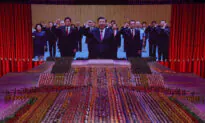
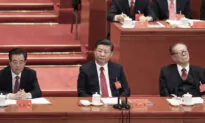
Former Chinese Communist Party head JiangZemin attends the closing session of the 18th National Congress on Nov. 14, 2012 in Beijing. during which Xi Jinping, who pursued members of Jiang's faction with corruption charges for 19 months, was voted Party

According to Shi, Wang was directly promoted by JiangZemin. However, after many members of Jiang’s faction were purged by Xi, the internal power struggle between Jiang and Xi have become more intense.
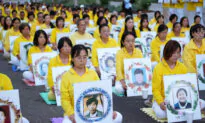
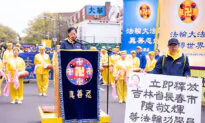
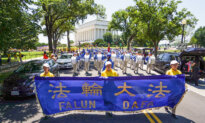
On July 20, 1999, former CCP leader JiangZemin began the persecution of Falun Gong when the number of Chinese people practicing had grown larger than the CCP, and while people were enthusiastically embracing it across China.
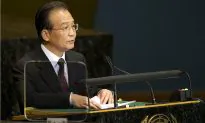
Wen, now 81, stepped down as premier in March 2013 and made his most recent public appearance in late 2022 when he attended the funeral of former CCP dictator JiangZemin.
After former party chief Hu Jintao came to power, Jiang interfered in Mr.
The former leader of the Chinese Communist Party (CCP), JiangZemin, came to consider the spiritual practice's popularity as a threat to the communist regime's atheist ideology.
Originating in mainland China in 1992, Falun Gong attracted some 70 million practitioners, according to CCP estimates, before former Chinese regime leader JiangZemin turned the party apparatus against the practice.
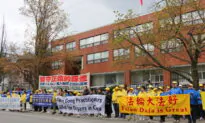
An Ottawa Falun Gong practitioner said she has been receiving harassment calls ever since the CCP began persecuting her faith in 1999, spearheaded by then-Party leader JiangZemin, now deceased.
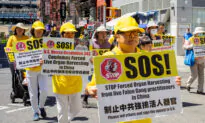
In 1999, JiangZemin initiated a nationwide campaign to defame Falun Gong and persecute Falun Gong practitioners. Practitioners subsequently suffered from harassment, illegal detention, and forced labor.
However, by 1999, JiangZemin—then leader of the Chinese Communist Party (CCP)—came to view Falun Gong’s moral teachings and growing popularity as a threat to the CCP's authoritarian, atheist rule, and launched a campaign of persecution to eradicate the
However, Falun Gong's widespread popularity was viewed as a threat to the totalitarian rule of the late CCP leader JiangZemin. In July 1999, he launched a far-reaching persecution campaign, vowing to "eradicate" the practice from China.
Fearful of the practice's surging popularity, then-Party boss JiangZemin ordered the eradication of Falun Gong in 1999, mobilizing the entire nation's public security organs to monitor and detain adherents.
The “Shanghai Gang,” or “Shanghai Clique,” is a name given to a group of CCP officials who rose to power through ties with former CCP leader JiangZemin, who was also the former mayor of Shanghai. Jiang is Xi's political rival.
Zeng, whose family owns Fantasia Holdings Group, a large property developer, was a close ally of former CCP general secretary JiangZemin. He was instrumental in helping Jiang hold onto power. For years, Mr.
The prologue sets the tone: This is an industrial-scale “kill-to-order” system enabled by the CCP’s persecution of Falun Gong since 1999, when Chinese leader JiangZemin labeled it an “evil cult” and vowed its elimination.
Official estimates put the number of adherents between 70 million and 100 million before the CCP, led by then-party head JiangZemin, launched a persecution campaign to "eradicate" Falun Gong in 1999.
The atheist communist regime, under then-Communist Party leader JiangZemin, initiated a sweeping campaign on July 20, 1999, aimed at eradicating Falun Gong, as it perceived the growing number of adherents as a threat to its authoritarian control.
The founder of Fantasia, Zeng Bao Bao, is the niece of former Vice President Zeng Qinghong, who, along with Zhou Yongkang were hardcore supporters of JiangZemin, known as the “Jiang faction.”
Commentary
Most Westerners know about JiangZemin through Robert Lawrence Kuhn’s biography “Man Who Changed China: The Life and Legacy of JiangZemin.” Now that Jiang is gone, it’s time to evaluate his legacy to see how he changed China.
In that time, Wang has risen to prominence as a close confident to the succession of China’s paramount leaders—the “Emperor’s Tutor” to General Secretaries JiangZemin, Hu Jintao, and now to Xi Jinping.