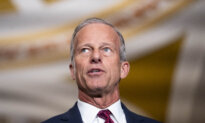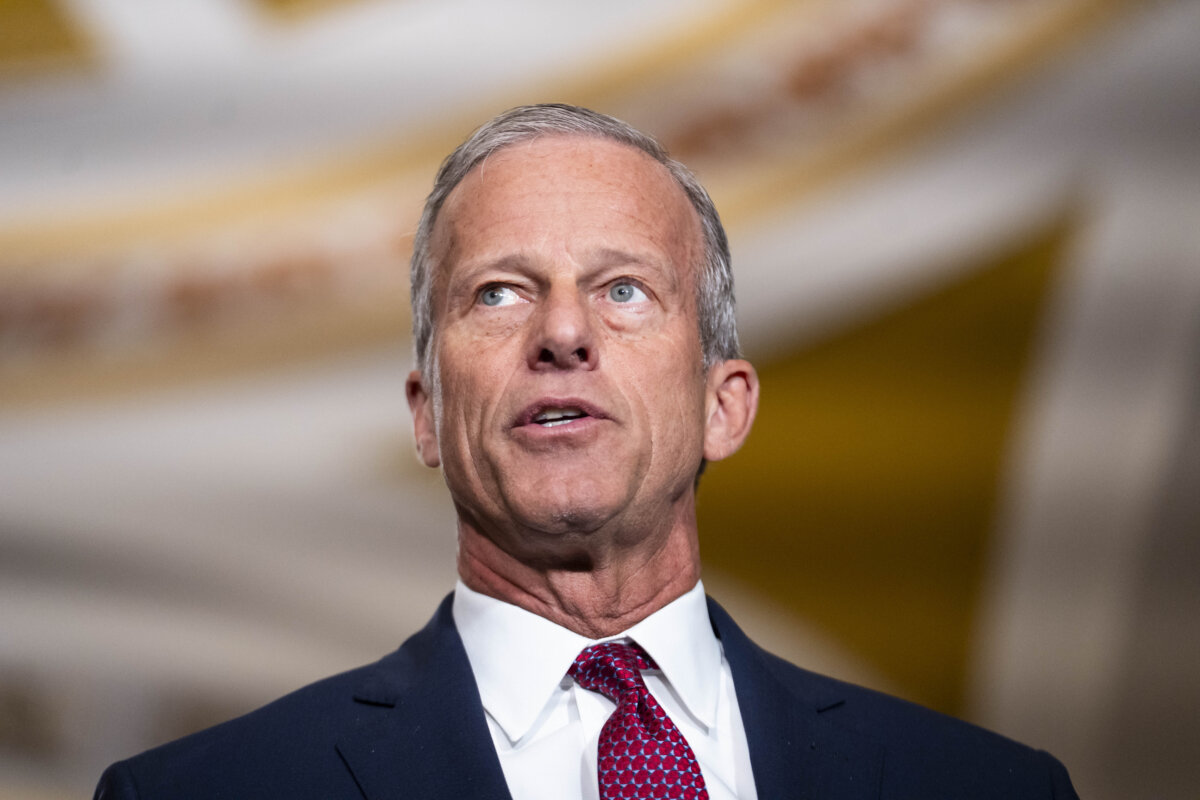

Senate Majority Leader John Thune (R-S.D.) revealed on July 23 that Iran was being added to a bipartisan Russia sanctions bill that was introduced earlier this month.
The sanctions bill, known as the Lindsey O. Graham Sanctioning Russia Act of 2026, was recently introduced in the Senate. The bill would impose tariffs on goods from the top five countries that purchase Russian oil, gas, and other exports. The legislation, which was first introduced last year, is intended to prevent Russia from continuing to fund its war against Ukraine using oil and gas sales.
The addition of Iran to the Russia sanctions bill was confirmed by Thune just days after President Donald Trump called for the Senate to add the regime to the legislation.
“It was a late add,” Thune told reporters on Thursday. “I think everybody’s fine with it because we would do it anyway. Iran sanctions is something we’ve had in place for the last 30 years.”
Thune told reporters that the Senate could pass the sanctions bill before the start of the Senate recess on Aug. 7.
“I’ve been having conversations with Democrats and folks on our side, and I think we’re homing in on it,” he said. “So I’m hoping we can get it teed up, and then if we could get some sort of limited time agreement to help expedite it on the floor, that would help too.”
A revised version of a sanctions bill on purchasers of Russian oil was introduced by a bipartisan group of lawmakers at a press conference on July 14. The group of lawmakers said the bill was a “tribute” to Sen. Lindsey Graham, who died on July 11. Graham introduced the original version of the Russia sanctions bill in April 2025, but it never made it past the Senate Banking, Housing, and Urban Affairs Committee.
Sen. Darline Graham (R-S.C.), who was appointed to replace her brother, Lindsey Graham, and Sen. Richard Blumenthal (D-Conn.) officially introduced the revised legislation as the Lindsey O. Graham Sanctioning Russia Act of 2026 on July 16.
The original version of the Russia sanctions bill was changed after some lawmakers expressed concerns that the sanctions included in the legislation were too broad and could cause economic harm to key U.S. allies. The Trump administration had also expressed concerns that the president needed flexibility to waive sanctions if it was in America’s best interest.
The updated bill narrowed the implementation of tariffs against the top five purchasers of Russian oil and natural gas. The sanctions would impose tariffs of up to 100 percent on those purchasers.
In a Truth Social post on July 19, Trump urged lawmakers to add Iran to the Russia sanctions bill.
“Republicans should add Iran to the Russian Sanctions Bill,” he wrote. “That’s what Lindsey wanted to do, and it was going to happen. IMPORTANT!!!”
In a statement on July 21, the office of Sen. Sheldon Whitehouse (D-R.I.) confirmed that the Russia sanctions bill had more than 60 cosponsors, ensuring that the legislation had enough votes to bypass the Senate filibuster.
“This forceful, bipartisan measure will disrupt the Kremlin’s massive oil and gas economy, up the financial stakes, and help achieve victory for Ukraine,” Whitehouse said.
Darline Graham, who was sworn in to replace her brother on July 14, said she looked forward to working with the Senate to pass the bill.
“Until the very day he passed, Lindsey remained focused on passing the Russia sanctions bill,” she said. “Passing this legislation would honor my brother’s steadfast commitment to our national security and it would provide President Trump with additional leverage to bring this war to an end.”
The inclusion of Iran in the sanctions bill came after the collapse of a memorandum of understanding between the United States and Iran. The two countries have exchanged strikes since early July, when Iran fired at commercial vessels in the Strait of Hormuz.
On Wednesday, U.S. Central Command announced that the U.S. military had carried out strikes against Iran for 12 consecutive days. In response to the U.S. military strikes, Iran launched attacks at U.S. bases in the Middle East, resulting in the deaths of four U.S. soldiers last weekend.
On July 23, Trump said he was considering a larger strike against Iran.
“I am considering a massive attack,” he told Axios. “Bigger than ever before. I am close to making a decision. We are all set for it.”
Jack Phillips contributed to this report.
 Friends Read Free
Copy
Facebook
Tweet
Friends Read Free
Copy
Facebook
Tweet