In the face of a crumbling financial kingdom, the CCP's then-ruling JiangZemin government set up four major asset management companies—Huarong Assets, Great Wall Assets, Orient Assets, and Cinda Assets—to address the bad debt crisis.
The Taiwan issue is much knottier than at any time since China and the United States established diplomatic relations; and it differs from terms of ex-leaders like Mao Zedong, Deng Xiaoping, JiangZemin, and Hu Jintao, said Guo on Jan. 29 on Elite Forum
Yet the then-Chinese leader JiangZemin, feeling threatened by its popularity, launched a massive campaign in July to persecute the practice and its adherents.
There he was received and welcomed by then-Chinese leader JiangZemin and then-Premier Li Peng.
"The special bromance between Chinese and Australian leaders was back on track.
But Chinese Communist Party leader JiangZemin believed that Falun Gong was a threat to the ideological control of his atheist regime. In July 1999, he ordered the practice “eradicated.”
“Xi Jinping Thought” is being taught as an economic blueprint for the country’s development, although the GDP grew much faster under previous leaders JiangZemin and Hu Jintao.
Bekri also actively participated in the campaign to persecute Falun Gong adherents initiated by former CCP paramount leader JiangZemin and his security czar Zhou Yongkang.
Feeling threatened by its popularity, China’s ruling Communist Party and its then-leader JiangZemin launched a persecution against Falun Gong in July 1999.
The previous Hu Jintao regime ended along with the influence of former leader JiangZemin. The political and business sectors entered a turbulent period of struggles between the old and new factions within the CCP.
While most inside and outside China reportedly believe that the persecution of Falun Gong began in reaction to the April 25 event in Beijing, Zheng argues that “from 1996 to 1999, years before the incident in Tianjin, the then-head of the CCP, JiangZemin
Then-CCP leader JiangZemin subsequently declared Wang a “guardian of the seawaters and airspace,” and CCP propaganda celebrated him as a “revolutionary martyr,” forever enshrining his actions in the cultural lexicon of Chinese communist tactics.
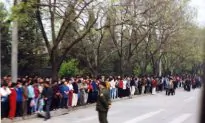
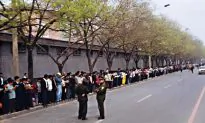
However, the act of mass appeal, although absolutely peaceful, sparked fear within the Chinese Communist Party (CCP), leading to a brutal campaign ordered by former Chinese leader JiangZemin.
Under the rule of then-Chinese Communist Party (CCP) leader JiangZemin, China launched a far-reaching campaign of persecution against the practice in 1999, which continues to this day.
Viewing the practice's popularity as a threat to the Party's power, then-leader JiangZemin ordered a brutal nationwide campaign of suppression that continues to today.
In later years, top Chinese leaders visited Renmin University multiple times, including JiangZemin, Hu Jintao, and Xi Jinping.
Xi visited the university five times in 2005, 2006, 2009, 2012, and 2022.
(Sergei Karpukhin/Reuters)
Former Chinese Communist Party (CCP) leader JiangZemin signed a treaty with Russian President Vladamir Putin in 2001 titled "Sino-Russian Treaty of Good-Neighborliness, Friendship and Cooperation."
Tung by late CCP leader JiangZemin, who initiated the persecution of Falun Gong.
Former Hong Kong Chief Executive Tung Chee-hwa attends a closing session in Beijing, on March 20, 2018.
However, former Chinese leader JiangZemin saw Falun Gong's popularity as a threat to the communist regime's totalitarian rule, and pledged to eradicate the practice in the country.
As early as 1998, former CCP leader JiangZemin came up with the policy of "nipping all instabilities in the bud." This policy has been enforced for more than 20 years. But why did it fail this time?
Hui is known to have close ties with Zeng Qinghong, former vice chair and a member of a political faction loyal to the late former CCP leader JiangZemin.
Additionally, Mr.
Posters Exposed 'Lies of the CCP' About Falun Gong
Tsang's posters, pictured in the courtroom, showed how the former CCP regime head JiangZemin staged the "Tiananmen self-immolation" incident in 2001 to smear Falun Gong.
He said, “SIBP’s party secretary was [a] schoolmate of JiangZemin [former Chinese leader] ... no one dared to touch the case.”
When Henan was engaged in the plasma economy, the party chief of Henan was Li Changchun, succeeded by Li Keqiang.
Bai said that during his tenure, then-CCP leader JiangZemin, responsible for launching the persecution against Falun Gong, personally ordered the organ harvesting of practitioners.
The title “core” was also given to former CCP leaders JiangZemin and Deng Xiaoping. Jiang continues to have influence over major issues in the CCP's domestic and foreign affairs.
The labor camp had two separate male sections and one female section, but was expanded in 1999 to imprison Falun Gong practitioners when former CCP leader JiangZemin ordered the nationwide massive suppression of the spiritual practice.
JiangZemin, then head of the Chinese Communist Party (CCP), perceived the popularity of Falun Gong—a spiritual practice with meditative exercises and teachings based on the tenets of truthfulness, compassion, and forbearance that had around 70 million
At the end of 2021, Xi replaced Xinjiang’s communist party chief with one of his cronies, Ma Xingrui, after the faction of his opponent, JiangZemin, had controlled the autonomous region for nearly three decades.
Originating in China in 1992, Falun Gong attracted some 70 million practitioners, according to official estimates, before former Chinese regime leader JiangZemin turned the party apparatus against the practice.