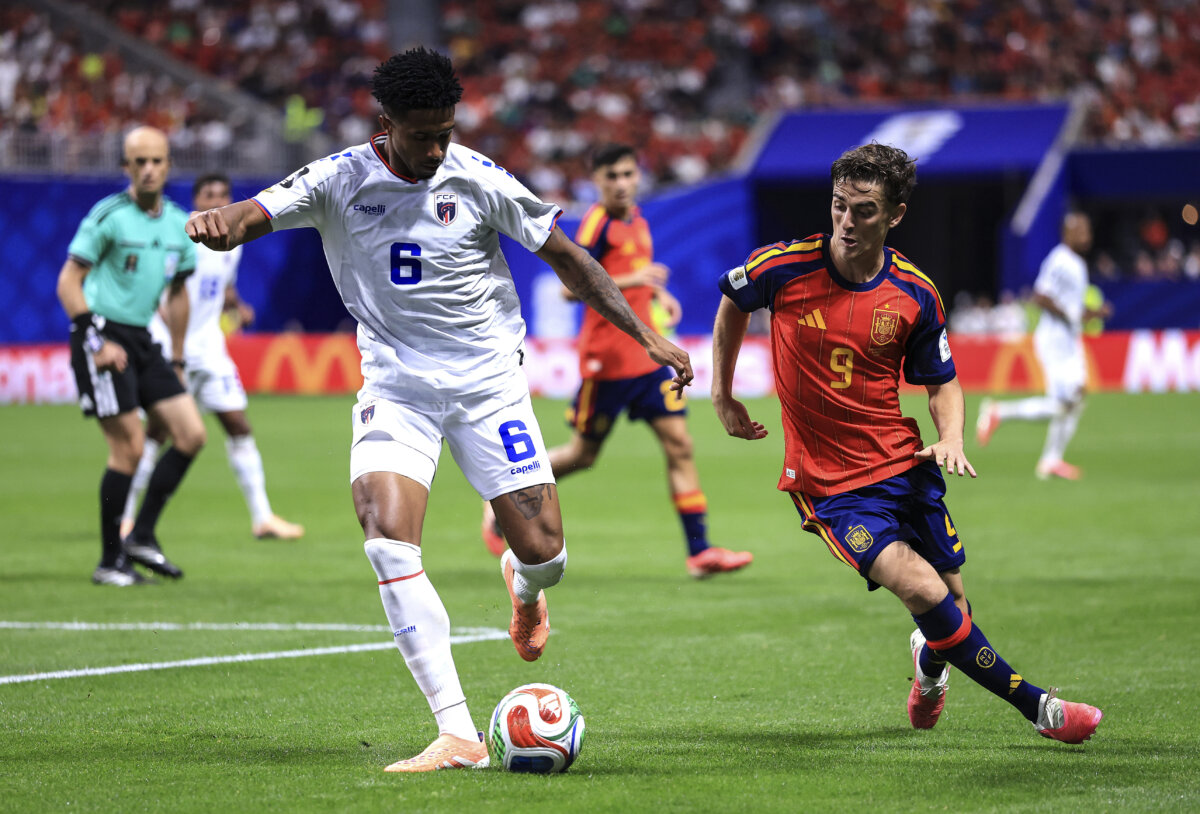

It was a most unusual day in World Cup play on Monday, and it has been part of a trend in the early going of the worldwide soccer tournament.
For the first time in 68 years, four matches in the World Cup ended in ties. It started with No. 67 Cape Verde’s stunning 0–0 draw against No. 2 Spain for Group H play in Atlanta.
Considered a massive upset despite being a tie, Cape Verde’s scoreless deadlock marked one of several upsets as ties thus far in the World Cup. Half of the first 16 matches have actually ended in ties, and two others before Monday are considered significant upsets, based on world rankings.
No. 56 Qatar drew 1–1 with No. 19 Switzerland in Group B play on June 13 in San Francisco. Similarly, No. 64 Bosnia surprised No. 30 Canada with a 1–1 tie on June 12 in Toronto.
Other ties before Monday didn’t reach the same pitch of upset worthiness, but lower-ranked teams nonetheless made waves with draws. No. 18 Japan tied No. 8 Netherlands 2–2 for Group F play in Dallas on Sunday. No. 7 Morocco and No. 6 Brazil played to a 1–1 draw on June 13 in New York for Group C play.
As for Monday’s upsets, the other three besides Spain-Cape Verde featured significantly lower-ranked teams coming through with draws. No. 85 New Zealand played No. 20 Iran to a 2–2 draw in Group G play at Los Angeles. No. 61 Saudi Arabia had a 1–1 draw with No. 16 Uruguay for Group H play in Miami. No. 29 Egypt posted a 1–1 tie with No. 9 Belgium for Group G play in Seattle.
While the ranking distance in many of these ties is quite notable, there has been one upset where a significantly lower-ranked team won a match. That’s No. 33 Ivory Coast, which stunned No. 23 Ecuador 1–0 on Sunday for Group E play in Philadelphia.
As for the four-tie Monday, that volume of ties last occurred during the 1958 World Cup in Sweden. That was on June 15, 1958, according to OptaStats.
On that day, West Germany tied Northern Ireland 2–2, Paraguay tied Yugoslavia 3–3, Sweden tied Wales 0–0, and England tied Austria 2–2. Those weren’t the only matches on that day, and the rest of the games ended in win-loss decisions, which included Czechoslovakia’s 6–1 win over Argentina and Brazil’s 2–0 victory over the Soviet Union.
The United States did not compete in that tournament, but it hosted the last World Cup to feature at least three ties in a day. That occurred in 1994, when three matches ended in a tie on June 28. Brazil tied Sweden 1–1, Italy tied Mexico 1–1, and Ireland tied Norway 0–0.
While historically unique, Monday’s ties created urgency in the teams’ respective groups. All four teams in Groups B, G, and H acquired draws in their first outing, and two teams have draws in Groups C and F.
Four more Groups have yet to play matches through Monday, which means more of the 48-team field could potentially get knotted up with more ties. Meanwhile, wins become premium for Groups B, G, and H with only two matches remaining per team. As for Groups C and F, little room for error remains for the team with draws since there are only two more chances to collect at least a win.
Teams with 1–1–1 marks likely can advance, and a 1–0–2 record is also doable for advancing. Spain, Brazil, and Morocco have the most at stake as three of the top-10 teams in the world.
While Spain is tied up with four teams drawing ties in Group H, Spain sits behind Uruguay and Saudi Arabia because of no goals scored. Similarly, Brazil and Morocco fell behind in the Group C standings with a goal allowed apiece. More so, Scotland, making its first World Cup appearance since 1998, beat Haiti 1–0 in Group C play to take the lead in the standings at the moment.
 Friends Read Free
Copy
Facebook
Tweet
Friends Read Free
Copy
Facebook
Tweet