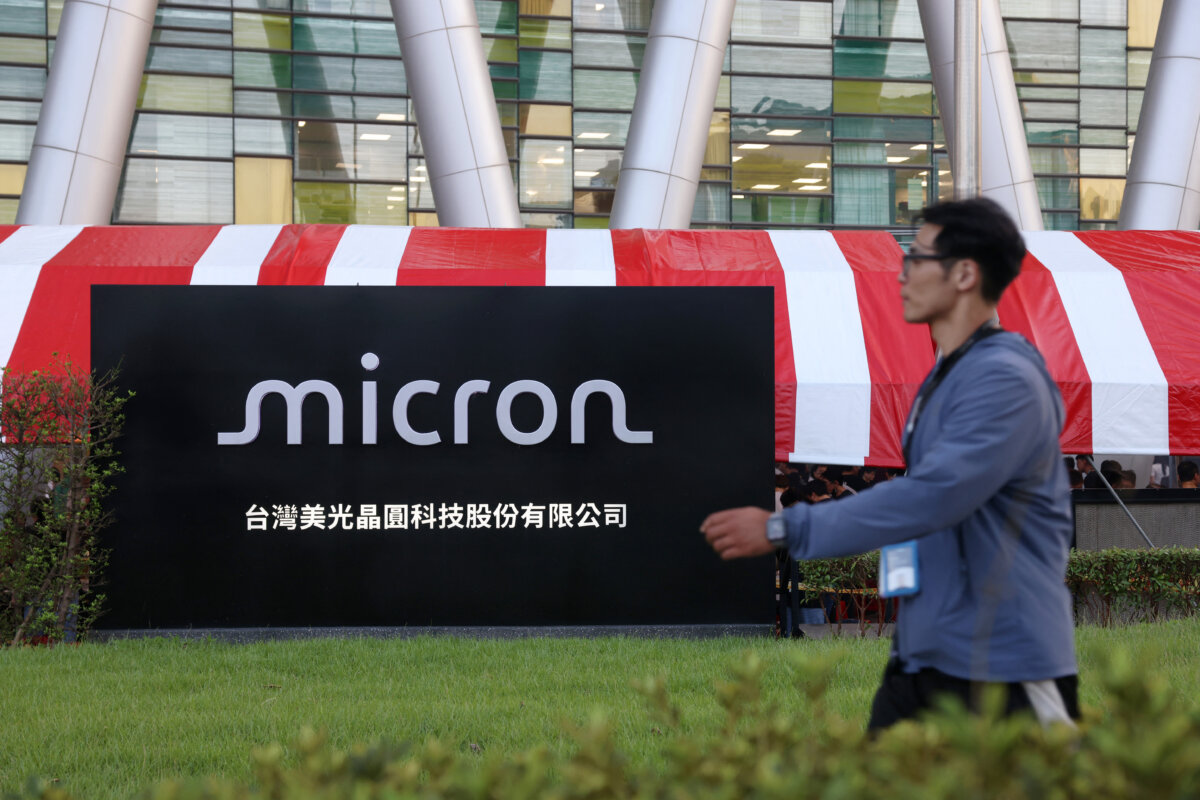

Workers at U.S. memory chip maker Micron Technology’s plant in Taoyuan, Taiwan, have secured the authorization to go on strike, raising the risk of labor disruption on the island, the company’s largest production base.
The vote comes as voracious demand for artificial intelligence servers has left memory chips in short supply worldwide. Strikes are uncommon in Taiwan’s chip industry.
The plant’s union announced on Oct. 7 that 1,994 of its 2,258 eligible members voted in favor of a strike by ballot, according to Taiwan’s Central News Agency (CNA). That was 99 percent of the 2,012 votes cast. Under Taiwanese law, a strike needs approval from more than half of all union members.
The union wants Micron to give employees 15 percent of its operating profit through a permanent plan, rather than just offering one-time bonuses, CNA reported.
Micron said in a statement that it fully respects employees’ legal rights, has heard their concerns, and will continue to negotiate with its unions in good faith.
Taiwan’s Ministry of Labor said it respected the vote for a strike and urged Micron to offer clear proposals to resolve the dispute.
Stakes for AI
Micron makes about 50 to 60 percent of its chips in Taiwan. It is also the only U.S.-based company that makes high-bandwidth memory (HBM), the stacked chips used in AI processors.
HBM is made in the same factories and on the same silicon wafers as the dynamic random-access memory (DRAM) used in phones and laptops. Making a gigabyte of HBM requires about four times as much factory space as making a gigabyte of standard DRAM, according to a September report by the Center for Strategic and International Studies.
As memory makers chase AI orders, less capacity is left for phones and computers. The resulting shortage has dramatically raised the price for regular computer products.
Apple, for one, raised Mac and iPad prices in June. In July, then-CEO Tim Cook said in an Apple earnings call that the company was facing a “100-year flood” in memory pricing.
Micron’s Taoyuan fab mainly produces standard DRAM. The bigger challenge may be in Taichung, where Micron’s largest Taiwan site is located. About 11,000 of roughly 12,300 workers there belong to a different union, which could also vote to strike if mediation fails, according to CNA. A second advanced packaging plant in Taichung is set to start HBM production in mid-October.
Micron says the squeeze is not easing. Its Taiwan executives said on Oct. 1 that memory supply in 2027 and 2028 would be even tighter than this year, and most of next year’s HBM output is already sold.
When asked about Chinese rivals expanding capacity, Micron Taiwan Chairman Lu Donghui said the company takes all competitors seriously, CNA reported. He added that Micron is also building U.S. plants to be close to its main AI customers.
The Bonus Gap
Micron’s record earnings show how much money is at stake. The company reported $99.3 billion in operating income for fiscal 2026, which ended Sept. 3. Fifteen percent of that is about $14.9 billion.
Micron has already announced its largest payout ever. Taiwan production workers will receive rewards equivalent to 35 to 68 months’ pay for fiscal 2026, including a cash bonus of 1 million New Taiwan dollars (about $31,500), according to CNA.
The union says the largest rewards still go to the company’s top executives. Citing company filings, it said the chief executive received 83,015 restricted shares in fiscal 2025, which is about 400 times the average employee grant, according to Taiwan’s United Daily News.
Profit sharing would not be new at Micron, the union says, noting that the company once paid quarterly bonuses worth 10 percent of net income, CNA reported. The union also cites Samsung Electronics, which averted an 18-day strike in May by setting aside 10.5 percent of its chip division’s operating profit for bonuses, according to the Taipei Times.
Waiting on the Board
The union has not set a strike date. It is waiting for the results of Micron’s board meeting on Oct. 8 and 9, U.S. time, after which it may notify members via text message of a surprise strike, leaving the company no time to prepare, according to the CNA report.
Both unions plan to hold a rally in Taipei on Oct. 19, and the Taichung union will return to mediation on Oct. 22.
Jerry Lin, the Taoyuan union’s chairman, said Micron should present concrete proposals out of the board meeting before the union takes further action.
 Friends Read Free
Copy
Facebook
Tweet
Friends Read Free
Copy
Facebook
Tweet