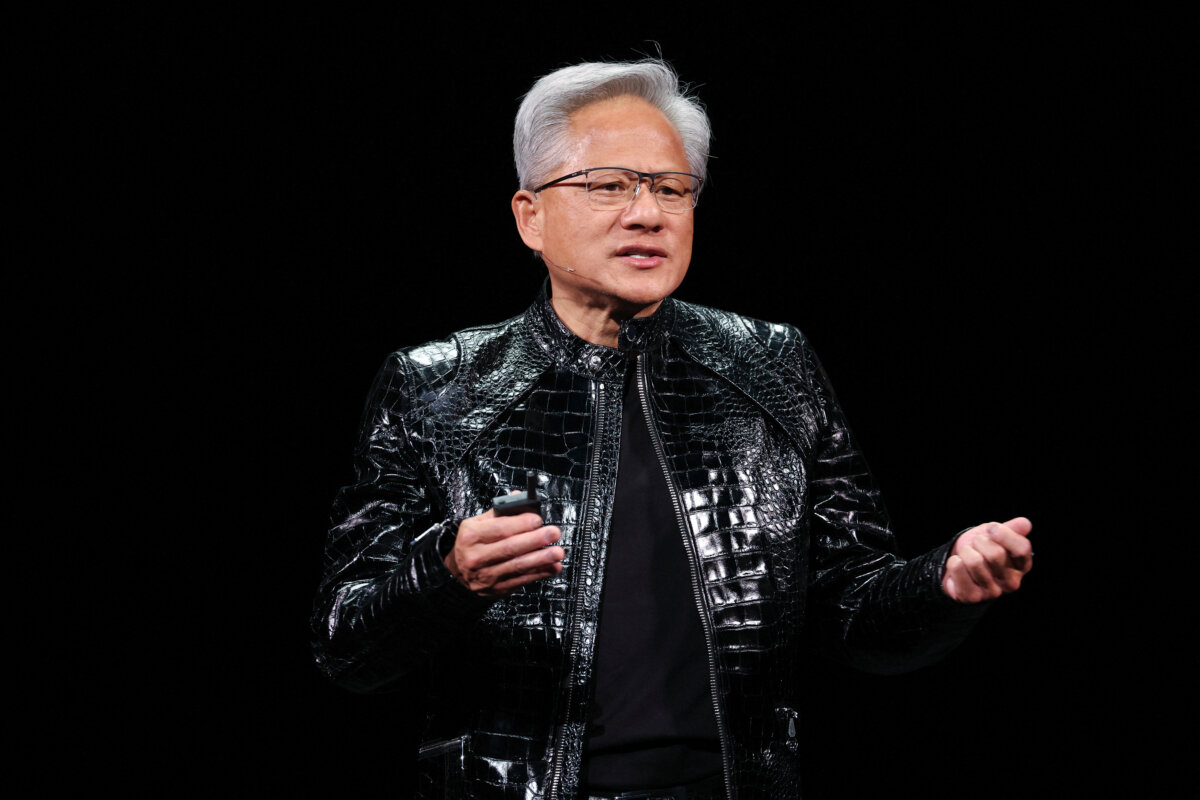

The next generation of Nvidia’s artificial intelligence chips has entered full production, CEO Jensen Huang announced on Jan. 5.
Speaking at the Consumer Electronics Show (CES) in Las Vegas, Huang said the new platform, known as Vera Rubin, could deliver five times the AI computing performance of Nvidia’s previous generation when running chatbots and other AI applications.
“Today, I can tell you that Vera Rubin is in full production,” Huang said during his keynote address.
Nvidia’s chip roadmap is unfolding against the backdrop of increasingly complex U.S. export controls on advanced AI technologies destined for China.
Huang used his CES appearance to present a video outlining the architecture of the Vera Rubin system, which combines new central processing units, graphics processing units, and networking technologies into a tightly integrated computing platform.
According to the video shown on Jan. 5, “Vera, a custom-designed CPU, doubles the performance of the previous generation.”
It said the Rubin graphics processing unit (GPU) and Vera CPU, Nvidia’s custom-designed central processing unit, were “co-designed from the start to bidirectionally and coherently share data faster and with lower latency.”
The video described how 17,000 components are assembled onto a single Vera Rubin compute board using high-speed robotic systems that place parts with micron-level precision.
The final assembly includes one Vera CPU and two Reuben GPUs capable of delivering 100 petaflops of AI performance, which the company said is five times that of its predecessor.
The presentation also highlighted Nvidia’s emphasis on data movement, a critical bottleneck in large-scale AI systems.
“AI needs data fast,” the video stated, adding that ConnectX-9 networking technology delivers 1.6 terabits per second of scale-out bandwidth to each GPU.
BlueField-4 data processing units are used to offload storage and security tasks, allowing computing resources to remain focused on AI workloads, the video said.
It added that the Vera Rubin compute tray was redesigned to operate without cables, hoses, or fans, incorporating BlueField-4 DPUs, eight ConnectX-9 network interface cards, two Vera CPUs, and four Rubin GPUs as the core building block of what Nvidia calls the Vera Rubin AI supercomputer.
Scaling Up AI Systems
The video presentation also introduced what Nvidia described as its sixth-generation NVLink switch, which can move more data than the global internet and connect 18 compute nodes, scaling up to 72 Rubin GPUs operating as a single system.
It further highlighted Spectrum-X Ethernet Photonics, which Nvidia called the world’s first Ethernet switch with 512 lanes of 200-gigabit co-packaged optics, designed to scale thousands of racks into what the company refers to as an “AI factory.”
The video said the Vera Rubin platform represented the result of 15,000 engineer-years of work since the design process began. It described the first Vera Rubin NVL72 rack as comprising six chips, 18 compute trays, nine NVLink switch trays, and 220 trillion transistors, weighing nearly two tons.
“One giant leap to the next frontier of AI,” the video concluded. “Rubin is here.”
Proprietary Data Formats and Performance Gains
Huang said Nvidia achieved the performance leap in part by relying on a proprietary data format that the company hopes will gain broader industry adoption.
“This is how we were able to deliver such a gigantic step up in performance, even though we only have 1.6 times the number of transistors,” Huang said on Jan. 5.
Much of Huang’s speech focused on how the new chips would perform in generative AI applications, particularly chatbots.
He said Nvidia had added a new storage layer called “context memory store,” designed to help AI systems respond more quickly to long prompts and extended conversations.
Export Controls and China Sales
Nvidia’s current Blackwell line represents its latest generation of AI chips, and the company plans to release the more advanced Rubin AI chip next year. Neither Blackwell nor Rubin chips are approved for export to China under existing U.S. rules.
Chinese companies currently rely on Nvidia’s H20 chip for AI workloads. The Trump administration briefly considered banning H20 exports to China in April before reversing course. President Donald Trump floated the idea of requiring 15 percent of H20 sales to be paid to the United States, though that proposal was not implemented.
White House press secretary Karoline Leavitt said during a Dec. 11 briefing that plans to sell Nvidia’s H200 chips to Chinese customers were consistent with national security policy and export controls.
“The administration continues to maintain a strict export control regime, and we are ensuring that Blackwell chip and other advanced technologies stay right here in America,” Leavitt said.
“And these H200 chips will only be sent to China after undergoing a security inspection here in the United States.”
President Donald Trump said on Dec. 8 in a post on Truth Social that he would approve sales of Nvidia’s H200 chips to “approved customers” in China.
The decision has drawn scrutiny from U.S. lawmakers concerned about the national security implications of exporting advanced AI technology.
On Dec. 22, Sen. Elizabeth Warren (D-Mass.), the ranking Democrat on the Senate Banking, Housing, and Urban Affairs Committee, and Rep. Gregory Meeks (D-N.Y.), the top Democrat on the House Foreign Affairs Committee, sent a letter to Commerce Department official Jeffrey Kessler seeking details about the administration’s reversal on AI chip export controls to China.
The lawmakers said Congress had oversight authority over export control decisions and requested clarification on how the approval aligned with existing restrictions.
 Friends Read Free
Copy
Facebook
Tweet
Friends Read Free
Copy
Facebook
Tweet