
The jury began deliberations Thursday in a high-profile Texas Antifa trial, after nearly three weeks of federal evidence.
The government alleges that an Antifa cell launched a coordinated attack against the Prairieland Immigration and Customs Enforcement (ICE) facility outside Dallas on July 4, 2025. The facility housed illegal immigrants. One officer was shot in the neck.
The nine defendants in the case have pleaded not guilty in the case being tried in the U.S. District Court for the Northern District of Texas in Fort Worth.
Here are the key points about the case.
Groundbreaking Trial
Members of the left-wing extremist group Antifa, short for “anti-fascist,” have not faced terrorism-related charges until now. They have been involved in nationwide protests that have, at times, turned violent.
The trial follows President Donald Trump’s executive order on Sept. 22, 2025, designating Antifa as a domestic terrorist organization.
FBI Director Kash Patel highlighted the historic development in an October 2025 X post: “First time ever: the FBI arrested Antifa-aligned anarchist violent extremists and terrorism charges have been brought for the July 4 Prairieland ICE attack in Texas.”
Several witnesses, whom the government identified as members of the Antifa cell, testified against the defendants after signing plea deals with federal prosecutors.
Cooperating witnesses were key for identifying defendants at the scene, as all protesters wore black bloc—Antifa’s hallmark black clothing and face coverings.
Several of the cooperating witnesses testified that defendant Benjamin Song was the shooter. Others told the jury about picking him up after he hid in a wooded area near the immigration facility after the shooting, and helping him hide from police.
Song told some group members to bring rifles to the ICE protest, saying, “because I’m not going to jail,” according to a prosecution witness.
The government alleged that Song shot at police and detention officers 11 times before his rifle jammed. Song and others allegedly planned an ambush that night, and Song was accused of seeking conflict.
No Defense Witnesses
Defense attorneys, who rested their case unexpectedly on March 10, argued that the government’s claims lacked substance.
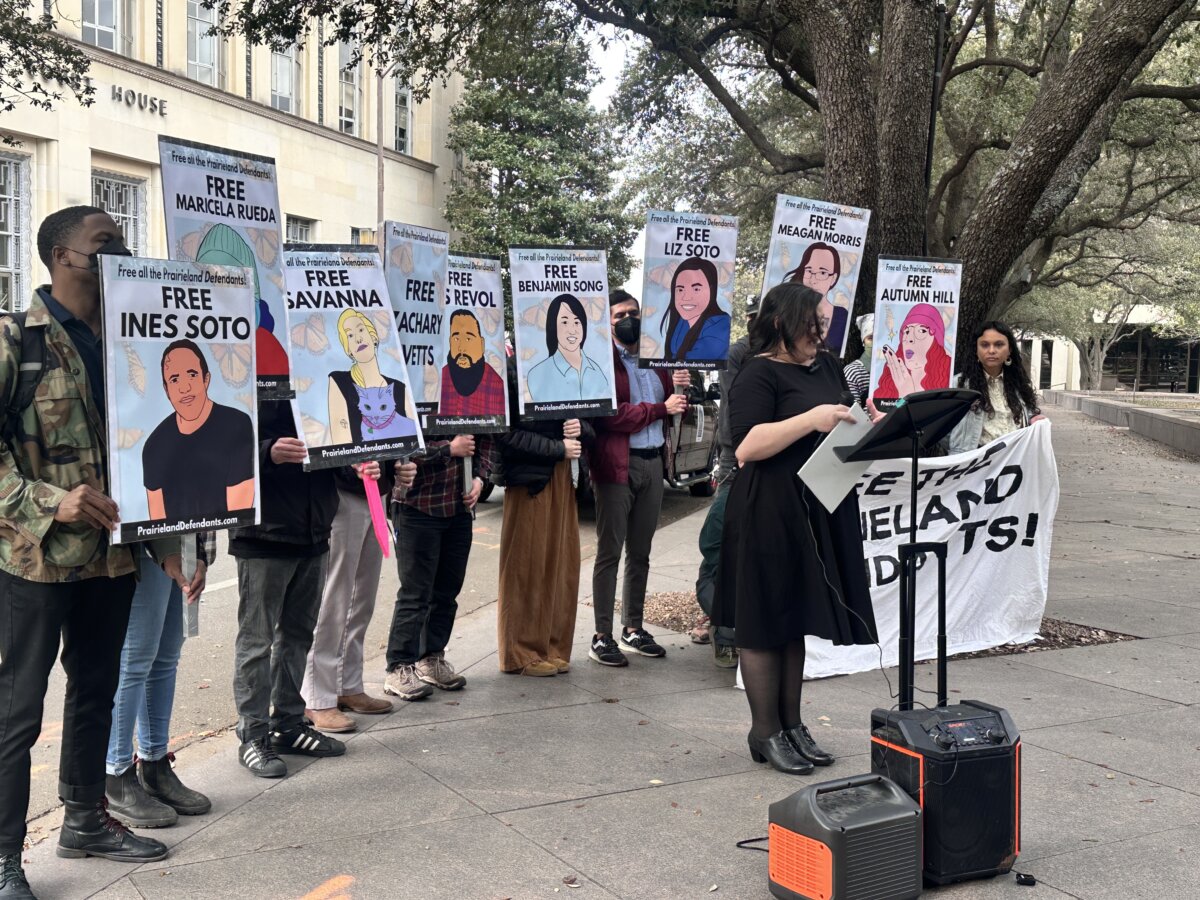
Cameron Arnold (also known as Autumn Hill), Zachary Evetts, Bradford Morris (also known as Meagan Morris), Maricela Rueda, and Song face the most serious charges of attempted murder, discharging a firearm during a crime of violence, and providing material support to terrorists.
If convicted, Arnold, Song, Evetts, Morris, and Rueda each face a minimum penalty of 10 years in federal prison and a maximum penalty of life, according to the U.S. Attorney’s Office.
Other defendants facing lesser charges include Savanna Batten, Elizabeth Soto, Ines Soto, and Daniel Rolando Sanchez-Estrada.
Defense attorney Cody Cofer indicated that the defendants’ attorneys didn’t need to call defense witnesses because the government failed to prove its case.
“Some of you looked really surprised when the defense rested,” Cofer said during closing arguments.
Defense attorneys argued that the government’s ambush claim was weak, saying that no shots were fired at officers who came out of the immigration facility to investigate noises.
Song’s attorney Phillip Hayes said during closing arguments that there was “no call for arms” until after the police lieutenant arrived at the scene and pulled his gun.
Witnesses described Song, the alleged shooter, as shouting, “Get to the rifles,” before gunfire erupted.
Hayes said no shots were fired until after the officer pointed a gun at the back of a fleeing comrade.
“What happened on July 4 was a tragedy, honestly,” Hayes said.
Inside Texas Antifa
Cooperating witnesses, whom the government identified as Antifa, said Dallas-area members considered themselves victims of society or those who wanted to protect “marginalized” people.
Their shared beliefs drew them together. They supported LGBT and minority rights and see illegal immigrants as a marginalized group.
They preferred identifying themselves as anti-fascists or socialists rather than Antifa.
Antifa is modeled after a violent arm of the Communist Party of Germany in the 1930s. It is a loose group of leftists operating under one banner, according to an expert on extremist groups who testified for the government.
Group members testified that they hung out at the “big gay house” in Dallas, where transgender defendants Morris and Hill lived with others.
They would hold karaoke nights and recite poetry on Thursday nights, according to testimony.
Defendants attended monthly meetings at the Emma Goldman Book Club. There, they discussed articles, book excerpts, and self-published materials called zines with an anti-capitalist, anti-government perspective.
Goldman, the book club’s namesake, was a Russian-born Jew and revolutionary who advanced an anti-capitalist, anarchist ideology in the United States in the early 1900s until she was deported.
At the discussions, minorities and women were deferred to when speaking, because white people already “took up too much space,” according to testimony.
The defendants formed close-knit “affinity groups” that participated in “direct action” protests.
Direct action campaigns aim to stop government policies that the group opposes. According to an expert government witness, they can involve bombings and prison breaks to foment insurrection, which could eventually spark a revolution.
Most of the defendants were members of the far-left Socialist Rifle Association.
They described practicing shooting together at an outdoor range in Ferris, Texas, before the July 2025 ICE protest, targeting images depicting the Ku Klux Klan.
Transgender Connection
According to testimony, Antifa supports those who have been bullied or ostracized or are part of a minority group.
Two of the Antifa defendants, Morris and Hill, are transgender. Some witnesses said Song used “they” pronouns. Others were gay.
Meanwhile, protestors dressed in Antifa’s signature black bloc clothing have also shown up at rallies against transitioning children in Texas and beyond.
The ties between Antifa and transgender individuals were scrutinized more closely after conservative influencer Charlie Kirk’s assassination last September.
The accused shooter, Tyler Robinson, was romantically involved with a transgender partner.
A cartridge from a rifle allegedly tied to Kirk’s shooting held the message “Hey fascist! Catch!”
 Friends Read Free
Copy
Facebook
Tweet
Friends Read Free
Copy
Facebook
Tweet