



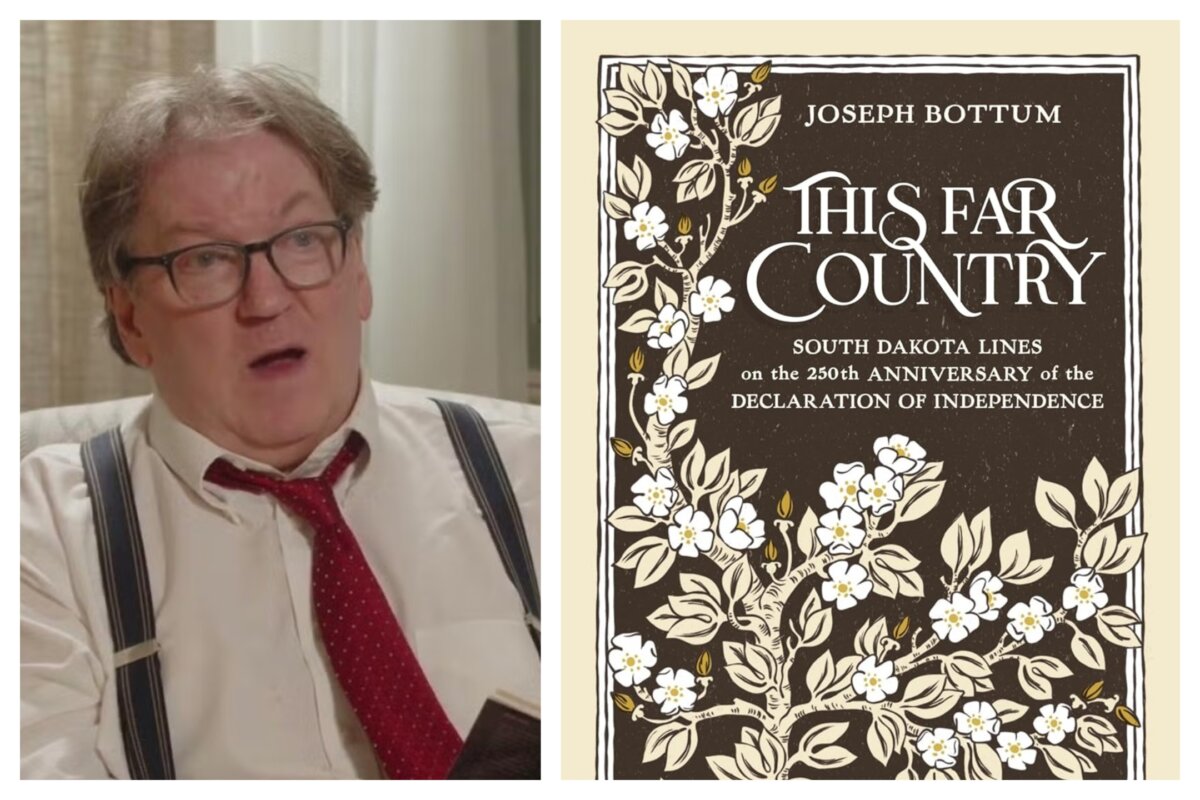
Unlike the flood of poets in public positions who focus on identity politics and are critical of our nation’s founding values, Joseph Bottum stands apart as a voice for America.
A bestselling author, he’s probably best known for his sociological study “An Anxious Age,” in which he diagnoses the scramble for moral purpose that has followed from the collapse of America’s Protestant churchgoing tradition.
Bottum’s poetry serves as a partial antidote to this crisis. While art can’t fill every void or solve the national debt, it can speak to our larger spiritual yearnings.
A Poem for the Ages—Literally
That vision is on display in “This Far Country: South Dakota Lines on the 250th Anniversary of the Declaration of Independence,” a work commissioned and published by the South Dakota Historical Society Press. The book itself is beautifully produced, featuring woodcut-style illustrations by Jeanne Bowman that accompany the poems.
Notably, “This Far Country” is among the objects selected for inclusion in the America 250 Time Capsule, to be buried in Philadelphia on July 4, 2026 and remain sealed until 2276. Each state is allowed a small box in the capsule’s limited space. It speaks to the good judgment of South Dakotans that—among so many possible submissions—they chose a poet to represent them.
Though described as an “epic poem,” Bottum’s work is—unlike Homer or Dante—quite short. At only 25 pages, it can easily be read in one sitting. Technically, it’s more a collection of bucolic odes in praise of South Dakota’s symbols. Where the epic quality comes in is how it connects these local themes with a broader vision of national destiny.
 South Dakota reveals its logo to celebrate the 250th anniversary of America’s founding. (Courtesy of South Dakota State Historical Press)
A Poetic Bird but Not a State Bird
Literary works delegated by committees have a tendency to be dull and uninspired. Recitations at presidential inaugurations come to mind.
“This Far Country” escapes this trap. It is, in fact, the only commissioned poem I have ever read that is first-rate. Bottum’s verse strikes just the right balance: sophisticated but approachable. It’s structured in subtle ways and is also easy to understand. It opens with a piece in praise of the meadowlark. The first stanza reads:
Springing like daybreak in fields by the river—
The Lac qui Parle River that begs from the dawn
Arrows of sunlight in quivering morning—
An effortless meadowlark sings to the fawn,
Sings to the chipmunks on chokecherry branches,
Sings to the scurrying squirrels on the lawn,
Sings of impossible love to the new day,
Sings to the mallard and trumpeter swan.
Through the repetition of “sings” in the last four lines (a memorable device with the unmemorable name “anaphora”), a theme unfurls across the next four stanzas. The meadowlark becomes an “unruffled, unflustered” symbol of life and freedom. It’s quieter than sparklers and monuments, but more enduring.
As I discovered after reading this, the Western Meadowlark is the state bird of North Dakota (and five other states), but not its southern neighbor. South Dakota’s official bird is the Chinese Ring-necked Pheasant.
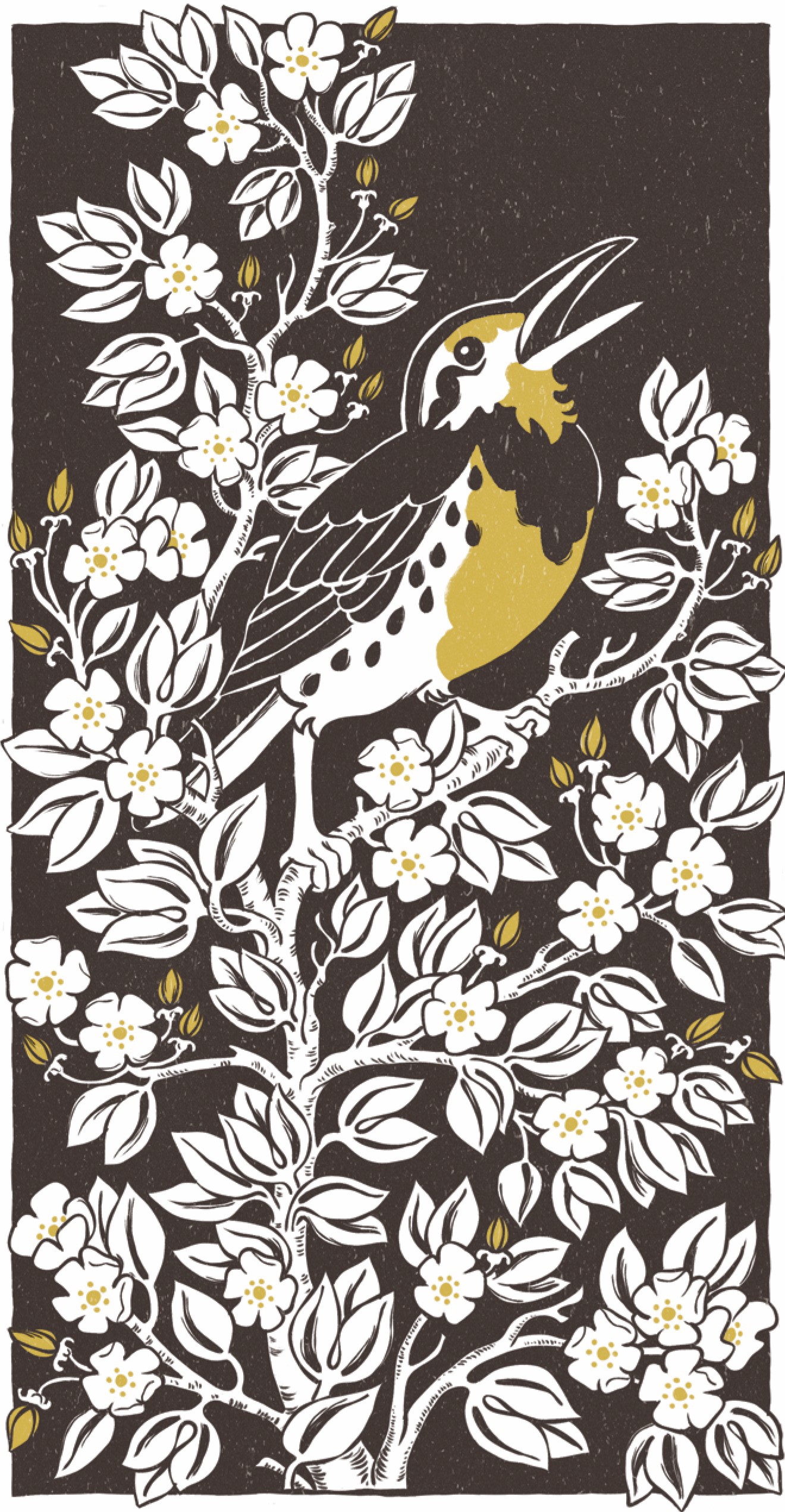 The meadowlark is a common songbird across the Great Plains. (Courtesy of WHO?)
That’s a mouthful to cram in a line, though. In addition, the meadowlark conjures pleasant poetic associations that a pheasant does not with its jarring, unmusical call. As the reader helpfully learns after reading a note in the back, Bottum’s verse references both George Meredith’s “The Lark Ascending” (1881) and Willa Cather’s “The Song of the Lark” (1915). After the nightingale, the lark is probably the most celebrated bird in Western poetry, and Bottum does justice to that minor tradition here.
The next two poems are similarly filled with erudite but unobtrusive allusions to great writers in the Western traditions. Knowing these references aids a fuller understanding, but ignorance doesn’t hinder appreciation.
The third poem, “The Homestead,” has a more sorrowful character than the first. It is at once an elegy for the “gone and graveless” residents of a long-abandoned house and an homage to the endless plains of Bottum’s beloved state. The following lines capture the character of the “wending” wheat fields that surround the home:
Nothing much is here but the nothing:
A nothing that nothings best of all
God’s empty places. And we are the spaces
Where nothing is not: fleeting and small.
This clearly non-descriptive description aptly articulates the vague feelings of anyone who has ever taken a road trip through the Midwest. It’s a passage worthy of Bottum’s fellow South Dakota natives, Laura Ingalls Wilder and O.E. Rolvaag (who is quoted in the book’s epigraph).
Streams of Influence
Rivers are prominent in this book, both thematically and geographically. The first line of the first poem ends with the word, and the meadowlark’s grass-rooted singing of “bright mornings and springs” is contrasted with the “alkaline gullies” of “The Bad River.” In the second poem, “Chokecherry Jelly,” sitters in easy chairs are feasting in “riverside cabins,” and the wending wheat of “Homestead” is described as “a river of summer.”
Each subsequent poem in the collection runs a bit longer than the previous one. The fourth and final poem, “The River,” is longer than all the others combined. Written in blank iambic tetrameter, it begins in nature description before taking a different turn:
But many things may be like our river.
When I imagine a swelling moment,
A time that history starts to flood,
I think of 1776—
As serious men of serious purpose
Set their names to a claim of freedom:
Life and fortune, sacred honor,
Cast on the table in one mad wager.
A catalogue of famous names and events follow. But where a modernist poet will quickly go over the reader’s head with obscure language, Bottum’s references are straightforward and self-explanatory. From ancient authors like Aristotle and Cicero to Thomas Aquinas and John Locke, his purpose is to show the intellectual and cultural streams flowing into America’s founding, the background milieu of ideas that went into the Declaration of Independence.
Against Oblivion
Nearly everyone who puts pen to paper (or clickety-clacks on keyboards) is motivated by the hope that someone in the future will read what they wrote. Bottum is one of the lucky few who has, with some certainty, triumphed against oblivion.
It’s tempting to imagine people opening that time capsule 250 years from now. Will they react with wonder? With head-scratching? Condescension? And what will they themselves be like?
If America still exists in 250 years, it will likely be very different. Physically, maps may be redrawn to reflect geopolitical shifts. Culturally and technologically, so much has changed in the past generation that any prediction of what life will be like 10 generations from now is almost certainly erroneous.
Some things don’t change, though. The Midwestern plains will probably remain much the same as Bottum describes them, barring the possibility of a landscape disfigured by too many wind turbines. Chokecherry jelly will continue to nourish. The meadowlark will hopefully be thriving, though it’s currently threatened in New Jersey.
Whatever America’s actual status in 2276, its founding ideals will remain a beacon for future peoples and civilizations. Just as the founders looked to Cicero and Montesquieu, the future will look to us as a model for values on how and how not to live. And at least a few among that distant population will peruse “This Far Country” as a guidebook to that end.
What arts and culture topics would you like us to cover? Please email ideas or feedback to features@epochtimes.nyc
