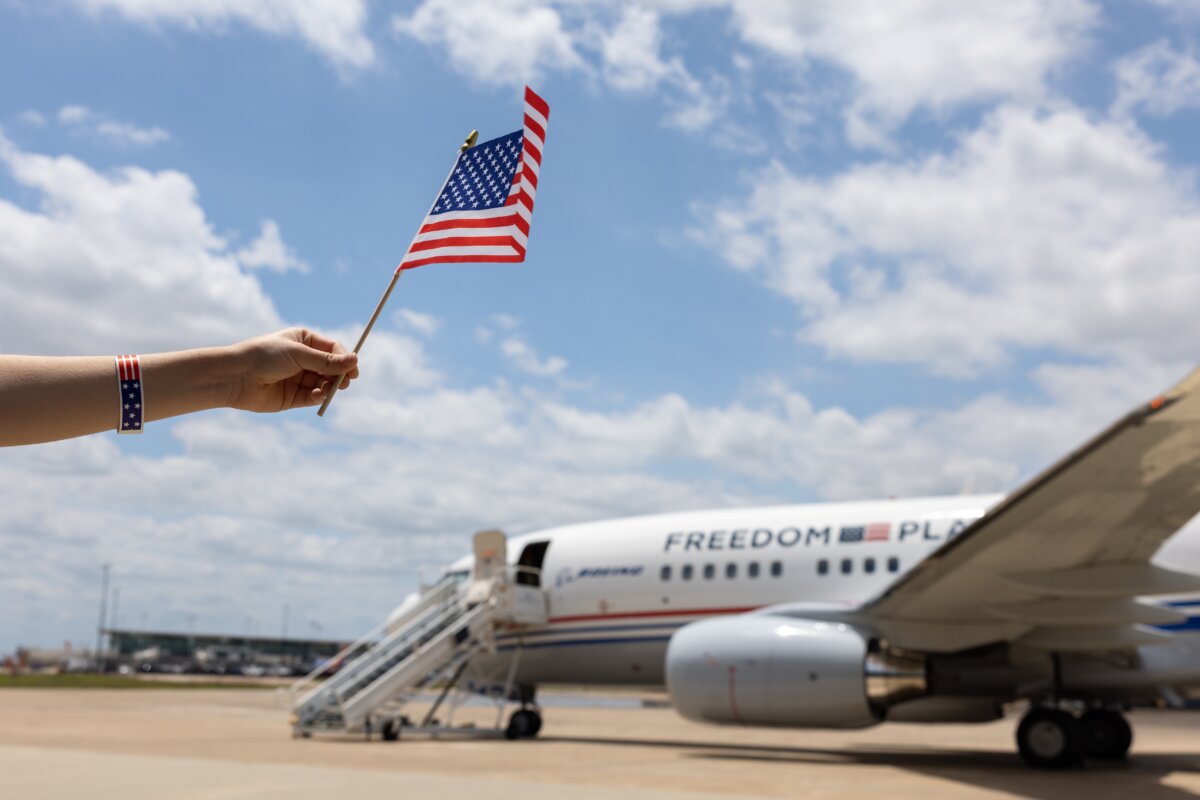
HOUSTON—A Boeing 737-7BC known as “Archive One,” or the “Freedom Plane,” is flying nine founding-era documents to eight cities to commemorate America’s 250th anniversary.
Onboard are the 1774 Articles of Association from the First Continental Congress, which called for the boycott of British goods; three Oaths of Allegiance from 1778, signed by Aaron Burr, Alexander Hamilton, and George Washington; the 1783 Treaty of Paris, which officially ended the War for Independence; New Jersey delegate David Brearley’s secret printing of the United States Constitution; the delegates’ voting record for passing the Constitution; the Bill of Rights, with annotations and edits from Senate members; and one of approximately 50 surviving copies of William Stone’s 1823 engraving of the Declaration of Independence.
These documents are currently housed at the Houston Museum of Natural Science (HMNS). Houston is the fourth city to be honored with the historic exhibition. The first stop of the “Freedom Plane National Tour: Documents That Forged a Nation” was Kansas City, Missouri, followed by Atlanta and Los Angeles. The documents will remain on display in Houston until May 25, before jetting off to Denver and Miami, before heading to Dearborn, Michigan, and finally to Seattle.
Selecting Houston
This is not the first time the HMNS has hosted a National Archives exhibition. Its most recent collaboration occurred in late 2011 and early 2012 when it hosted “Discovering the Civil War” for the 150th commemoration of the Civil War. Dirk Van Tuerenhout, the museum’s director of collections and curator of anthropology, was there for the Civil War exhibition and is overseeing the current Freedom Plane celebration.
Tuerenhout called the exhibition an honor for Houston, saying it made sense that the nation’s fourth-largest city was selected. He highlighted the city’s size and accessibility via Interstate 10, along with the museum’s strong track record with the National Archives and major temporary exhibitions, including 2003’s “Saint Peter and the Vatican: The Legacy of the Popes,” to commemorate 2,000 years of Christianity.
Preparing the Exhibition
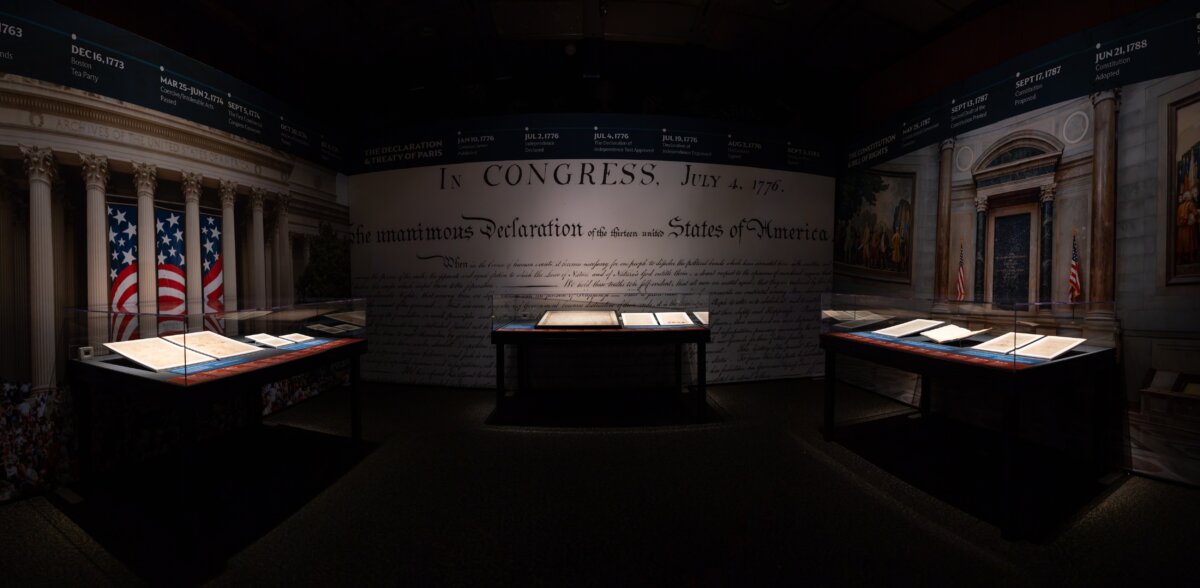
This touring exhibition, which is free to the public in each city, required several reconfigurations to the museum itself, including new furniture, display cases, artwork, historical timeline displays, and, most importantly, adjusted lighting.
“Everything is carefully prepared for the arrival of these documents,” Tuerenhout said. “When they are not exposed to light and the public, there is a textile cover that goes over them. There is a very specific number of hours where they can be exposed.”
Of the documents on display, Tuerenhout said he was captivated by the three signed postcard-sized Oaths of Allegiance.
“The Oath of Allegiance, for me, is like one step away from [George] Washington,” he said.
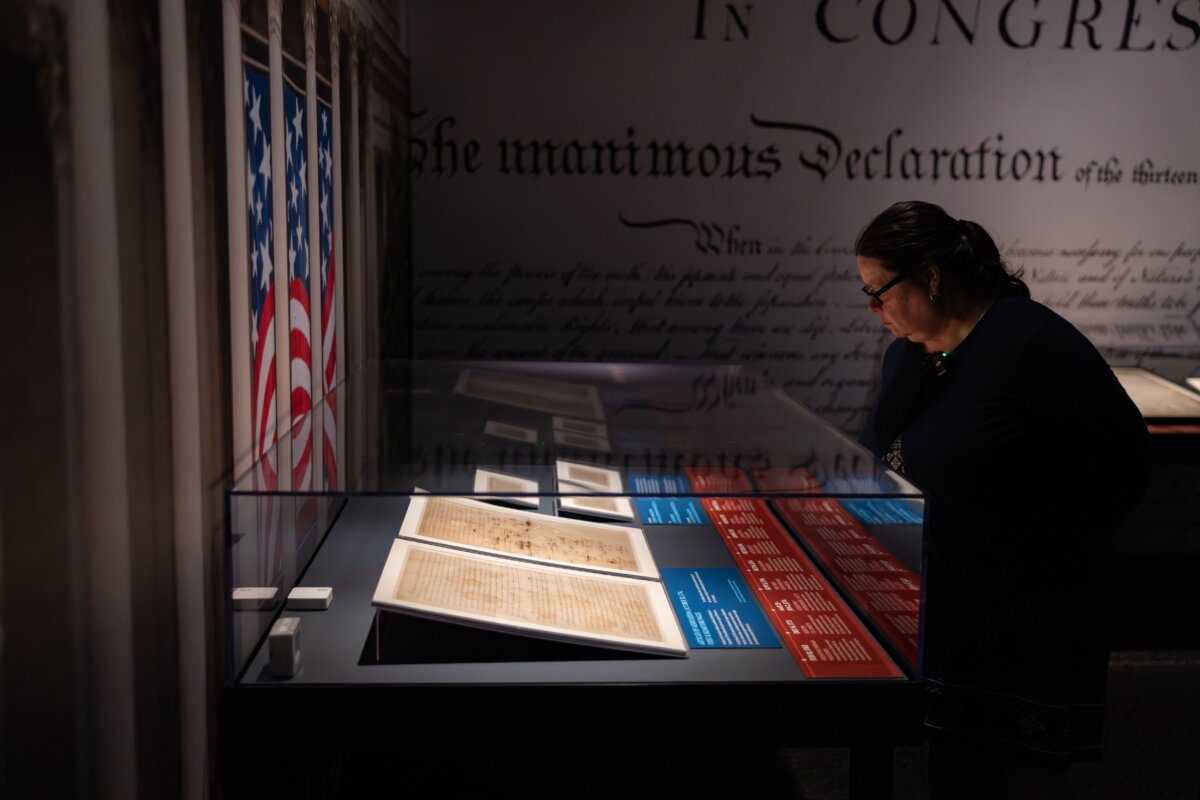
For many visitors, seeing America’s founding documents up close and in person is a once-in-a-lifetime opportunity. The only other way to view such documents would be to visit the nation’s capital, which is very far for Houstonians, not to mention residents of Los Angeles and Seattle that are soon to be visited. In fact, if recent history is any indication, it may be another 50 years before these documents leave their home quarters.
Before the Freedom Plane came the Freedom Train—twice. About two years after World War II ended, several of America’s founding documents traversed over 37,000 miles across the nation’s contiguous 48 states. Approximately 3 million visitors saw the Declaration of Independence, the Constitution, and the Bill of Rights. The Freedom Train was such a success that it was repeated for the nation’s bicentennial from 1975 to 1976.
Pause and Reflect
For all the documents, artifacts, and displays that have come through the Houston Museum of Natural Science, Tuerenhout placed this one in his top three; when it comes to American history, it undoubtedly takes the top spot. He hopes as many people as possible can personally view these documents. As an anthropologist, he has a keen perspective on how important these documents are, not only to the nation and its citizens but also to the world.
“We live in a society that is grounded in these documents,” he said.
He noted that Americans enjoy privileges not found in other countries because of one of those documents on display: the Bill of Rights. He hopes that when visitors enter the darkened corridor showcasing these priceless documents, they will pause and reflect on the importance of each and be inspired to learn more about America’s founding.
“This is the place where we live and we should know more about it.”
To learn more about this The Freedom Plane, visit FreedomPlane.org.
What arts and culture topics would you like us to cover? Please email ideas or feedback to features@epochtimes.nyc