Seated squarely at the center of the canvas in an olive-green military uniform is a teddy bear. Behind a parted crimson curtain, a constellation of symbolic details awaits the observant eye: a Nobel Peace Prize medal, a New York City police commissioner’s badge, a vintage rifle, and a naval anchor—each subtly woven into the composition like an artistic Easter egg.
Titled “Teddy,” this oil painting is the creation of 18-year-old Maggie Jiang. It marks the first fully original composition of her burgeoning artistic journey. The figure depicted is no ordinary plush toy, but the anthropomorphic embodiment of the 26th president of the United States: Theodore “Teddy” Roosevelt.
In June, as the nation prepared to commemorate America’s 250th anniversary, the work garnered first place in the nationwide American Heroes Student Art Contest, organized by Freedom 250 and the National Endowment for the Humanities. From June 25 through July 10, the canvas was exhibited in the Arts and Culture Pavilion of the Great American State Fair on the National Mall in Washington.
“To see the teddy bear, to see all the symbols of Roosevelt’s past—it really floored me,” recounted Maggie’s history teacher, Michael McCloskey. “My immediate response was a big smile and joyous laughter. How she tied in President Roosevelt with his boyish charm along with his accomplishments, and presented it in a way that was instantly recognizable to anyone with a background in Theodore Roosevelt, was fabulous!”
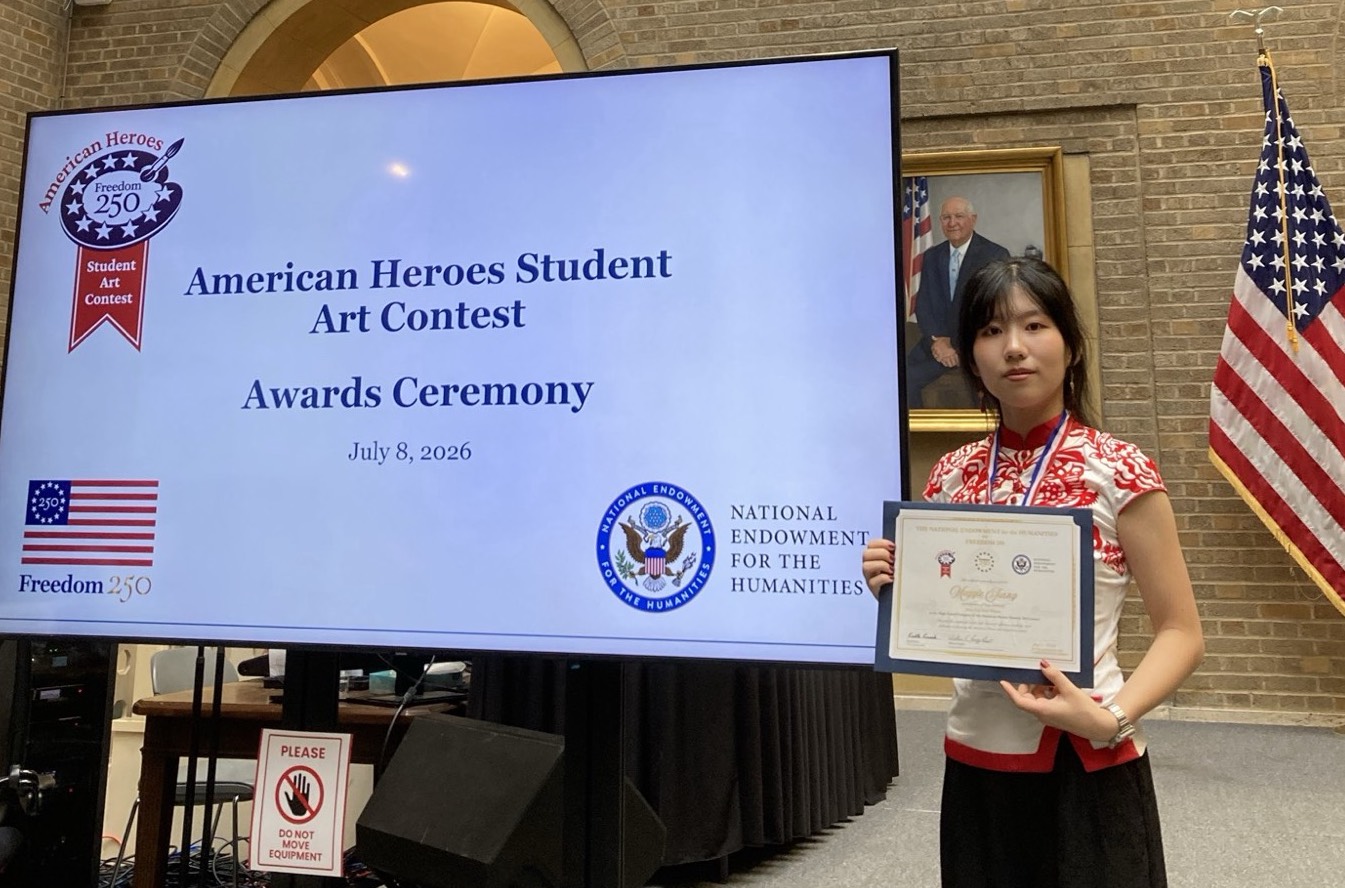 Maggie Jiang at the American Heroes Student Art Contest award ceremony at the Department of Agriculture in Washington on July 8, 2026. (Courtesy of Maggie Jiang)
A Spark in History Class
The theme of the competition was “American Heroes,” inviting participating students to select a subject from a roster of iconic figures throughout U.S. history. For Maggie, the choice was immediate and personal: “I chose this president because of a history teacher I admire immensely. He told me that his favorite president was Theodore Roosevelt.”
That teacher was McCloskey. Far from a conventional academic, McCloskey brings a remarkably diverse tapestry of life experience to the classroom: He worked as a professional chef for 12 years, operated an independent business in Gettysburg, Pennsylvania, for five, sold cellphones while attending college, interpreted history at the Carlisle Barracks Army War College, and contributed to historical film productions and reenactments. In recent years, he has brought this seasoned perspective to Northern Academy of the Arts, where he employs creative storytelling and historical inquiry to engage young minds.
In class, McCloskey does not merely recount dry chronology; he candidly shares life lessons, anecdotes, and personal passions with his students.
“His sharing helped my creative process tremendously,” Maggie recalled. “The moment that left the deepest impression on me was when he explained why Roosevelt was his favorite president.”
Intrigued by her teacher’s reverence for the 26th president, Maggie embarked on an exhaustive study of Roosevelt’s biography.
“I came to love him deeply—he was a person of immense fortitude,” she reflected. “As a sickly child with severe asthma, he built his physique through sheer discipline and perseverance. Later in life, when he was shot in the chest before giving a campaign speech, he insisted on finishing the 90-minute address while bleeding. Such indomitable courage fills me with reverence. He is, without question, one of the American heroes I admire most.”
McCloskey noticed the depth of scholarship embedded within the canvas: “Maggie puts thought, research, and creativity into what she does. When she did ‘Teddy,’ she dug deep to find out his history, and it is presented in full view in the painting. She has various symbols representing aspects of Teddy Roosevelt’s life—from going out West and the Nobel Peace Prize to heading the New York City Police Department, the Rough Riders of the Spanish-American War, and the ‘Big Stick’ foreign policy. Even the American flag features the exact number of stars corresponding to Roosevelt’s presidency.”
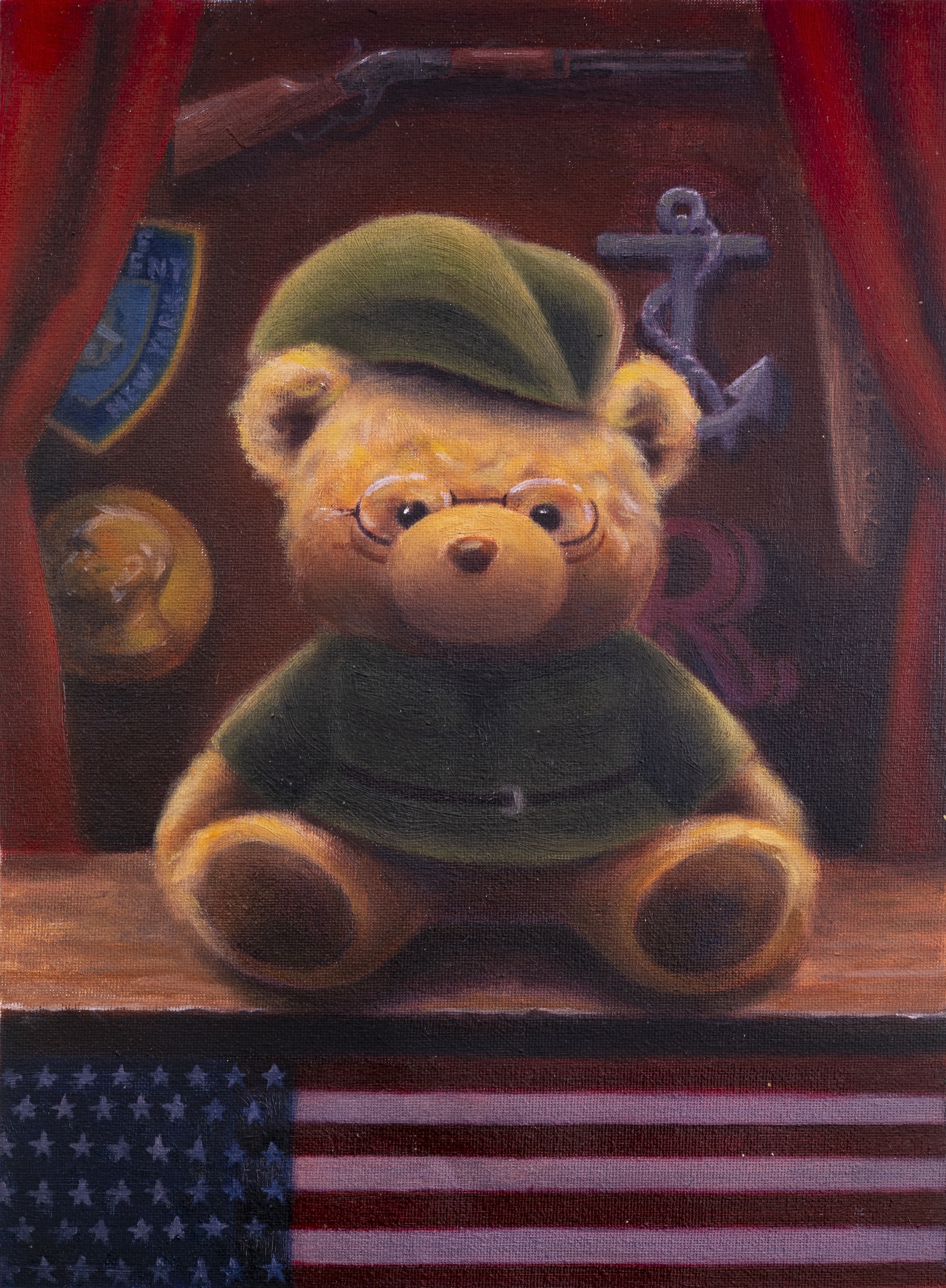 “Teddy” (oil on canvas): Maggie Jiang’s award-winning portrayal of Theodore Roosevelt. (Courtesy of Maggie Jiang)
From Modest Expectations to National Laureate
Maggie’s affinity for visual arts was awakened early. She began drawing in kindergarten, studied traditional Chinese calligraphy and ink painting during elementary school, and honed her draftsmanship through pencil and charcoal sketching throughout middle and high school. Yet oil painting was an entirely novel discipline for her, one she had only begun exploring this year through self-directed study outside of class.
Maggie was a high school student at Northern Academy of the Arts in upstate New York when she submitted her entry. She entered with modest expectations, adopting the lighthearted mindset that “there was nothing to lose by trying.” Winning was the last thing on her mind.
“When the notification arrived announcing that I had placed—and that it was first place—I was completely stunned,” Maggie recalled with a laugh. “I thought, ‘Is this real? Did I truly win first place?’”
Maggie credits her achievement to three pillars of guidance: “First, the historical depth imparted by my history teacher during class; second, the invaluable advice on technical execution, composition, and color provided by my art teachers; and above all, the unwavering encouragement of my parents.”
The Price of Truth and the Discovery of Liberty
Yet beyond the prestigious accolade lies a far more compelling narrative: This young high school artist, newly arrived in the medium of oils, was not merely depicting an American hero of the past—she was projecting her own hard-won journey toward personal and spiritual freedom.
Maggie arrived in the United States less than three years ago, and her transformation at Northern Academy of the Arts has been profound. She still vividly recalls the culture shock of her first weeks in America: “Everything was completely different from China.”
In the United States, she observed, “Teachers banter and converse casually with students, and classmates raise their hands without hesitation to voice their thoughts.”
Accustomed to an atmosphere of silence and conformity, she initially found the environment disorienting.
“At first, I didn’t know how to fit in,” she said. “Yet both the faculty and the students treated me with genuine warmth.”
She fondly remembers the joy of attending an American classmate’s birthday party and participating in campus activities.
“Every day brought a fresh sense of wonder,” she said.
Maggie grew up in mainland China in a household that practiced Falun Gong, also known as Falun Dafa. This traditional spiritual meditation discipline has faced brutal, state-sanctioned persecution by the Chinese Communist Party since 1999.
In Maggie’s childhood, state harassment was an omnipresent shadow.
“Incidents where my mother was targeted for persecution were frequent,” she said.
On one harrowing occasion, her mother was arbitrarily detained by authorities and vanished for more than two months. The young child lived in daily terror, wondering whether her mother would ever return alive—a fear indelibly etched into her memory.
“I was in elementary school at the time,” Maggie recounted. “I came home for lunch one day and immediately sensed the heavy atmosphere. My mother told me, ‘I have to go on a business trip, and you might not see me for a month.’ But I knew she was a homemaker; she didn’t have business trips. I burst into tears on the spot, clinging to her, pleading, ‘Don’t go!’”
The most suffocating aspect of living under totalitarian rule, Maggie noted, was the compulsory erasure of self-expression.
“At school, I never dared to speak about my family’s reality to my classmates, no matter how much I wanted to share it with them,” she said.
She recalled an ideological politics class in China where the instructor recited official state propaganda defaming Falun Gong.
“In that instant, I felt the blood freeze in my veins. I wanted so desperately to stand up and tell him, ‘That isn’t true!’ But out of fear, the words remained trapped in my throat,” Maggie said.
Her reaction was not malice, but profound sorrow.
“I didn’t feel hatred toward the teacher. Instead, I felt an overwhelming pity for him—he simply didn’t know the truth, and that was why he spoke those words,” she said.
Another formative encounter occurred shortly before leaving China. When the authorities refused to issue her mother a passport, the family returned to their hometown to petition the local police bureau. Officers isolated Maggie in an interrogation room, surrounding her with hostile questioning.
When the officers repeated slanderous statements about her faith, something shifted within her.
“I was overcome with righteous indignation,” she said. “I looked at them and declared, ‘That is not true. Falun Gong is not an evil cult.’”
She acknowledged feeling terrified, yet the conviction to defend the truth overcame her fear.
When Maggie finally departed China and her flight touched down on foreign soil, she felt an overwhelming epiphany of release.
“It wasn’t nostalgia or sorrow at leaving my homeland. It was an instantaneous, visceral realization: ‘At last, I am free!’” she said.
That profound emancipation continues to shape her creative spirit.
“If I wish to speak, to act, or to create something today, I no longer have to live in dread of what others might think,” Maggie stated. “In a free country like the United States, I can express my genuine thoughts anytime, anywhere.”
Mastering Color and Narrative
Transitioning from sketch artist to painter proved demanding.
“The challenges were immense,” Maggie said. “Drawing deals in values—black, white, and shades of gray. Oil painting, by contrast, is entirely governed by chromatic relationships. It was an unfamiliar visual language.”
“My greatest technical hurdle was color harmony,” she said.
Habit initially prompted her to treat light and shadow monochromatically—adding black for shadows and white for highlights.
“Oil painting defies that simplistic approach. It requires subtle chromatic modulation and deep color theory. I found it exceptionally demanding, and I am still striving to master how to wield color fluently,” she said.
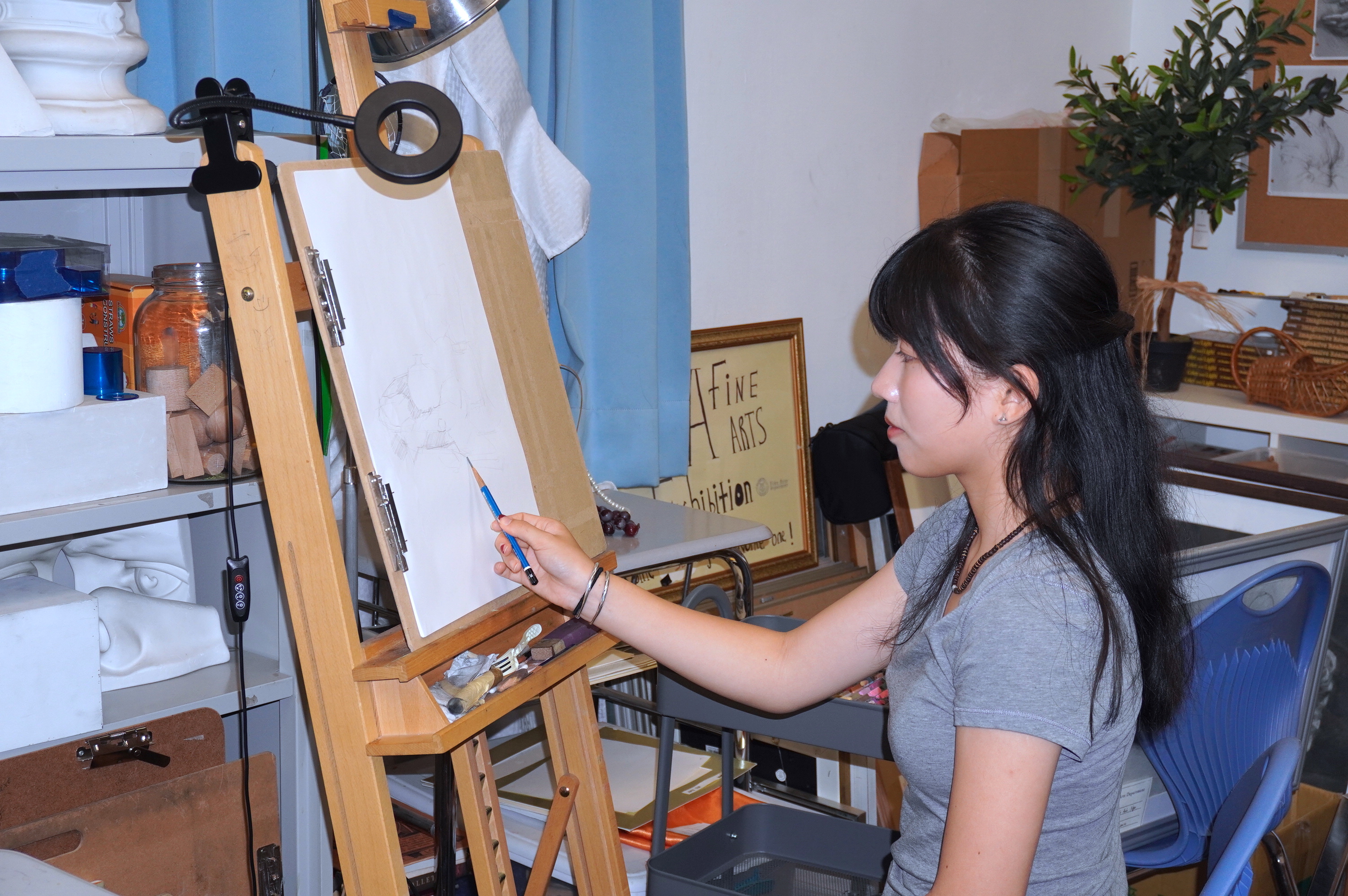 Maggie Jiang paints in an art studio at Northern Academy of the Arts in upstate New York. (Lily Yu/The Epoch Times)
“The experience proved immensely rewarding,” she said.
From the underlying geometry to the smallest narrative flourish, every square inch demanded intentional purpose. In doing so, Maggie discovered the ultimate power of painting.
“My greatest revelation from this piece was realizing that a fine painting must not merely be rendered skillfully—it must tell a compelling story,” she said.
A Teacher’s Pride
For McCloskey, watching Maggie’s evolution has been deeply gratifying.
“Maggie has always been creative and unafraid. I am sure she has things that scare her, but she has always been able to speak in class, and that only became more confident as she advanced through the years,” he said.
McCloskey initially noticed her visual acumen during an assignment requiring students to design a historical Monopoly board. Yet it was not until he viewed her sketches at the school’s annual Winter Showcase that her caliber as an artist became unmistakable.
“Her talent floored me. You only achieve that proficiency if you possess genuine passion—an interest in technique, history, stylistic nuance, and diverse mediums. Maggie has embraced all of them. I am immensely proud of her,” he said.
He also observed her integrity and warmth.
“She is exceptionally loyal to her friends and forms strong bonds easily. There always seemed to be an active, thoughtful inner world within her—and whatever was brewing, you knew it would be remarkable,” he said.
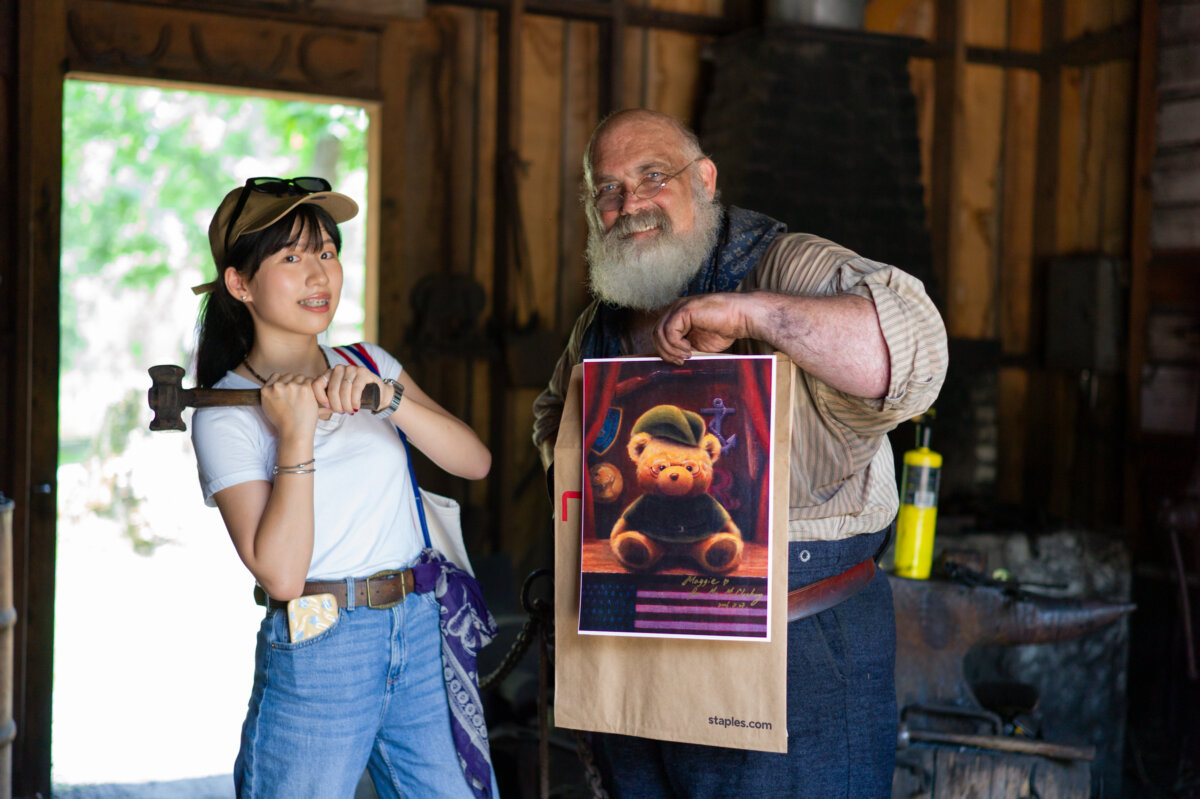
During this past summer, Maggie and a classmate traveled out to visit McCloskey at his summer trade as a blacksmith in Pennsylvania.
“They wanted to see what I do when I am not in the classroom,” McCloskey said, smiling. “When she arrived, she presented me with a signed, framed copy of her Theodore Roosevelt painting. I plan on hanging it proudly in my classroom.”
As a teacher, McCloskey reflected on the profound significance of seeing a student bring classroom lessons into the realm of high art.
“What Maggie has accomplished means more than I can put into words,” he said. “It is what every teacher hopes for at least once in their career—to have a student take a topic from class, chase down the historical details, and take such ownership of the narrative that they can share their vision with the nation. I look at it every day, and it never fails to make me smile. I am very proud of her. Her Teddy Roosevelt really was awesome!”