
President Donald Trump’s return to the White House came with a flurry of executive orders, and among them were some that affected how the government addresses transgender issues.
Here is what to know about a few of Trump’s policies and the way the courts have handled them.
Passports and Government Documents
On his first day in office, Trump issued a wide-reaching executive order with the stated intent of defending women from “gender ideology extremism” that allows “men to self-identify as women and gain access to intimate single-sex spaces and activities designed for women, from women’s domestic abuse shelters to women’s workplace showers.”
The order provides a definition of “male” and “female” based on which reproductive cells an individual produces and states that sex markers on official government documents must match the holder’s biological sex.
This means that under the order, individuals can no longer use “X” as a sex identification marker.
Ash Orr and other transgender-identifying plaintiffs, backed by the American Civil Liberties Union and activist groups, sued in February. The policy, they alleged, was discriminatory, unconstitutional, and motivated by “animus” toward transgender-identifying Americans.
In April, Judge Julia Kobick of the U.S. District Court for the District of Massachusetts ruled in favor of Orr, but initially the ruling applied to only the plaintiffs in the case.
In June, she expanded the block nationwide; in September, the U.S. Court of Appeals for the First Circuit declined to halt that decision while the government appeals.
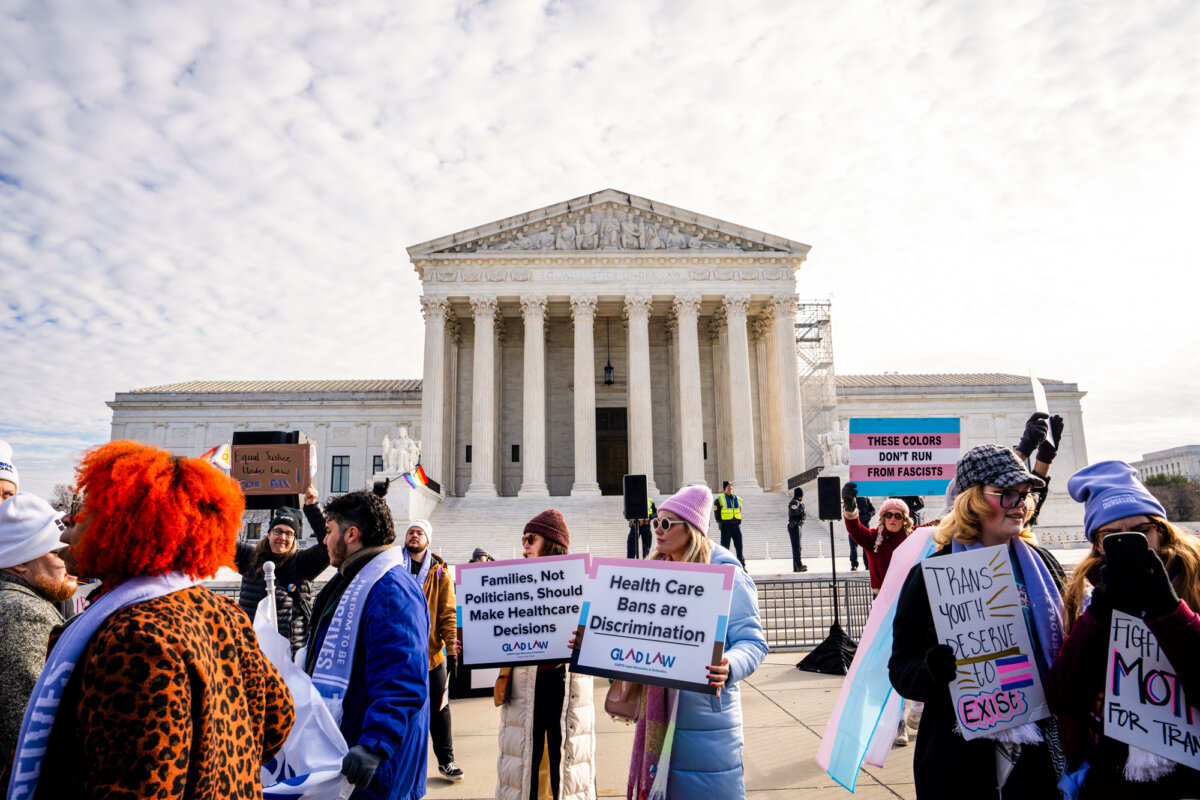
That same month, the government filed for an emergency stay of the lower court decision; on Nov. 6, the Supreme Court granted it, pending the ongoing appeal.
“Displaying passport holders’ sex at birth no more offends equal protection principles than displaying their country of birth—in both cases, the Government is merely attesting to a historical fact without subjecting anyone to differential treatment,” the brief, unsigned order reads.
Justice Ketanji Brown Jackson issued a dissent, joined by Justices Sonia Sotomayor and Elena Kagan.
Jackson criticized the majority for the brevity of the order, saying that the plaintiffs will suffer immediate harm as a result.
“The Government seeks to enforce a questionably legal new policy immediately … while the plaintiffs will be subject to imminent, concrete injury if the policy goes into effect,” she wrote.
“The documented real-world harms to these plaintiffs obviously outweigh the Government’s unexplained (and inexplicable) interest in immediate implementation of the Passport Policy.”
In the government’s emergency application with the Supreme Court, Solicitor General D. John Sauer said the district court injunction blocking the policy “has no basis in law or logic.”
“[Private citizens may not compel the government] to use inaccurate sex designations on identification documents that fail to reflect the person’s biological sex—especially not on identification documents that are government property and an exercise of the President’s constitutional and statutory power to communicate with foreign governments,” Sauer wrote.
“[The injunction harms the government by forcing it] to speak to foreign governments in contravention of both the President’s foreign policy and scientific reality.”
The passport policy does not discriminate on the basis of sex because it applies equally to everyone by “defining sex for everyone in terms of biology rather than self-identification,” Sauer said.
The Supreme Court has not yet agreed to take on the case fully, as it waits for the First Circuit’s ruling.
In the Military
In May, the high court also halted a block on the Trump administration’s decision to ban people who identify as transgender from serving in the military.
That case began with another executive order issued on Jan. 20, which states that the administration’s policy is to maintain traits such as honesty, lethality, and integrity but that these are “inconsistent with the medical, surgical, and mental health constraints on individuals with gender dysphoria.”
“This policy is also inconsistent with shifting pronoun usage or use of pronouns that inaccurately reflect an individual’s sex,” Trump’s order states.
After a suit by a group of soldiers who identify as transgender, along with one individual wishing to enlist, Judge Benjamin Hale Settle of the U.S. District Court for the Western District of Washington put a stop to that order in March.
But in the interim, the U.S. government had put its plan into action, issuing a memo stating that it planned to remove 1,000 transgender-identifying service members.
On May 6, the Supreme Court issued a brief, unexplained order pausing the lower court’s ruling until the government’s appeal plays out in the U.S. Court of Appeals for the Ninth Circuit. The order includes no opinion or commentary but notes that Kagan, Sotomayor, and Jackson would decline to take up the case.
The Ninth Circuit heard oral arguments for that case, Shilling v. Trump, on Oct. 20, and the judges seemed skeptical of the government’s argument that the policy discriminates on only a medical basis.
Gender Surgeries in Children
Trump issued an order addressing gender-altering procedures in children on Jan. 28.
“Medical professionals are maiming and sterilizing a growing number of impressionable children under the radical and false claim that adults can change a child’s sex through a series of irreversible medical interventions,” it states.
That order ended the government’s reliance on guidance from the World Professional Association for Transgender Health and ordered agencies to cease making grants to institutions that performed such procedures.
As a result, many hospitals ceased performing those surgeries.
In response, a group of minor transgender-identifying plaintiffs sued, backed by the LGBT activist group Parents and Friends of Lesbians and Gays. They alleged that suddenly ending their gender-altering procedures caused mental distress and put them in danger of self-harm.
In March, Judge Brendan Hurson of the U.S. District Court for the District of Maryland granted the plaintiffs a preliminary block and forbade the government from conditioning, withholding, or terminating federal funding under Trump’s order.
The case, Parents and Friends of Lesbians and Gays v. Trump, is pending in the U.S. Court of Appeals for the Fourth Circuit.
A similar suit, Commonwealth of Massachusetts v. Trump, was brought by 16 states and the District of Columbia. That case has been put on hold because of the government shutdown.
Neither of those cases has reached the Supreme Court yet, and their future is uncertain after a landmark decision upholding Tennessee’s ban on gender-altering procedures in minors.
Matthew Vadum contributed to this report.
Correction: A previous version of this article misspelled the name of Justice Sonia Sotomayor. The Epoch Times regrets the error.
 Friends Read Free
Copy
Facebook
Tweet
Friends Read Free
Copy
Facebook
Tweet