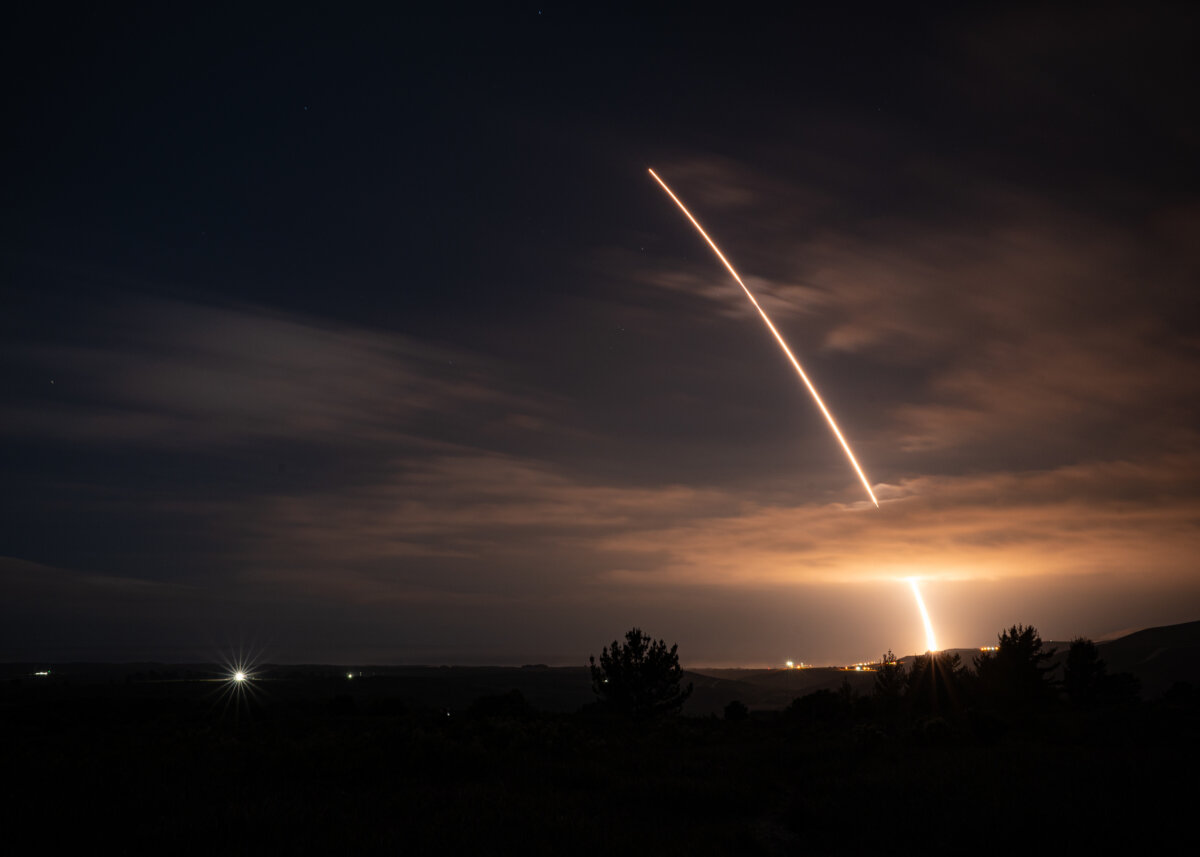

The U.S. Air Force has conducted a test launch of a Minuteman III intercontinental ballistic missile (ICBM) without a nuclear warhead.
The test took place on Nov. 5 at Vandenberg Space Force Base in California, according to the Air Force Global Strike Command. The unarmed missile flew approximately 4,200 miles before it landed in the designated impact area in the Marshall Islands in the northwestern Pacific Ocean.
Designated as GT-254, the test “evaluated the ongoing reliability, operational readiness, and accuracy of the ICBM system,” the command said in a statement.
“This test is routine and was scheduled years in advance.”
The Minuteman III, first deployed in the 1970s, serves as the land-based component of the U.S. nuclear triad, alongside submarine-launched and bomber-delivered weapons. About 400 of them remain active across 450 underground silos in Wyoming, Montana, North Dakota, Colorado, and Nebraska.
Those missiles are now at least half a century old, prompting the Air Force to contract with Northrop Grumman in 2020 to develop its replacement, the Sentinel ICBM, as part of a broader effort to modernize the U.S. nuclear arsenal.
A September report by federal auditors suggested that the Air Force might have to keep operating Minuteman IIIs through 2050, as the Sentinel program continues to face “critical cost overruns and schedule delays.”
“As we modernize to the Sentinel weapon system, we must continue to maintain the readiness of the existing Minuteman III fleet,” said Gen. S.L. Davis, commander of Air Force Global Strike Command. “GT 254 helps fulfill that commitment, ensuring its continued accuracy and reliability.”
Russia Reacts
Shortly after the test, the Kremlin signaled that it would mirror U.S. moves.
During a Nov. 5 meeting of Russia’s Security Council, Defense Minister Andrei Belousov said that it would be “appropriate” to begin preparations for full-scale nuclear tests in response to the U.S. launch.
Russian President Vladimir Putin, who chairs the council, asked officials to assess the feasibility of such preparations and submit proposals.
“I want to emphasize that the president did not give an order to begin preparations for testing,” Putin’s press secretary, Dmitry Peskov, told state-owned news agency TASS.
Trump Resumes Nuclear Testing
GT-254 marked the first ICBM test since President Donald Trump announced in late October that the United States would resume nuclear weapons testing.
In a post on Truth Social, the president wrote that the move is necessary to match the growing capabilities of Russia and China.
“Because of the tremendous destructive power, I HATED to do it, but had no choice! Russia is second, and China is a distant third, but will be even within 5 years,” he wrote. “Because of other countries testing programs, I have instructed the Department of War to start testing our Nuclear Weapons on an equal basis. That process will begin immediately.”
U.S. Energy Secretary Chris Wright later clarified in an interview with Fox News that these would be “system tests” that do not include actual atomic detonations.
“You’re testing all the other parts of a nuclear weapon to make sure they deliver the appropriate geometry, and they set up the nuclear explosion,” said Wright, whose agency oversees the tests.
The United States last conducted a nuclear weapon test involving a live detonation in 1992 at the Nevada National Security Site. Four years later, Washington signed the Comprehensive Nuclear-Test-Ban Treaty (CTBT), which categorically bans all nuclear test explosions for both military and civilian purposes. The U.S. Senate rejected ratification in 1999.
Russia revoked its ratification of the CTBT in 2023, citing the need to maintain parity with the United States.
To date, 187 nations have signed the treaty and 178 have ratified it, but it has not entered into force, lacking ratification of nine states: China, Egypt, India, Iran, Israel, North Korea, Pakistan, Russia, and the United States.
The United States and Russia each hold more than 5,000 nuclear warheads, according to the Stockholm International Peace Research Institute. China is estimated to have at least 600 nuclear warheads, up from about 500 in 2024.
“Depending on how it decides to structure its forces, China could potentially have at least as many ICBMs as either Russia or the USA by the turn of the decade,” the institute stated in an analysis, noting that even if China reaches the upper projection of 1,500 warheads by 2035, that figure would still represent only about one-third of each of the current U.S. and Russian nuclear stockpiles.
 Friends Read Free
Copy
Facebook
Tweet
Friends Read Free
Copy
Facebook
Tweet