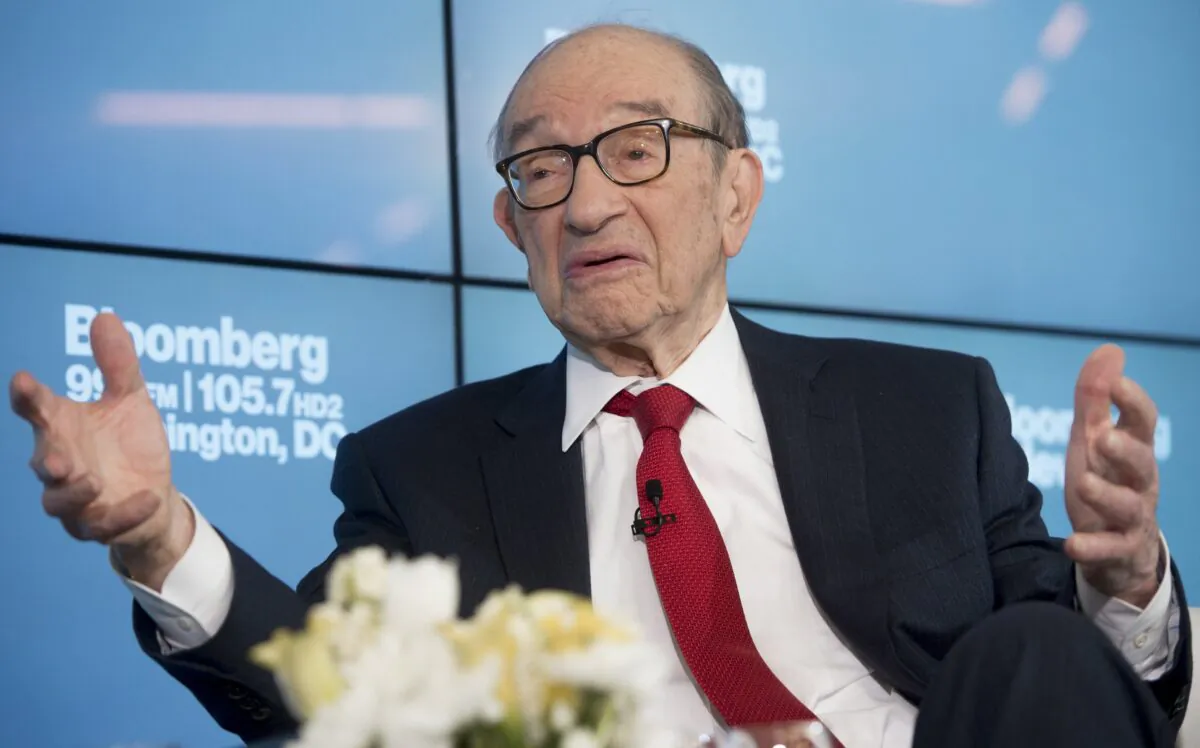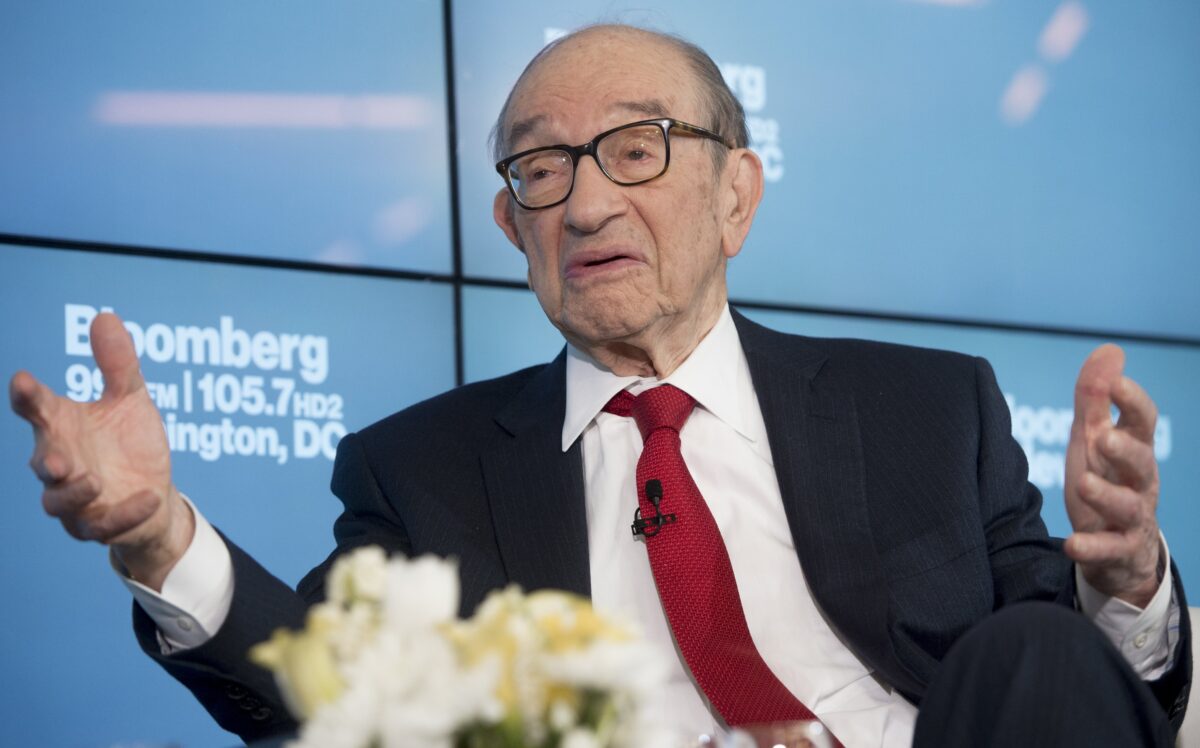

Alan Greenspan, Former Federal Reserve Chairman, Dies at 100
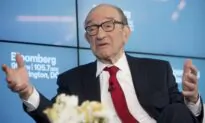
Former Federal Reserve Chairman Alan Greenspan died on June 22, his wife said in a statement.
Greenspan, who led the U.S. central bank for 19 years under four presidents, passed away at the age of 100 from complications relating to Parkinson’s disease.
“He was a giant of a man who helped shape the U.S. economy for decades under presidents of both parties, but was always honest in acknowledging his mistakes,” Andrea Mitchell, chief Washington correspondent and chief foreign affairs correspondent for NBC News, said in a statement.
“To me he was my husband, who shaped my life from our very first date in 1984. He had ‘irrational exuberance’ for baseball, the Washington Commanders, tennis, golf and music, especially jazz. He will be remembered for his brilliance and his kindness. Being his life partner was the joy of my life.”
The Federal Reserve acknowledged Greenspan’s death, remembering his contributions to monetary policy and the field of economics.
Greenspan guided the Fed through various expansions and “periods of considerable stress,” the central bank said in a statement following the news of his death.
“He brought rigorous analytical discipline to monetary policymaking and helped establish the credibility that remains one of the Federal Reserve’s most important assets,” the Fed said.
“Chairman Greenspan’s legacy endures at the Federal Reserve—in those he mentored directly, in the economists and public servants he inspired, and in the frameworks and practices he helped shape.”
Nominated by President Ronald Reagan in 1987—succeeding Chairman Paul Volcker—Greenspan became one of the most influential central bank figures in the modern era.
He was born in March 1926 in New York. Greenspan initially studied at the Juilliard School before enrolling at New York University to earn a bachelor’s and master’s in economics.
Greenspan worked on a doctorate at Columbia University under economist Arthur Burns, who became Fed chairman under President Richard Nixon in February 1970.
In the 1950s and 1960s, Greenspan was a close confidant of Ayn Rand, author of “Atlas Shrugged” and “The Fountainhead.” His early views were shaped by Rand’s objectivist philosophy of self-interest and laissez-faire capitalism. He also contributed essays to her 1966 book, “Capitalism: The Unknown Ideal.”
However, his record at the Federal Reserve was quite different from Rand’s economic philosophy. She advocated separating money from the state, supporting a gold standard. Greenspan leaned on the conventional monetary toolbox, mainly using interest rates to manage the U.S. economy.
Black Monday and ‘Irrational Exuberance’
Greenspan’s first major event occurred early in his tenure.
In October 1987, the U.S. stock market suffered the largest single-day percentage drop on record of almost 23 percent—also known as the Black Monday Crash. He cushioned the blows of the market plunge by injecting liquidity into the financial system, primarily through the discount window and ensuring banks continued lending to each other.
“The Federal Reserve, consistent with its responsibilities as the nation’s central bank, affirmed today its readiness to serve as a source of liquidity to support the economic and financial system,” Greenspan said in an Oct. 20, 1987, statement.
Years later, Greenspan presided over the second-longest economic expansion in the nation’s history—1991 to 2001—that enjoyed low inflation, enormous productivity growth, and a stock market boom.
Market watchers had labeled Greenspan as the “Maestro.”
Despite the 1990s boom, Greenspan warned of “irrational exuberance” and questioned whether this was inflating asset values.
“But how do we know when irrational exuberance has unduly escalated asset values, which then become subject to unexpected and prolonged contractions as they have in Japan over the past decade? And how do we factor that assessment into monetary policy?” Greenspan wrote in his now-iconic 1996 speech at the American Enterprise Institute.
“Indeed, the sharp stock market break of 1987 had few negative consequences for the economy. But we should not underestimate or become complacent about the complexity of the interactions of asset markets and the economy. Thus, evaluating shifts in balance sheets generally, and in asset prices particularly, must be an integral part of the development of monetary policy.”
Stocks—at home and abroad—declined immediately after his comments, with investors viewing his speech as a warning of speculative asset bubbles and unsound fundamental equities. But they quickly rebounded.
By the late 1990s and early 2000s, Greenspan navigated a series of domestic and global shocks: the Asian financial crisis, the dot-com bust, and the 9/11 terrorist attacks.
Critics also attributed his easy-money stance to the housing bubble.
A 2011 report by the bipartisan Financial Crisis Inquiry Commission determined that the financial crisis was fueled, in part, by Greenspan’s failure to rein in trading in securities backed by subprime mortgages.
“More than 30 years of deregulation and reliance on self-regulation by financial institutions, championed by former Federal Reserve chairman Alan Greenspan and others, supported by successive administrations and Congresses, and actively pushed by the powerful financial industry at every turn, had stripped away key safeguards, which could have helped avoid catastrophe,” the report said in part.
Greenspan, appearing before the House Committee on Oversight and Government Reform in October 2008, said the economic collapse was caused by a “once-in-a-century credit tsunami.”
Since leaving the central bank, Greenspan founded a consulting firm and authored several books, including his memoir “The Age of Turbulence.”
 Friends Read Free
Copy
Facebook
Tweet
Friends Read Free
Copy
Facebook
Tweet