



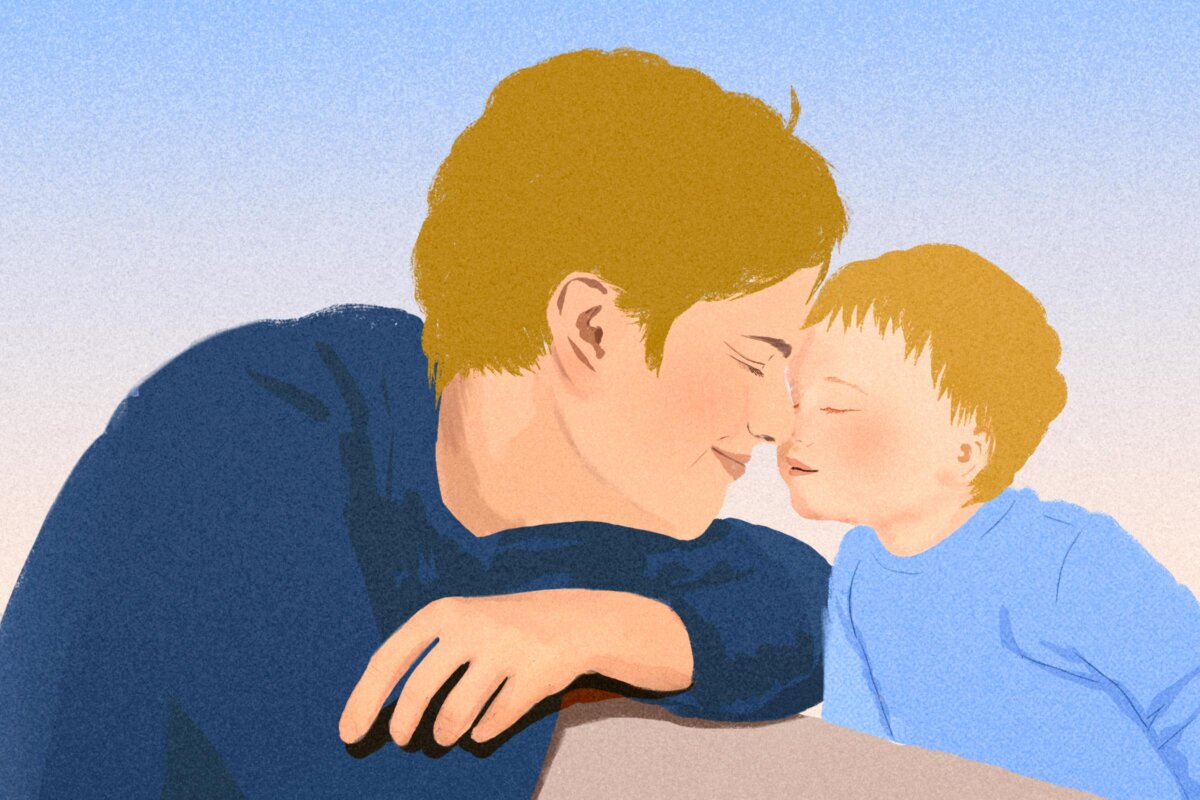
Decades of research have examined what fathers do for their children. Almost none of it asks the question: What does having children do to fathers?
Many men struggle to articulate what happens after they become fathers. Life continues to look similar from the outside—the same job, the same house, and similar daily routines. Yet many fathers describe the feeling that something fundamental has shifted.
“Fatherhood doesn’t just create a new identity,” Tommy Mattera, a licensed marriage and family therapist, told The Epoch Times. “Sometimes it reveals something that was already there but hadn’t yet been called forward.”
Scientists are now finding evidence of measurable changes in expectant fathers even before they begin changing diapers or reading bedtime stories.
Changes in the Body
Fatherhood is often considered to begin in the delivery room. Research suggests it may begin much earlier.
A 2025 study followed first-time fathers and found measurable hormonal changes in the men before the baby arrived, challenging the view of fathers as observers waiting on the sidelines.
The study found that fathers had higher oxytocin levels than nonfathers. Often referred to as the “bonding hormone,” it plays a role in attachment, trust, and social connection. Researchers believe it may help support the close parent–child relationships that develop during infancy.
One of the most intriguing findings of the study involves testosterone. It found that fathers often experience lower testosterone levels after becoming parents, a shift that may help redirect attention away from competition and toward family life. Expectant fathers with lower testosterone levels while their children were in the womb were more likely to become highly involved fathers after their children were born.
The changes are not limited to hormone levels.
“Brain regions related to empathy and affection see an increase in activity, and there’s even a shift in how the cortisol works in the body,” Augusto Blanco, a psychologist, told The Epoch Times. “This helps the father be more aware of the baby’s needs and respond faster to them.”
Changes in Character
While both mothers and fathers become parents, the transition unfolds differently for men.
While mothers undergo more visible physical changes during pregnancy and childbirth, fathers are more likely to experience the transition internally.
“The biggest thing for me has been learning patience,” Justin Antunez, a California father of two sons, told The Epoch Times. “Kids want your attention all the time. You realize they’re not trying to be difficult; they just want to share their world with you. Fatherhood has forced me to slow down and see things through their eyes.”
The transition happened gradually for Antunez, he said, through countless ordinary moments that required him to place another person’s needs ahead of his own. His experience reflects a theme that appears repeatedly in conversations with fathers. Many describe the feeling that life becomes less centered on personal ambition and more focused on serving a purpose larger than themselves.
“Men are often socialized to prioritize achievement, productivity, independence, and professional success,” Doriel Jacov, a psychotherapist who works with fathers, told The Epoch Times. “Fatherhood challenges that identity.”
A 2024 review known as “The Paternal Body” described fatherhood as a “developmental transition,” concluding that it can affect how men think, feel, and understand themselves. Across dozens of studies, researchers found that becoming a father can reshape a man’s physical health, emotional life, relationship, and even identity.
“The role has a way of doing what years of therapy sometimes can’t,” Mattera said. “It moves life from the abstract to the concrete very fast.”
With no onboarding process, a newborn forces a man to find answers.
“Someone is depending on you,” Mattera said. “Watching you. Learning from you whether you intend it or not.”
Child Becomes the Mirror
For many men, becoming a dad challenges what they were taught a man was supposed to be. Many boys grow up hearing messages such as “don’t cry” and “be tough,” often from a father who showed love by working hard rather than by talking about feelings.
Jacov describes how, when children start to cry, some dads’ first impulse is to walk away. Others go to the opposite extreme, hovering over every sound from the baby monitor, determined not to repeat the emotional distance they felt as kids. In both cases, fatherhood forces many men to see how their own upbringing—and the version of masculinity they were given—shows up in their parenting.
Shannon Franklin, a psychologist who specializes in family dynamics, told The Epoch Times that the process of caring for a child is often where the most distinctive growth happens. Men who were never asked how they felt suddenly have to track both their children’s emotions and their own. Over time, many learn how to manage their reactions and remain present during difficult situations. Franklin said she believes that those experiences often serve as catalysts for a father’s own development.
Becoming a father can reactivate memories and patterns from a man’s relationship with his own parents, Blanco said, “and in some cases, as they understand their own parents better, it becomes an opportunity to address issues that have lingered for years.”
Children also have a way of reflecting both parents’ strengths and shortcomings. Fatherhood becomes an unexpected mirror—and an opportunity for growth.
A Purpose That Changes Everything
Children introduce responsibilities that can feel overwhelming, but they also provide a reason to endure challenges that might otherwise seem impossible. Sleep and personal time suddenly become far more flexible than they once seemed.
Blanco has observed that men experience greater self-confidence, improved relationship quality, increased emotional flexibility, and higher levels of life satisfaction after becoming fathers. Every day presents opportunities to show up, fall short, learn, and try again.
A newborn does not care what a man does for a living. A child has no interest in professional accomplishments or the status symbols that once seemed important. The child only knows whether someone comes when he or she cries, whether someone stays when things are difficult, and whether someone can be counted on tomorrow.
For many men, that simple reality becomes one of the most powerful forces of change they will ever experience. It asks more of them than they expected, and it reveals parts of themselves they might never have discovered otherwise. In the process of raising a child, many find that they, too, are still becoming the men they hope to be.