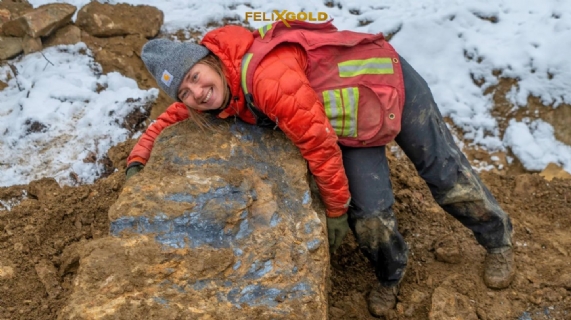

Alaska mines that supplied materials for allied forces during World War I and World War II are producing stibnite ore that exceeds U.S. military-grade quality, the company Felix Gold announced March 26.
Recent tests from samples taken at the Treasure Creek Antimony Project, operated by the Australian company, confirmed that hand-sorted stibnite, a mineral form of antimony trisulfide, can be processed into high-purity antimony metal through direct smelting or chemical extraction methods.
The ore “can be excavated, hand-sorted and delivered as high-grade feed, [and is] now shown to exceed U.S. military-grade concentrate specifications as direct ore,” Joseph Webb, Felix Gold’s executive director, said in a statement.
“There are no known sources to the company’s knowledge of military-grade antimony concentrate in the Western world—and this exceeds that threshold straight out of the ground,” Webb said.
The U.S. military is in critical need of a domestic supply of antimony, which is used in ammunition and explosives. The United States currently imports 85 percent of its antimony, and China largely controls the global supply chain.
The Trump administration prioritized building domesic supply chains of critical minerals shortly after President Donald Trump was sworn into office for his second term last year.
In April 2025, Trump signed an executive order focusing on critical minerals and rare earth metals. The order came a few months after China banned the export to the U.S. of antimony, gallium, germanium, and other key materials needed in defense applications.
Trump has also fast-tracked several critical mineral production projects to advance the domestic supply initiative.
At the Treasure Creek project, the ore can be converted to metal—either by direct smelting of untreated ore or by leaching and electrowinning. Both can be done without pre-treating the ore, the first tests revealed.
“All of this sits within a U.S. policy environment actively seeking a domestic supply of critical minerals, supported by established infrastructure and a brownfields setting at Treasure Creek,” Webb said. “In a market where the United States has no integrated domestic antimony supply chain, that combination is highly significant.”
The tests were performed by independent laboratories, according to Felix Gold.
The U.S. military is developing a small-scale pilot refinery in Idaho to domestically process antimony trisulfide at the Idaho National Laboratory.
The metal enhances the hardness of lead alloys used in ammunition manufacturing and has flame-retardant characteristics that are crucial for military vehicle components and equipment.
The critical mineral can also serve a role in specialized military electronics for advanced guidance systems and communications equipment.
 Friends Read Free
Copy
Facebook
Tweet
Friends Read Free
Copy
Facebook
Tweet