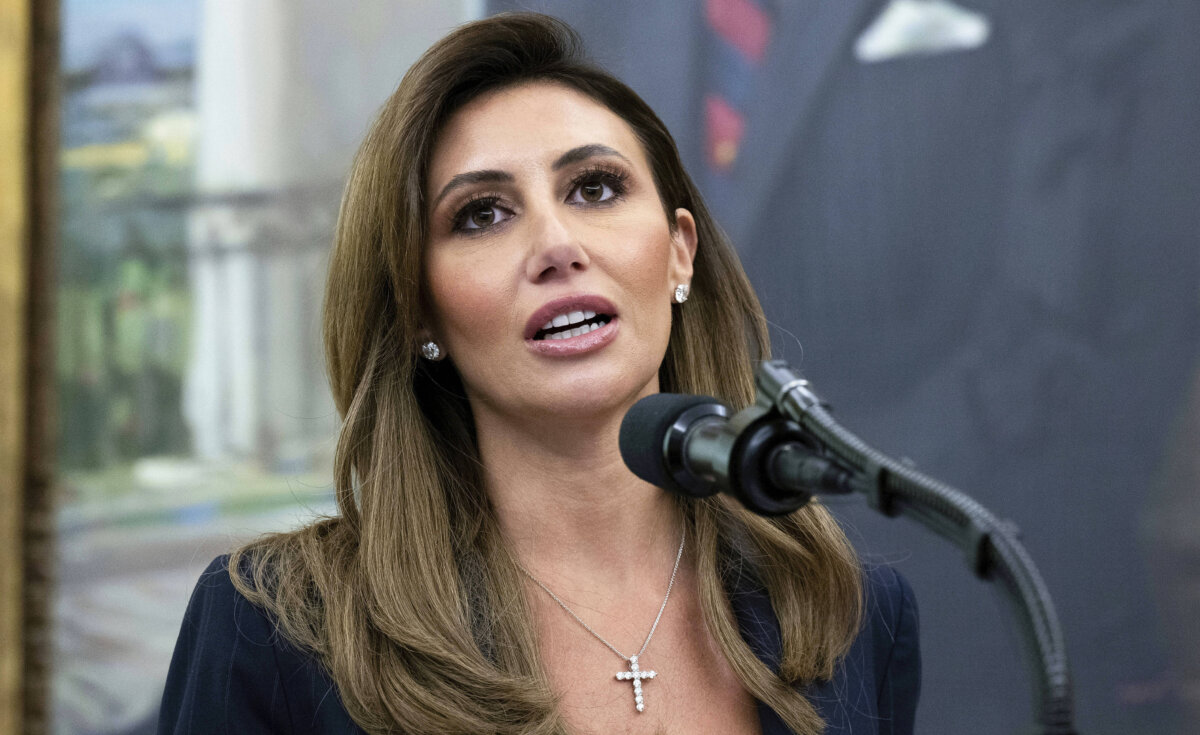
A federal appeals court on Jan. 26 declined to rehear an attempt by the Justice Department to reinstate Alina Habba as the acting U.S. attorney for New Jersey.
A three-judge panel of the U.S. Court of Appeals for the Third Circuit, on Dec. 1, affirmed a district court decision that disqualified Habba from serving in the role, to which she was appointed on July 24. The Justice Department petitioned the whole court to rehear the case, but a majority of the judges voted to deny that request.
“[A] majority of the judges of the circuit in regular service not having voted for rehearing, the petition for rehearing by the panel and the Court en banc, is denied,” the appeals court wrote in its decision.
Three circuit judges, out of the 14 active judges on the court, voted in favor of the rehearing, with one of them, U.S. Circuit Judge Jennifer Mascott, indicating she would file a written dissent later.
The Justice Department could petition the U.S. Supreme Court to hear the case. The Supreme Court’s rules require such petitions be filed within 90 days after denial of a rehearing.
Habba served as the interim U.S. attorney for the District of New Jersey from March 28 to July 26, representing the 120-day maximum allowed under the law. The district court had the authority to appoint her to continue in that role, but declined to do so.
Habba was then hired by the Justice Department for a different position before being installed as the first assistant U.S. attorney in the office. The Federal Vacancies Reform Act states that, when the position of an officer of the United States is vacant, the “first assistant” to that office becomes the acting officeholder.
The Justice Department argued that, because no permanent appointee was in place, Habba automatically became the acting U.S. attorney due to her position as the first assistant, as provided for under the act. The argument was rejected by both the district court and the appeals court.
“Only the first assistant in place at the time of the vacancy automatically assumes acting status under the [Federal Vacancies Reform Act],” the appeals court wrote in its decision on Dec. 1.
Justice Department leaders have criticized the district court for not appointing Habba to continue past the 120-day interim period. “[P]olitically minded judges refused to allow her to continue in her position,” Attorney General Pam Bondi wrote on July 22 on social media.
State leaders in New Jersey, by contrast, have supported the district court’s actions.
“Alina Habba was completely unqualified to lead the U.S. Attorneys’ Office for the District of New Jersey,” New Jersey Gov. Mikie Sherrill wrote on social media. “She explicitly politicized the office, weaponized it against the president’s perceived political opponents, and unlawfully stayed in this role until she was finally removed by the courts.”
Habba previously worked as a personal attorney for President Donald Trump. Before joining the Justice Department, she was a counselor to the president in the White House during his second term.
Habba’s case was one of many that have prompted courts to weigh in on federal law and attorney appointments.
Several first assistant U.S. attorneys appointed by the Trump administration have been disqualified by federal district courts from either serving as acting U.S. attorney or from participating in cases in that capacity.
In the Northern District of New York, First Assistant John Sarcone was disqualified from participating in an investigation as the acting U.S. attorney on Jan. 8. In the Central District of California, First Assistant Bill Essayli was also disqualified on Oct. 28.
 Friends Read Free
Copy
Facebook
Tweet
Friends Read Free
Copy
Facebook
Tweet