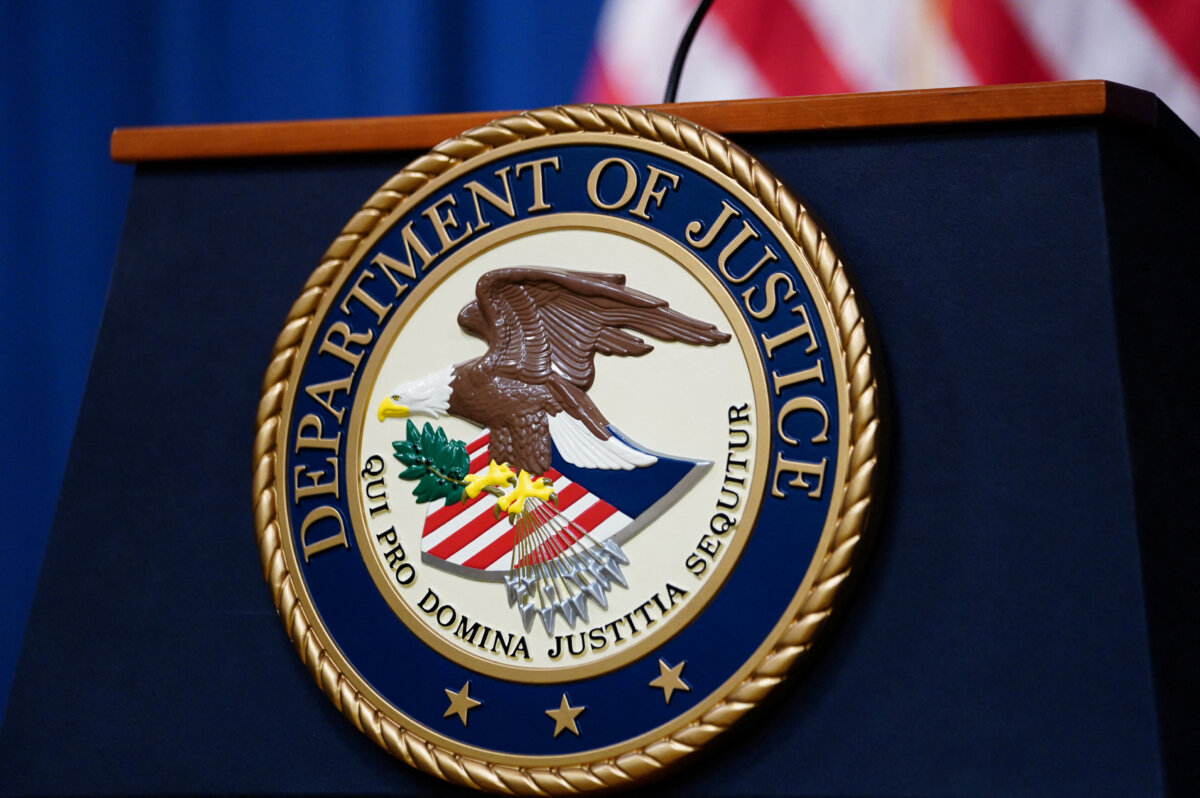
The Justice Department has appealed a federal court order disqualifying acting U.S. Attorney John Sarcone from pursuing investigations into New York Attorney General Letitia James’s office.
The department filed a notice of appeal on Jan. 23 alongside a brief telling U.S. District Judge Lorna Schofield that she misinterpreted a federal law governing attorney appointments. It’s now asking Schofield to halt the effects of her Jan. 8 order, which quashed Sarcone’s subpoenas targeting James’s investigations of President Donald Trump and the National Rifle Association.
“Mr. Sarcone is validly serving as Acting U.S. Attorney under [federal law] and … is authorized to supervise the subject investigations,” the department wrote in its filing. It argued that a law known as the Federal Vacancies Reform Act (FVRA) allowed Sarcone to serve in an acting attorney capacity in the U.S. Attorney’s Office for the Northern District of New York.
Sarcone was initially appointed on March 17, 2025, to be an “interim” rather than “acting” U.S. attorney—a position used to fill the job until a president’s nominees are appointed—and served for the maximum term of 120 days. Another section of federal law—28 U.S. Code § 546—required the district court to appoint an interim U.S. attorney until a Senate-confirmed replacement took the spot. In this case, the district court declined on July 14, 2025, to make an appointment.
That same day, Sarcone said he had been appointed as a “special attorney” and was designated as a “first assistant” to the Northern District of New York. That position was important because the Federal Vacancies Reform Act generally designates first assistants to serve as acting U.S. attorneys when the usual spot is vacant.
The Senate had confirmed former U.S. Attorney Carla Freedman to serve the northern district in 2021, but she resigned on Feb. 17, 2025, after President Donald Trump took office. Earlier this month, Schofield held that Sarcone’s move to the first assistant position was too late. Instead, she said, he would have had to be first assistant when Freedman resigned.
The law, she said, “ensures continuity of leadership by identifying the incumbent First Assistant as the acting officer at the moment a vacancy first arises.”
The department, by contrast, cited the text of the act to argue that it did not require Sarcone to be the first assistant at the time of the vacancy to become acting U.S. attorney.
“The FVRA does not limit acting service to only the individual (if any) who happened to be serving as the ‘first assistant to the office of the officer’ when the vacancy initially arose,” the department wrote.
The case is one of several where federal courts have ruled that Trump’s prosecutors were serving unlawfully. Alina Habba in the District of New Jersey was also disqualified from serving as acting U.S. attorney based on the Federal Vacancies Reform Act, as was Bill Essayli in the Central District of California.
More recently, on Jan. 20, Interim U.S. Attorney Lindsay Halligan, for the Eastern District of Virginia, resigned after a judge directed her to stop using that title. The district court, in her case, did not appoint her to continue and released a job vacancy announcement for the role.
The department stated that Halligan’s departure was a “significant loss … for the communities she served,” and criticized Democrats in the Senate for refusing to advance her nomination to serve as the permanent appointee.
“The circumstances that led to this outcome are deeply misguided. We are living in a time when a democratically elected President’s ability to staff key law enforcement positions faces serious obstacles,” Attorney General Pam Bondi wrote in a statement.
 Friends Read Free
Copy
Facebook
Tweet
Friends Read Free
Copy
Facebook
Tweet