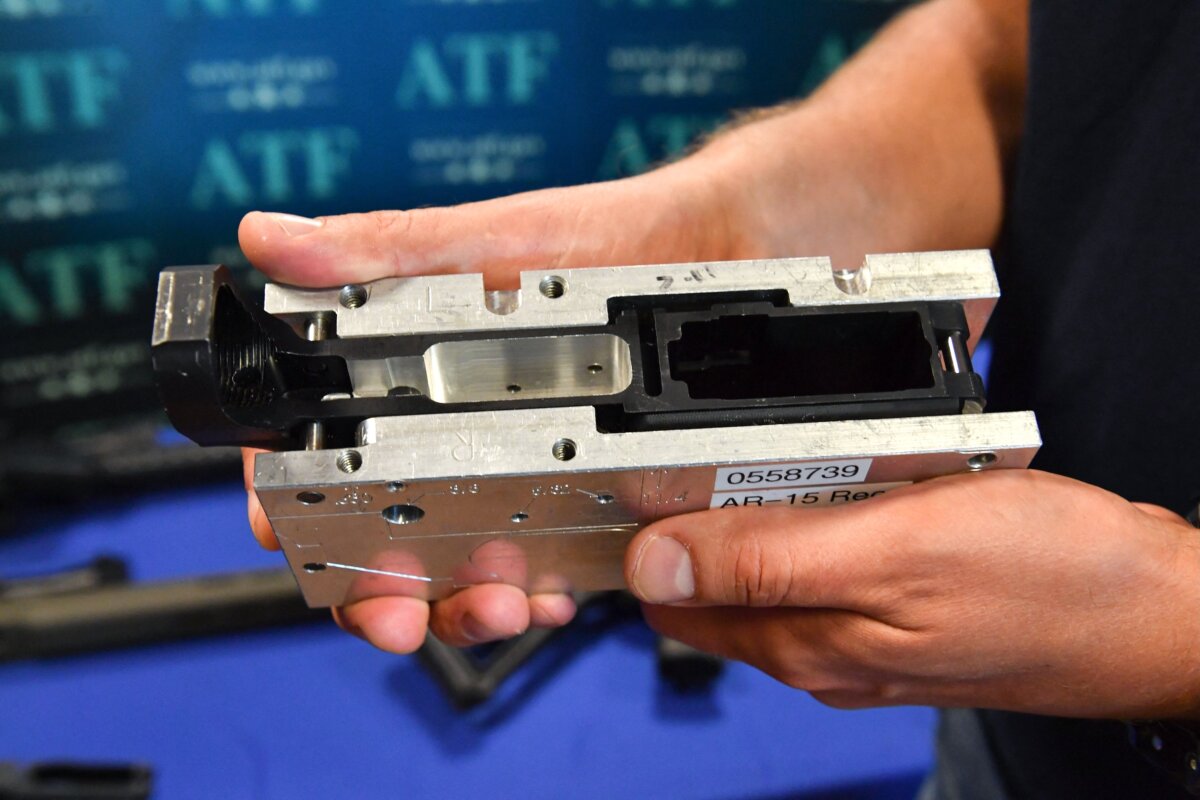

A federal appeals court has dismissed a lawsuit by California and a gun-safety advocacy group seeking stricter federal rules on “ghost guns”—firearms with no serial number on them, making them untraceable by law enforcement.
Overturning a lower court decision, the 9th U.S. Circuit Court of Appeals in San Francisco ruled 3–0 on Aug. 22 that the state of California and the Giffords Law Center failed to show that a federal rule made by the U.S. Bureau of Alcohol, Tobacco, Firearms, and Explosives (ATF) in 2022 caused them concrete, non-speculative harm.
Under the rule, the ATF only treated certain partially completed receivers or frames as firearms—those that were sold together with tools or jigs. Unfinished parts sold separately were to remained unregulated, which the plaintiffs claimed created a harmful loophole for access to unregulated firearms.
The court ruled that California and Giffords lacked standing because they failed to show how the rule had caused them harm beyond the alleged risks and problems predating the ATF rule.
“The Constitution assigns the judiciary a ‘limited’ role, and ‘[b]y ensuring that a plaintiff has standing to sue, federal courts ‘prevent the judicial process from being used to usurp the powers of the political branches,’” the majority opinion reads.
California Attorney General Rob Bonta and Giffords did not immediately say whether they will appeal the appellate court decision. The Epoch Times has contacted Bonta’s office for comment.
Due to the lack of serial numbers, ghost guns can be acquired without background checks. People otherwise ineligible to buy firearms can purchase components that they can use to build guns.
U.S. District Judge Edward Chen had ruled in favor of the plaintiffs in February 2024, finding that the ATF’s ghost gun rule was arbitrary and capricious.
In an Aug. 21 opinion, Circuit Judge Consuelo Callahan, on behalf of Judges Holly Thomas and Anthony Johnstone, wrote that the ATF’s partial ban “effectively extended the reach of the Gun Control Act.”
Callahan said California did not prove the ATF’s actions caused it to spend more to train law enforcement and speed up its own ghost gun legislation, while Giffords did not show that ATF undermined the nonprofit’s core mission and forced it to spend more combating the proliferation of guns.
“The causation requirement does not permit courts to accept links that are too ‘speculative’ or ‘attenuated,’” the judges said.
Separate Challenge
The decision was issued four days after U.S. District Judge Reed O’Connor in Fort Worth, Texas, ruled on a separate challenge, this time from pro-Second Amendment groups, that the 2022 rule was in violation of people’s constitutional right to bear arms under the Second Amendment.
The plaintiffs, Defense Distributed and the Second Amendment Foundation, argued that Americans have a long tradition of privately manufacturing their own firearms, and that the rule was unconstitutionally vague as to when a piece of metal or plastic would come to be considered a regulated firearm, citing the Fifth Amendment’s Due Process Clause.
O’Connor issued a party-specific injunction, not a nationwide one, blocking the federal government from enforcing the rule but only against the plaintiffs. For now, everyone else in the United States remains subject to the rule.
The federal government can appeal to the Fifth Circuit, where the relief could be affirmed or expanded. It is unclear if the Trump administration will seek an appeal.
In March 2025, in response to a separate challenge of the rule, the U.S. Supreme Court upheld the ATF’s authority to issue the rule. O’Connor had previously ruled on the case against the ATF’s authority.
 Friends Read Free
Copy
Facebook
Tweet
Friends Read Free
Copy
Facebook
Tweet