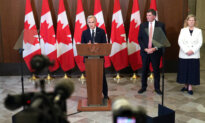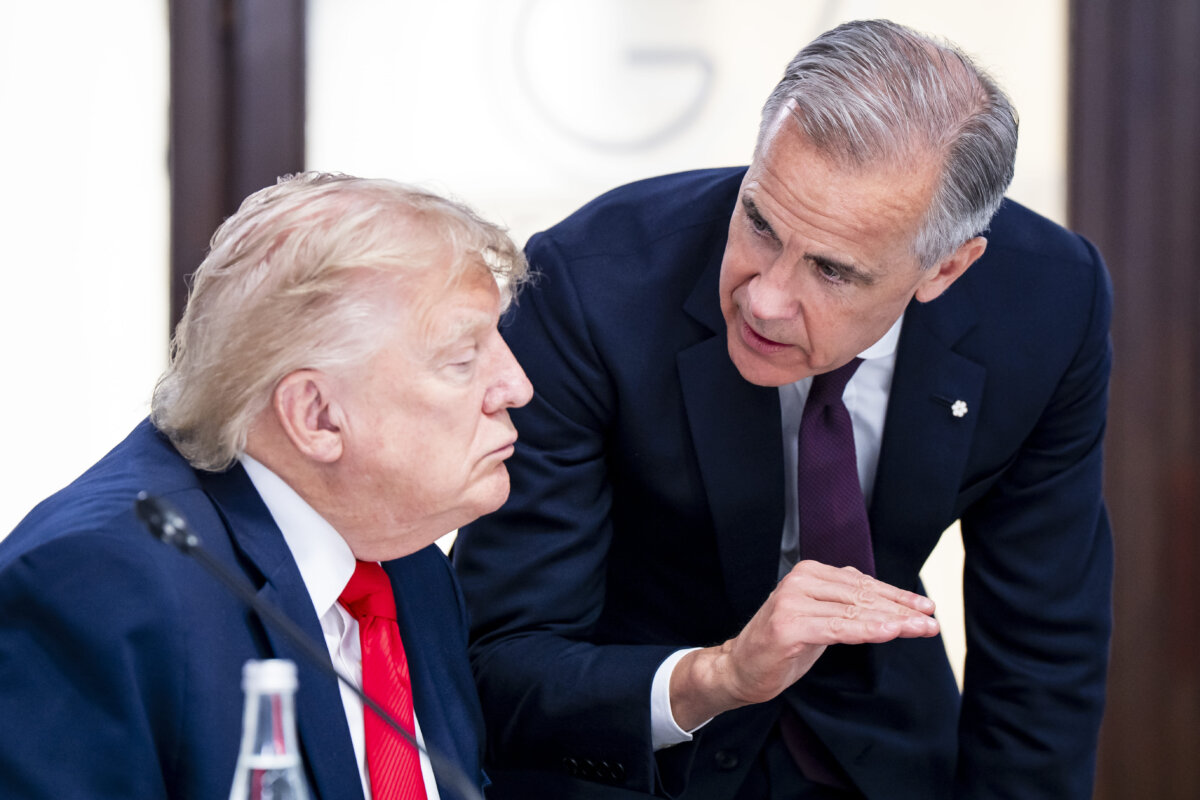

Prime Minister Mark Carney says trade talks with the United States failed over auto-sector tariffs and other demands that he said would adversely impact Canada’s sovereignty. Washington, meanwhile, is blaming Canada for the collapse of the trade talks.
U.S. President Donald Trump delayed his 50 percent tariffs on about $28 billion in Canadian goods for three days on Aug. 19 as the two sides worked on a deal, which ultimately fell through on Aug. 21.
Ottawa’s decision to walk away from the negotiating table came down to three specific factors, Carney said at a press conference in Ottawa on Aug. 22.
Trucks
Carney said certain tariff reductions applicable to the auto industry proposed by the U.S. side in exchange for concessions would not apply to medium- and heavy-duty trucks.
“With respect to Ford’s new plant, for example, in Oakville, which is F-350s, 450s, 550s, they would have been excluded. GM, Silverado, same thing, would have been excluded from that,” he said.
International Trade Deals
Carney said the United States also sought to restrict Canada’s ability to engage in trade deals.
“We’re the partner of choice in many respects for countries around the world, and the Americans wanted to restrict that. They had language that what they wanted was to restrict that. Unacceptable,” he said.
Conservative MP Michelle Rempel Garner asked for more details about what derailed the talks, saying that, as a legislator, she doesn’t know whether, for example, Canada’s decision to allow the import of Chinese EVs at reduced tariff rates was a factor.
Canada’s deal with China to allow up to 49,000 Chinese EVs into Canada at the 6.1 percent most-favoured-nation tariff rate has been a source of contention with the White House.
“As an MP, I need to immediately know what was in the deal and the precise rationale for walking away,” Rempel Garner said.
French-Language Requirements
Carney said the United States had also made demands to restrict Canada in imposing French-language requirements.
Speaking in French, he said that there were “threats” to a deal over protections of French-language content.
Quebec Premier Christine Fréchette, who along with other premiers was briefed by Carney on Aug. 22, said the irritants for Washington included requirements for French-language labelling and user manuals for products.
Carney was asked at the press conference if Canada made any last-minute requests that caused the talks to collapse, which he denied.
“No. There’s a short answer. From our perspective, we clarified what was on offer and were continually disappointed by the answers,” Carney said.
Washington’s Response
For its part, Washington blamed Canada for the failure of the trade talks, with U.S. Trade Representative Jamieson Greer saying Ottawa made “new demands and walk-backs of other commitments.”
“Under President Trump, Canada has had the lowest tariffs for its exports to the U.S. market. At the last minute, Canada walked away from a nearly completed deal that would have lowered these tariffs even further,” the Office of the U.S. Trade Representative wrote on social media.
Greer said the proposed deal would have provided Canada “significant tariff reductions” on steel, aluminum, autos, and lumber.
“The offer would have led to supply chain coordination on aerospace, complementary actions to address unfair trade practices, critical minerals cooperation, increased enforcement against imports produced with forced labor, and the announcement of formal U.S.-Mexico-Canada Agreement (USMCA) negotiations,” he said in a statement.
His office also shared a clip from a Fox interview with Greer in which he responded to Ottawa’s plan to retaliate against the latest U.S. tariffs “dollar for dollar.”
“We’re moving forward with measures that respond to Canadian retaliation. Remember, as President Trump has introduced a trade policy to reshore American production and protect American jobs, two countries have retaliated against the United States: the People’s Republic of China and Canada,” Greer said in the interview.
 Friends Read Free
Copy
Facebook
Tweet
Friends Read Free
Copy
Facebook
Tweet