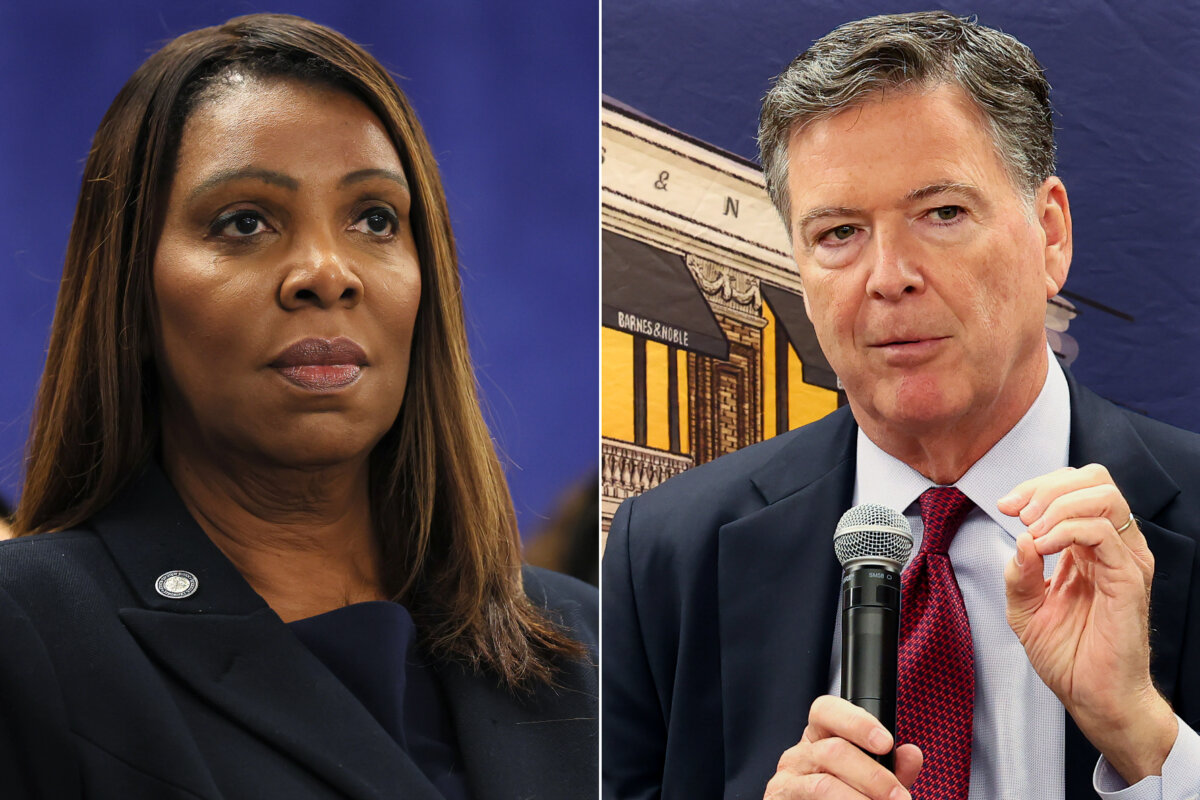
The Department of Justice is asking an appeals court to revive two cases—one against former FBI Director James Comey and the other against New York Attorney General Letitia James.
The Court of Appeals for the Fourth Circuit agreed to combine both DOJ appeals into one case and will hear arguments on Sept. 14.
Comey was indicted in September 2025 for allegedly lying to Congress about FBI media leaks, while James was charged with bank fraud and lying on a mortgage application. Comey and James have both denied the charges.
Both cases were tossed after a federal judge ruled that former Trump aide Lindsay Halligan had been illegally appointed as interim U.S. attorney for the Eastern District of Virginia and had no authority to bring the charges.
Halligan stepped into the role of acting U.S. attorney after her predecessor, Erik Siebert, resigned in September 2025. She secured the grand jury indictments against both defendants later that month.
Comey and James filed motions to dismiss their cases, arguing that then-Attorney General Pam Bondi had no right to appoint Halligan.
Section 546 of U.S. Code 28 says U.S. attorneys need Senate approval, but can be appointed by the attorney general to serve for 120 days during the confirmation process. If they haven’t been confirmed within that time, the local district court gets to select someone to fill the spot.
Siebert was never confirmed, but a district court had ruled that he could continue in the role.
Comey and James argued that, because the 120-day interim period had expired, the court—not Bondi—should have replaced Siebert. The Justice Department said the 120-day clock started over with Halligan’s appointment.
Last November, U.S. District Judge Cameron Currie found in favor of the defendants, saying that “all actions flowing from Ms. Halligan’s defective appointment … constitute unlawful exercises of executive power and must be set aside.”
Comey and James have both said the indictments against them are retaliatory, vindictive prosecution stemming from their opposition to President Donald Trump.
James had campaigned for attorney general with an explicit promise that she would investigate Trump, referring to him as an “illegitimate” president. She followed through on that, bringing multiple lawsuits against Trump, his family members, and business associates.
Comey was head of the FBI during the now debunked “Russiagate” hoax, in which the newly inaugurated president was accused of having stolen the U.S. election with the help of Russian President Vladimir Putin. Trump fired Comey in 2017.
The former FBI director is facing more legal action from the DOJ. He was indicted in April for posting a picture of seashells arranged to say “86 47” on social media. To “86” something means to get rid of, or kill, and Trump is the 47th U.S. president. Comey has said he thought the shells were a political statement, not a threat.
Halligan resigned earlier this year, after failing to secure Senate approval. Several other Trump-picked U.S. Attorneys have been removed by federal courts that ruled their appointments unlawful.
In New York, an appeals court upheld the removal of John Sarcone after he subpoenaed James as part of a Justice Department probe into her Trump investigations. The Ninth Circuit also ruled that Sigal Chattah was wrongly appointed in Nevada.
In both cases, those attorneys were appointed as first assistant to an already vacant U.S. attorney position, which theoretically allowed them to move into the top spot without Senate confirmation.
The courts ruled that was an unlawful workaround.
 Friends Read Free
Copy
Facebook
Tweet
Friends Read Free
Copy
Facebook
Tweet