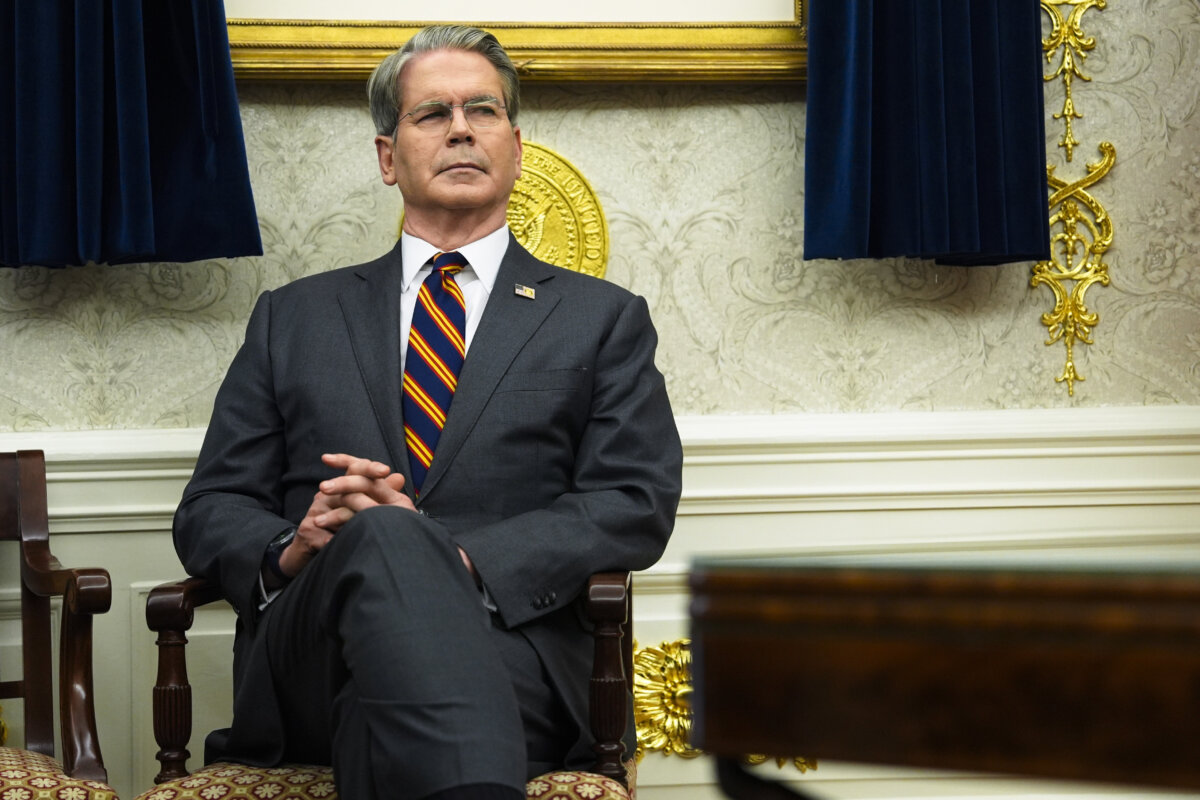

Treasury Secretary Scott Bessent said he has divested his soybean farm holdings and acknowledged that, despite China’s commitment to buy more U.S. agricultural products, farmers still need support from the federal government.
“I’m involved in the agriculture industry. I run a soybean farm,” Bessent said on Dec. 7 during an appearance on CBS’s “Face the Nation.”
He was discussing the difficult year faced by U.S. farmers after China drastically cut purchases of U.S. agricultural products, particularly corn and soybeans, in retaliation for tariffs from the Trump administration.
“I actually just divested it this week as part of my ethics agreement, so I’m out of that business,” he said.
Bessent’s divestiture comes four months after the U.S. Office of Government Ethics (OGE) informed the Senate Finance Committee that he had “failed to timely comply with certain terms” of the ethics agreement he signed before taking office in late January.
Federal officials must sell assets that could be affected by their official duties to avoid real or perceived conflicts of interest.
In a follow-up letter to the Senate committee, OGE said Treasury ethics officials reported that Bessent had committed to completing all remaining divestitures by Dec. 15, including farmland in North Dakota.
According to his financial disclosure filed with the OGE in January, Bessent owned corn and soybean farmland worth up to $25 million across North Dakota’s Burleigh, Kidder, Eddy, Benson, and Wells counties. He rented out the land through a revenue-sharing arrangement that could generate as much as $1 million a year, depending on crop prices.
Bessent, a hedge fund manager, has referred to himself as a soybean farmer and said that he, too, felt the pain of being caught in the middle of the U.S.–China trade war.
“I probably know more than any Treasury secretary about agriculture since the 1800s,” he told CBS’s Margaret Brennan. “And I can tell you that what farmers need is certainty.”
The certainty, according to Bessent, would come from a long-term purchase arrangement with China, which has pledged to restore its soybean imports from the United States to typical levels over the next three years.
For the current harvesting season, China committed to buying 12 million metric tons of soybeans, roughly equivalent to its average annual imports before the trade dispute.
Before that commitment, China had halted purchases of U.S. soybeans for several months and instead turned to Brazil, cutting American farmers off from their largest export market.
On Dec. 2, Agriculture Secretary Brooke Rollins announced at a Cabinet meeting at the White House that her department would soon distribute billions of dollars in one-time payments to crop farmers through the Farmer Bridge Assistance Program.
When asked why such payments were still necessary given the new commitments from China, Bessent said they are meant to offset the low crop prices producers face now.
“These prices haven’t come in because the Chinese actually used our soybean farmers as pawns in the trade negotiations,” Bessent told CBS.
“We are going to create this bridge because, again, agriculture is all about the future, you’ve got to start financing for planting next year, when things will be very good.”
 Friends Read Free
Copy
Facebook
Tweet
Friends Read Free
Copy
Facebook
Tweet