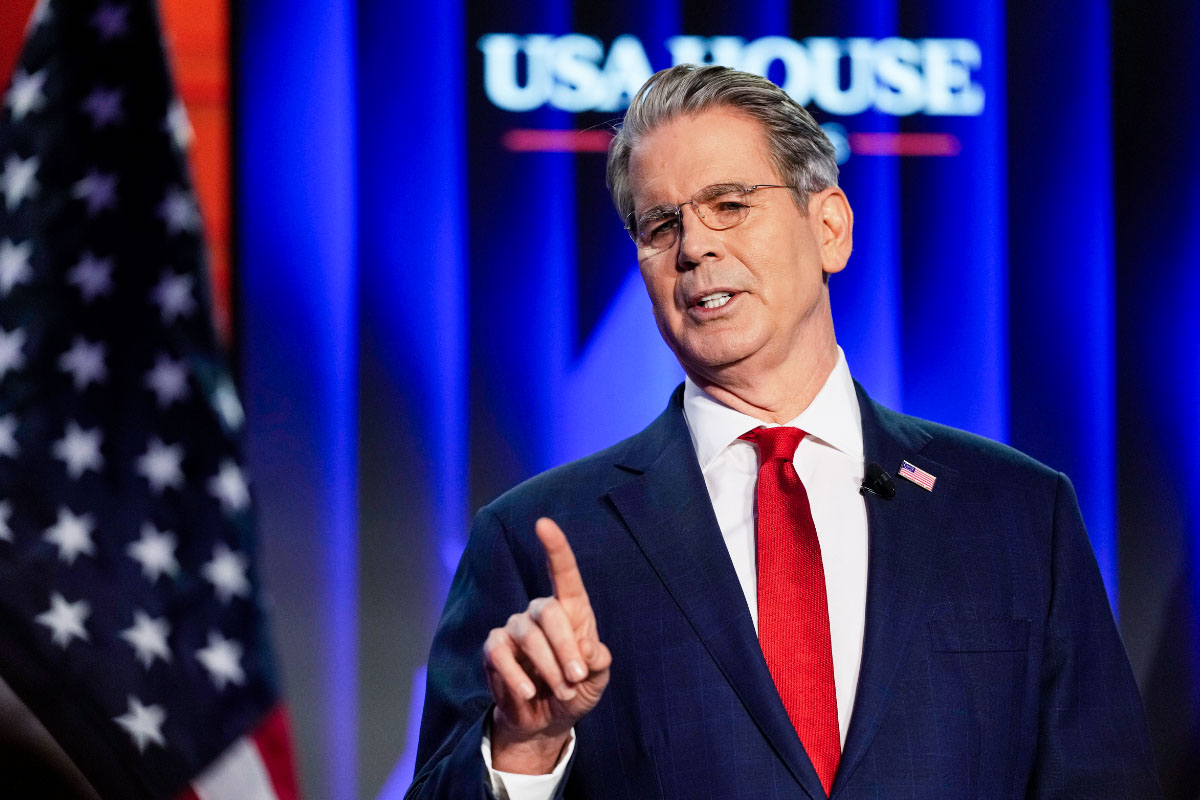

Treasury Secretary Scott Bessent said on Jan. 20 that the relationship between the United States and Europe has “never been closer.” His comments come as President Donald Trump imposed new tariffs on eight European countries that oppose U.S. plans to acquire Greenland.
Bessent made the comments during a press conference at the USA House in Davos, Switzerland, on the sidelines of the 2026 World Economic Forum (WEF), in response to a question about tariffs and the United States’ relationship with Europe.
“I think our relations have never been closer,” Bessent said, noting that in the post-World War II era of diplomacy, the allied European leaders did not always agree with U.S. presidents, “but that did not mean that we were not strong allies against the Soviet Union.”
Trump announced 10 percent tariffs on Jan. 17 against Denmark, France, Germany, Finland, the Netherlands, Norway, Sweden, and the UK for opposing his plans to take control of Greenland, an autonomous territory of Denmark. The tariffs will start on Feb. 1 and increase to 25 percent on June 1.
Affirming the relationship between European nations and the United States, Bessent said: “Europe is an ally, the U.S.’s NATO membership is unquestioned. We are partners in trying to stop this tragic war between Russia and Ukraine. But that does not mean that we cannot have disagreements on the future of Greenland.”
Bessent also urged trading partners to “take a deep breath,” rejecting the notion that parties were heading toward a “protracted trading war.”
The secretary highlighted that the United States and its global partners were in a similar position before agreeing on trade deals after Trump announced reciprocal tariffs in April 2025, and that they have largely reached resolutions.
“This is where we were last year. I’m sure you would have asked me the same question if we were here on April 2. And you know what? It all worked out. The economies are fine. We have a very good trade agreement,” Bessent said.
When asked about whether he had a message for European businesses, Bessent said, “I am confident that the leaders will not escalate and this will work out in a manner that ends up in a very good place for all for national security, for the U.S., and for Europe.”
European Reactions
Trump says the United States needs to acquire Greenland for national security purposes, amid possible threats from China and Russia.
After Trump announced the tariffs, European leaders held an emergency meeting on Jan. 18, after which EU Council President Antonio Costa said that member states agree the tariffs “undermine transatlantic relations and are incompatible with the EU-U.S. trade agreement.”
The eight countries subject to tariffs also issued a joint statement the same day, saying, “Tariff threats undermine transatlantic relations and risk a dangerous downward spiral.”
The European nations, all NATO members, also sent a small military contingent to the Arctic island. The group stressed that the military deployment “poses no threat to anyone” and is intended to bolster security “as a shared transatlantic interest.”
American Leadership
Bessent’s comments follow remarks he made the day before on the nature of American leadership on the world stage.
He told the press in Davos on Jan. 19 that the message he wants to convey during the annual WEF meeting is that “‘America First’ does not mean ‘America Alone.'”
“I think President Trump will be talking about. This is what American leadership in the world looks like,” he said.
Trump will attend the gathering in Davos on Jan. 21 and 22.
The United States will host the G20 summit in Miami in December, and, signalling what American leadership will look like at that event, Bessent said the United States would “identify the lack of growth as the greatest threat to financial stability.”
“So we are going to be pushing for growth, for deregulation,” he said.
US–EU Trade Deficit
On Jan. 20, U.S. Trade Representative Jamieson Greer said that the U.S. trade deficit with the EU for the past year “might end up being bigger than the trade deficit with China.”
“We reduced that trade deficit by about 25 percent last year. So when it comes to imbalance, we have a huge imbalance with Europe,” Greer said after delivering a keynote address at the USA House in Davos.
According to the Office of the U.S. Trade Representative, the United States had a total goods trade deficit with the EU of $235.9 billion in 2024, a 13.6 percent increase over 2023.
The U.S. trade deficit with China in 2024 totalled $295.5 billion, a 5.7 percent increase from the previous year.
Greer made the remarks in response to a question suggesting that the United States was treating the EU worse than China in terms of trade policy, which he rejected, noting that the United States has had “much higher tariffs on China.”
The trade representative said that while Europe has had “huge success in the U.S. market” for years, the United States has had “limited access to Europe.”
“You limit our agricultural imports, you limit our industrial imports, and you have a huge surplus with us. And it’s not because you’re particularly competitive,” he said.
 Friends Read Free
Copy
Facebook
Tweet
Friends Read Free
Copy
Facebook
Tweet