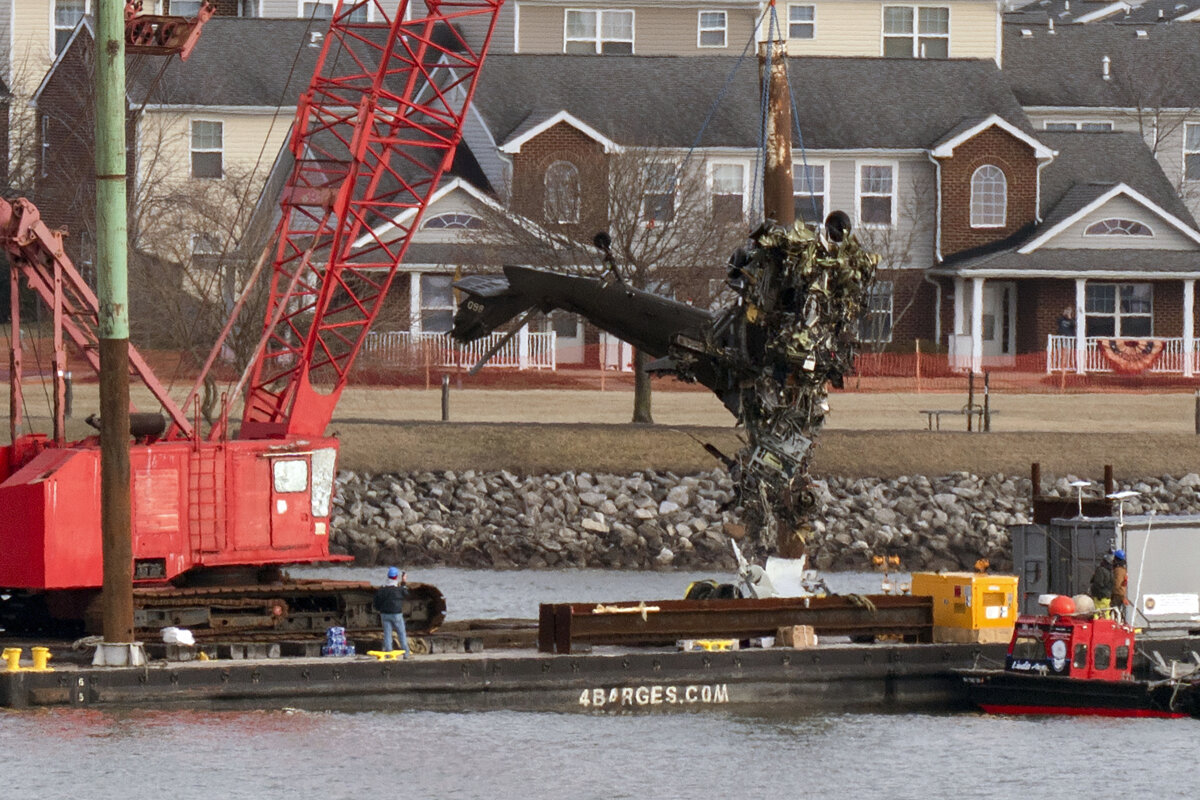

WASHINGTON—The crew of the Army Black Hawk helicopter that collided with a commercial jet earlier this year in the nation’s deadliest aviation accident in more than two decades was operating with incorrect altitude data, the National Transportation Safety Board (NTSB) revealed on July 30.
The information was released during the first day of a three-day “fact-finding” hearing by the NTSB, which is probing the Jan. 29 crash.
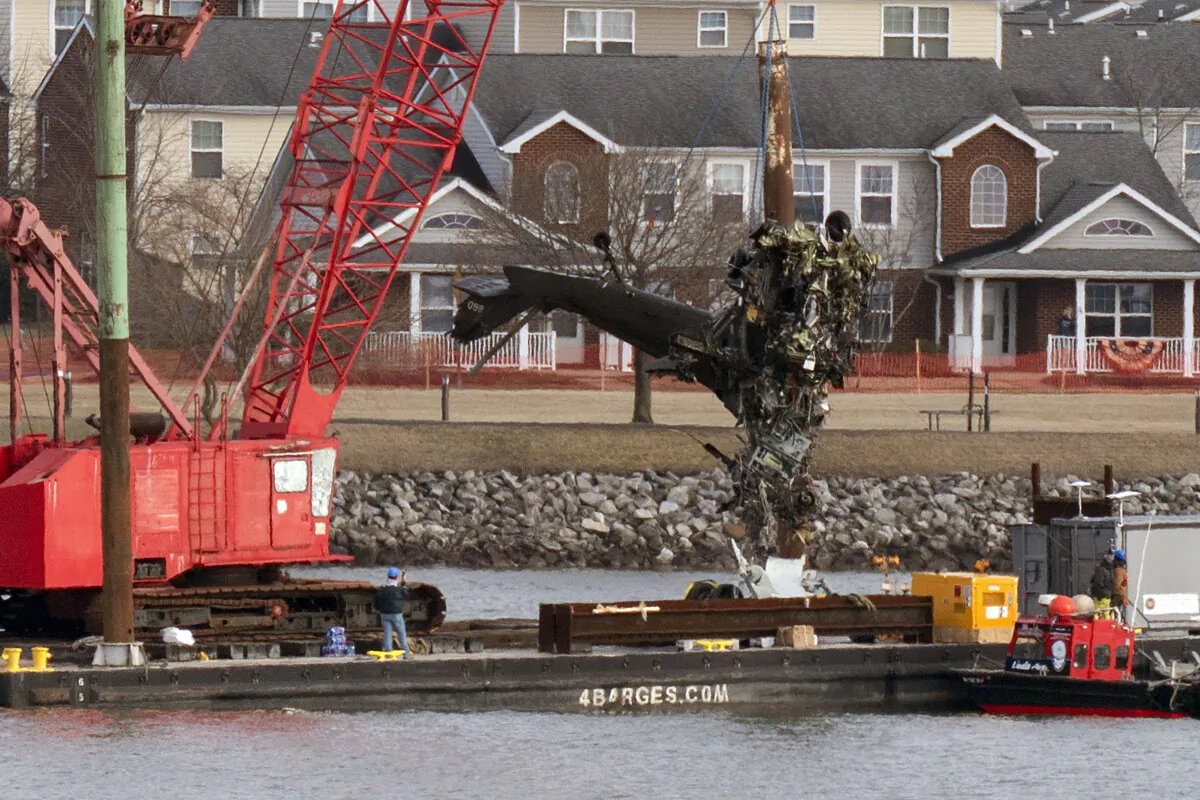
The collision occurred after the Army-operated Sikorsky Black Hawk helicopter crossed into the path of a CRJ700 regional jet operated by PSA Airlines on behalf of American Airlines.
Sixty-seven people died in the crash.
The plane had departed from Wichita, Kansas, and was en route to Ronald Reagan National Airport when it collided with the helicopter over the Potomac River.
“This hearing is a critical part of our ongoing investigation of the fatal mid-air collision,” NTSB Chair Jennifer Homendy said in her opening remarks.
“Please know that we are working diligently to make sure we know what occurred, how it occurred, and to prevent it from ever happening again.”
To determine altitude, helicopters deploy devices known as radio altimeters, which use radio waves to measure the distance between the aircraft and the ground below.
The Black Hawk crew also had access to a barometric altimeter, which uses atmospheric pressure readings to measure altitude.
Most crews operating at low altitudes, particularly over the Potomac River, will use the radio altimeter as it is regarded as more accurate.
However, the panelists at the NTSB’s hearing on Wednesday said the Black Hawk crew was trained to use their barometric altimeters to measure altitude during flight.
The NTSB revealed data showing discrepancies in the two altimeter readings on the helicopter that collided with the CRJ700 on Jan. 29.
Throughout its flight, the crew called out elevations to air traffic control that were roughly 80 to 100 feet lower than what their radio altimeter was recording, the NTSB said.
Investigators also tested three other Sikorsky Black Hawk helicopters after the collision and recorded similar discrepancies between the two altimeters.
The difference between the two readings increased when the helicopter’s rotors were activated.
Dan Cooper, senior technical fellow at Sikorsky helicopters, said the Black Hawk was designed in the 1970s and deploys a type of altimeter that was standard at the time.
By contrast, newer helicopters utilize air data computers and give crew members more accurate altitude data.
However, Army officials suggested that a 70- to 100-foot discrepancy between the helicopter’s altimeters is within what’s considered an acceptable range, as pilots are expected to maintain an altitude that is plus or minus 100 feet.
The Army’s Scott Rosengren said he found it more concerning that the Federal Aviation Administration (FAA) had approved flights around Reagan National Airport that allowed for a separation distance between helicopters and landing planes that is less than 500 feet.
NTSB board members grilled the Army panelists on Wednesday, demanding to know when training manuals for the helicopters would be updated to address the discrepancies between the aircraft’s two altimeters.
Steve Braddom, acting chief airworthiness engineer for the Army’s AvMC Systems Readiness Directorate, said the Army is currently working on a plan on how and when to incorporate the information on altimeter discrepancies into the helicopter’s manual.
The CRJ700 regional jet, by contrast, had consistent altitude readings in the moments before the deadly midair collision, the NTSB said.
The hearing began with an 11-minute animation that depicted the events leading up to the collision, ending with a newly released surveillance video that showed the Black Hawk helicopter crossing into the path of American Airlines flight 5342.
The footage ended at the moment of impact.
The NTSB questioned a panel of witnesses and investigators about how decisions by the Army and FAA may have contributed to America’s deadliest aviation accident since November 2001.
Investigators previously highlighted how the FAA has failed to act on a concerning record of 85 near misses around Reagan National Airport in the years before the deadly midair collision.
The Army has admitted a history of flying around Washington without critical location transmitting technology, known as ADS-B Out, engaged.
The final report on determining the probable cause of the crash is not expected until 2026.
On Thursday, the NTSB will continue its three-day “fact-finding” hearing into the deadly crash. The hearing will conclude on Friday.
The Associated Press contributed to this report.
 Friends Read Free
Copy
Facebook
Tweet
Friends Read Free
Copy
Facebook
Tweet