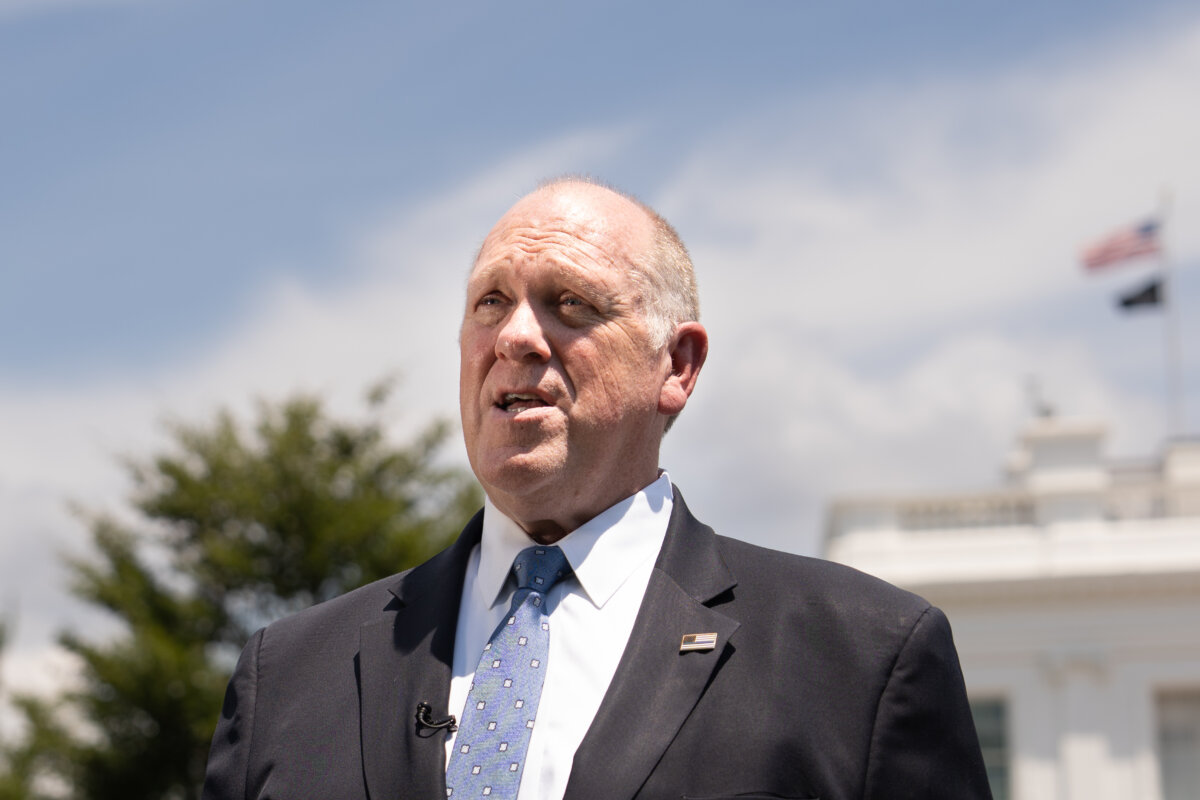

Border czar Tom Homan said Monday that Immigration and Customs Enforcement (ICE) officials will ramp up arrests of illegal immigrants following the passage of the One Big Beautiful Bill Act last week.
When asked about the funding provided under the bill, Homan said that that money will be used to construct more border walls along the U.S.–Mexico border, for ICE, and other enforcement efforts.
President Donald Trump signed the roughly 900-page bill into law on July 4, allowing for 10,000 more ICE officers to be hired. The bill provides ICE with enough detention capacity for 100,000 illegal immigrants and secures 80,000 new beds for the agency’s detention centers.
“It’s going to put more boots on the ground” for immigration enforcement, Homan told reporters on Monday during a press gaggle at the White House, adding that as of Monday, more than 600,000 illegal immigrants with criminal records are still in the United States.
Homan signaled that the administration is seeking to carry out more ICE-related arrests and indicated that a previously set threshold of 3,000 arrests per day isn’t enough.
“And for those that say 3,000 a day is too much, I want to remind them, do the math, we have to arrest 7,000 every single day for the remainder of this administration just to catch the ones [the previous administration] released into the nation,” Homan told reporters on Monday.
Homan said that as a conservative estimate, “well over” 20 million illegal immigrants are currently in the United States and signaled that more ICE arrests are forthcoming with the new funding.
“We’re going to be in New York City,” he continued. “President Trump said it two weeks ago—we’re going to double down and triple down on sanctuary cities. Why? Not because it’s a blue city or a blue state, but because we know that’s where the problem is.”
The border czar reiterated that ICE officials will arrest illegal immigrants in the communities in which they currently reside and at work sites. In Los Angeles, widespread protests and riots erupted last month over ICE enforcement efforts in the city, prompting the Trump administration to deploy thousands of National Guard members to quell the unrest.
The move prompted criticism from local Democrats, with California Attorney General Rob Bonta filing a lawsuit against the administration to block it from deploying state National Guard troops to the city. A judge allowed the Trump administration to retain control over the National Guard as the appeals process plays out.
“We’re gonna enforce the law,” Homan told reporters. “That’s what the people put President Trump in office to do, and that’s what we’re doing.”
The current annual budget for ICE, the government’s primary department for immigration enforcement, is around $10 billion. The bill’s signing allocates more than $100 billion to the agency to carry out enforcement operations amid Trump’s push for mass deportations, a pledge that he campaigned on in his 2024 presidential bid.
Homan, whose official title is White House executive associate director of enforcement and removal operations, told Politico on July 4 that the number of ICE officers that could be hired is unprecedented in U.S. history.
“Look, this isn’t easy. Ten thousand ICE officers? Never happened before,” he said. “But I’ll say this: It’s about time … with more money, we can do more.”
ICE, he added in the interview, has been “on a constant chase, trying to move flights out as quickly as possible just to make room for the arrests they’re making” and confirmed that the agency is averaging between 1,500 to 2,000 arrests per day.
“Teams are coming home before the end of a shift because of lack of beds—not a lot, but it’s happened a few times. So the beds are going to get us more capability for detention. That’s the big thing,” he said.
 Friends Read Free
Copy
Facebook
Tweet
Friends Read Free
Copy
Facebook
Tweet