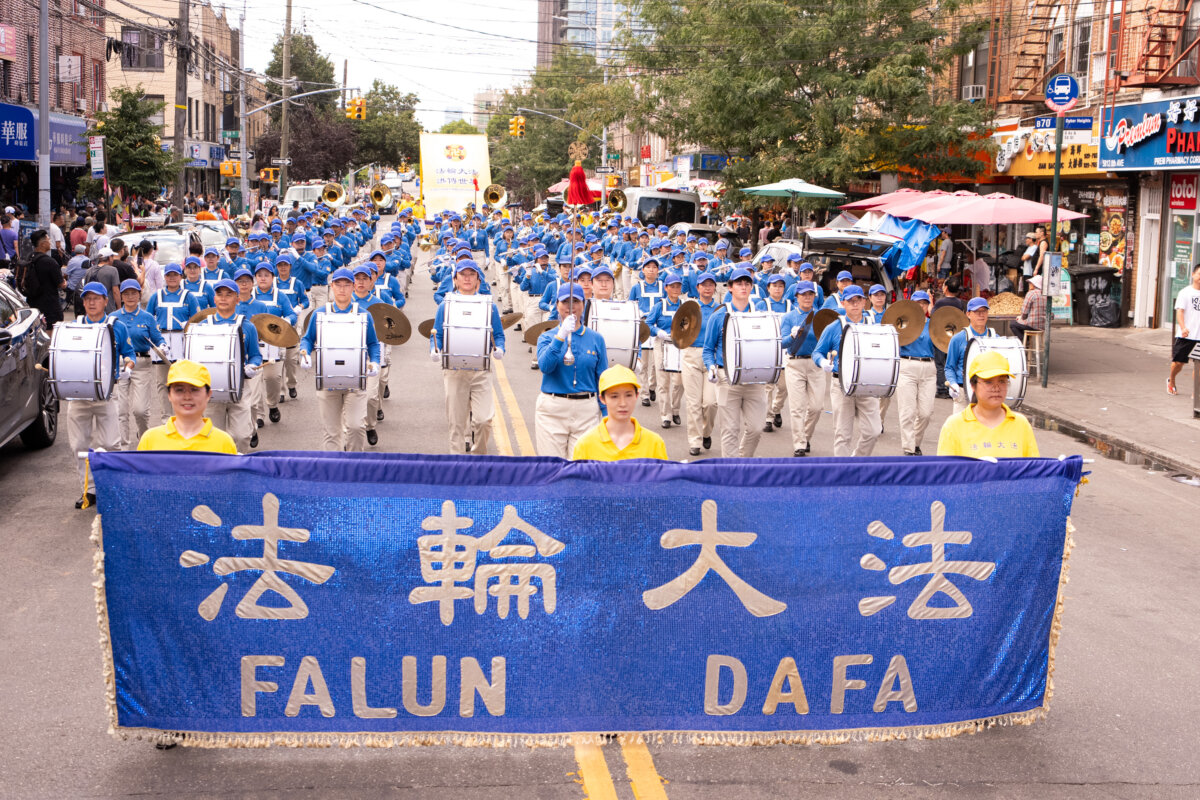

More than 1,000 Falun Gong practitioners paraded through Brooklyn’s Chinatown over the weekend to highlight the Chinese regime’s persecution of their faith and repression of residents on U.S. soil.
Wang Lirong was among those who joined the march on Aug. 23. During the Brooklyn parade in 2024, Wang was one of the victims of an attack by an Asian man who punched her multiple times, including in the head, nearly knocking her down.
“I really couldn’t have imagined it,” Wang told The Epoch Times’ sister media outlet NTD. “In the United States, even with American police officers providing tight security all around us, I was still subjected to this kind of attack.”
She said she had learned from a court that the attacker had been deported to his home country after being detained for several months.
The annual parade was organized by the Global Service Center for Quitting the CCP, a New York-based organization that helps Chinese people to renounce their affiliation with the Chinese Communist Party (CCP). It was founded shortly after The Epoch Times published “Nine Commentaries on the Chinese Communist Party” in 2004.
The publication contains numerous topics that are considered taboo in China, including the history of the Communist Party and its various crimes against the Chinese people. It has also inspired many Chinese people to renounce their ties with the CCP—a grassroots movement known as “Tuidang,” or “quit the party.”
As of Aug. 24, the organization posted on its website that more than 465 million Chinese people have quit the CCP through its platform.
Michael Yu, a representative from the organization, warned that the CCP’s repression of Falun Gong in the United States has broader implications for Americans’ fundamental freedoms.
“Given that [the CCP’s] repression can extend to the United States, it is no longer just an issue targeting Falun Gong. It involves [threats to] freedom of religion and freedom of speech in the United States,” Yu told NTD.
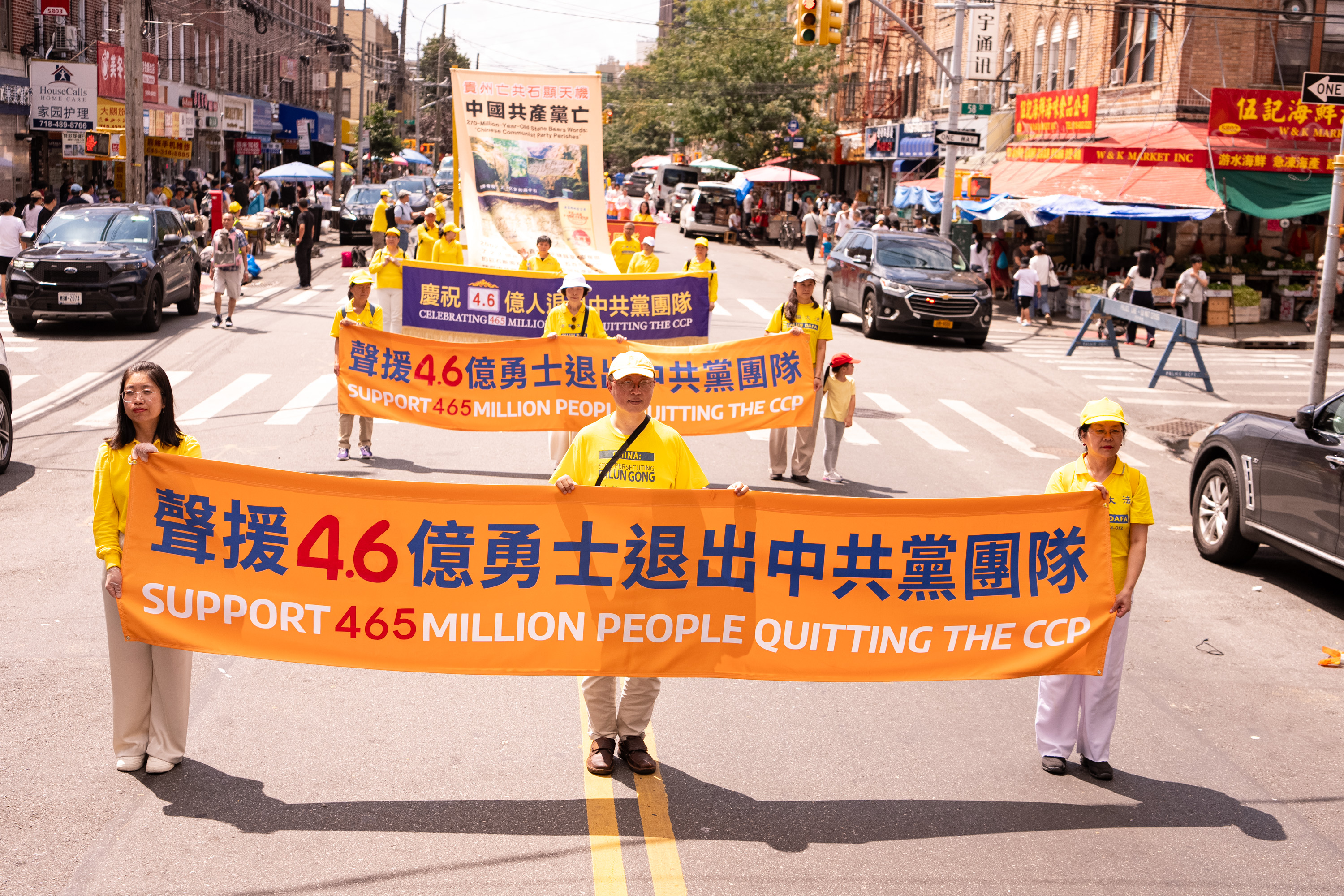 Falun Dafa practitioners take part in a march in Brooklyn, New York City, on Aug. 23, 2026. (Larry Dye/The Epoch Times)
One recent example took place in the Flushing neighborhood in February, when a man struck a resident in the back of the head, knocking her to the ground. She was volunteering at a Falun Gong information booth at the time.
Falun Gong, also known as Falun Dafa, is a spiritual practice grounded in the principles of truthfulness, compassion, and forbearance. Introduced to the Chinese public in 1992 by Mr. Li Hongzhi, the practice had spread widely by the late 1990s, with official estimates placing the number of practitioners at more than 70 million in China.
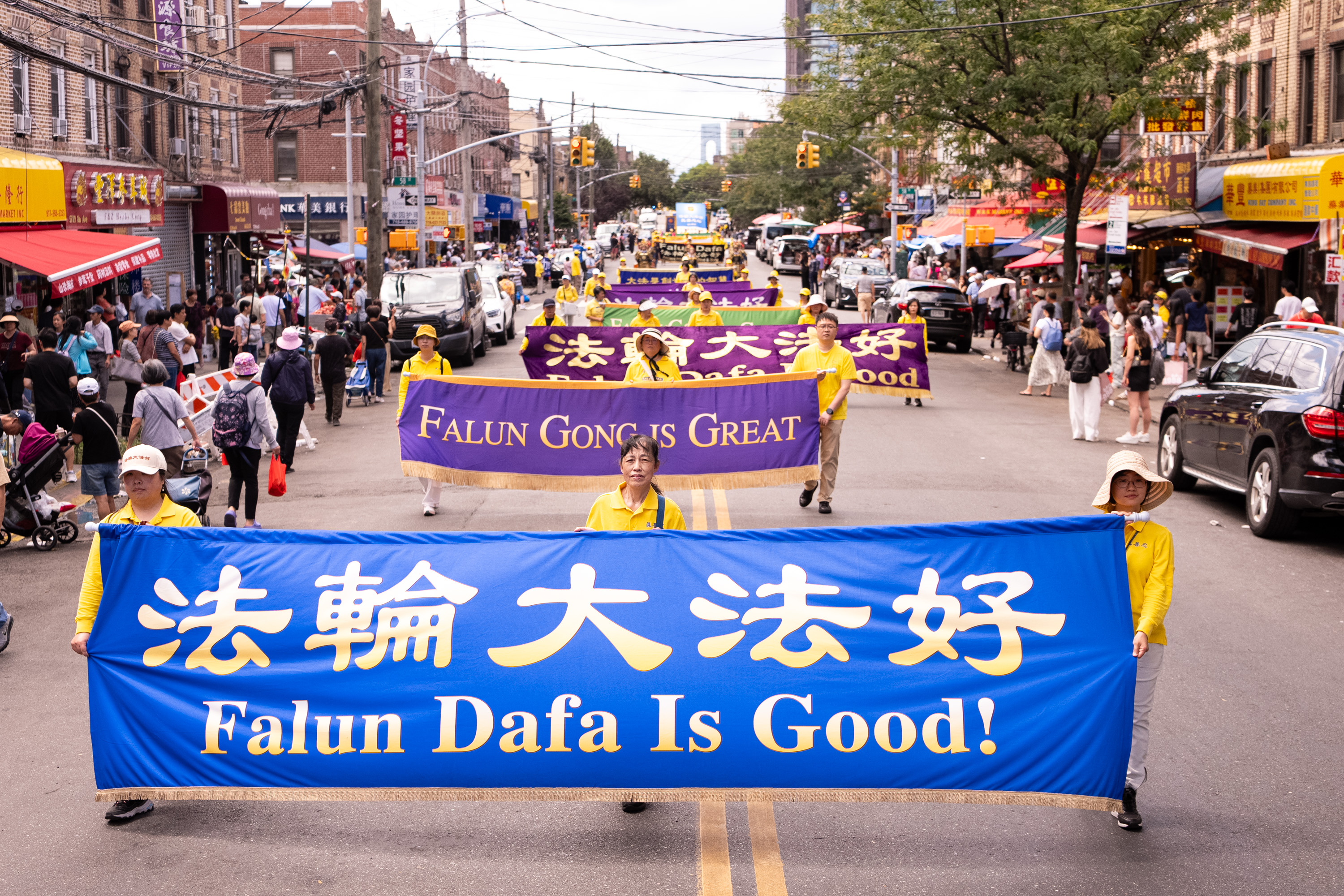 Falun Dafa practitioners take part in a march in Brooklyn, New York City, on Aug. 23, 2026. (Larry Dye/The Epoch Times)
In the past 27 years, an untold number of people have been imprisoned, tortured, subjected to forced labor, and killed for their organs.
Parade in Chinatown
During the parade, some participants held up banners bearing phrases such as “Stop Persecution of Falun Gong,” “Support 465 Million People Quitting the CCP,” and “Condemn the Chinese Communist Party’s Attack on Human Dignity.”
The parade also included a marching band and a waist-drum team.
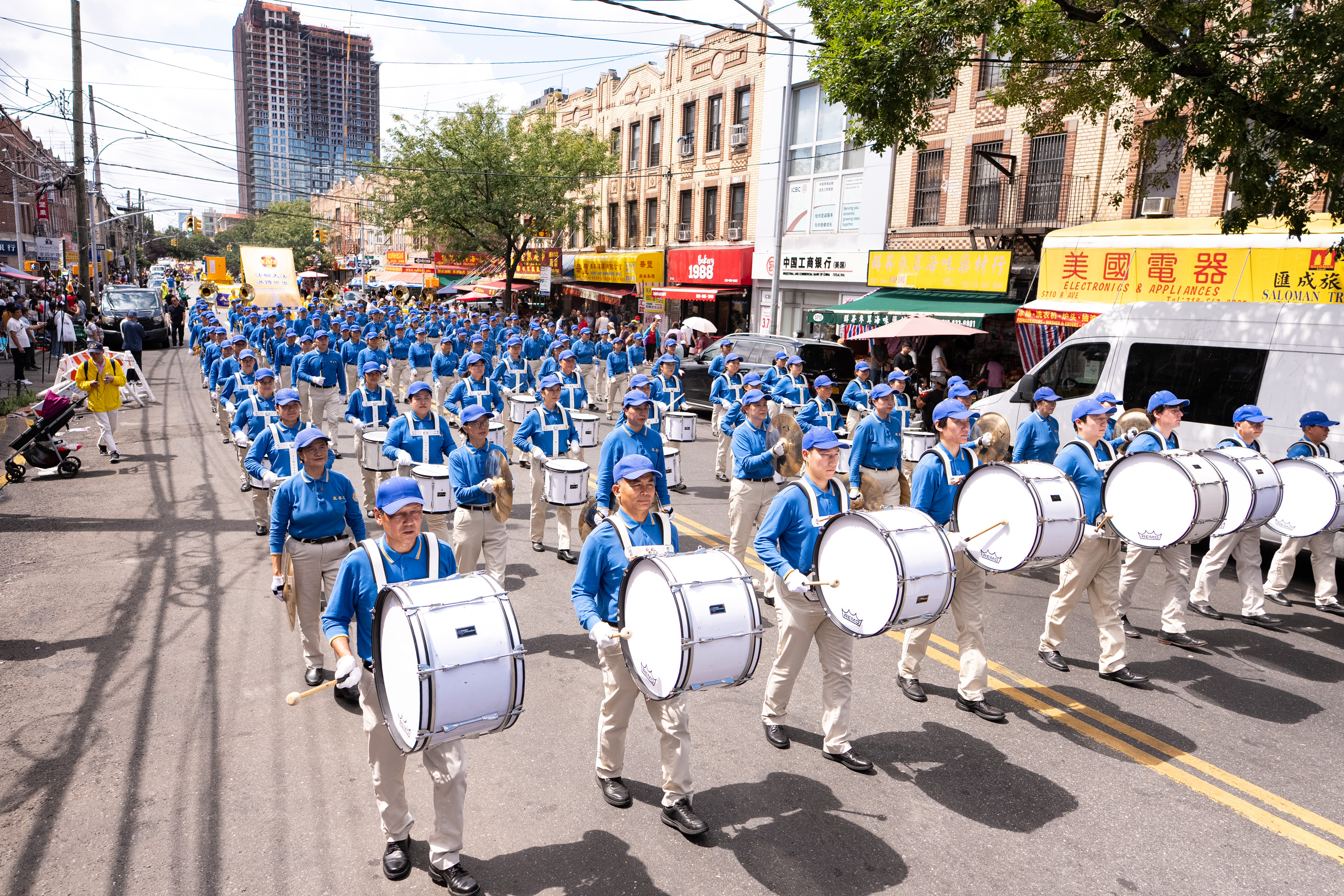 Falun Dafa practitioners take part in a march in Brooklyn, New York City, on Aug. 23, 2026. (Larry Dye/The Epoch Times)
“Changchun has long been one of the areas in China where the persecution of Falun Gong has been among the most severe,” Guan told The Epoch Times.
Guan pointed out that 26 Falun Gong practitioners in Changchun were detained in July, citing a recent report by Minghui.org, a U.S.-based website that tracks the persecution of Falun Gong in China. He said that all of them should be released immediately.
Among the 26 was 74-year-old Liu Yanchun. According to Minghui.org, three police officers from Changchun’s Public Security Bureau beat her in 2003, leaving her permanently disabled. In 2012, she was sentenced to two years in prison for her faith and was subjected to torture.
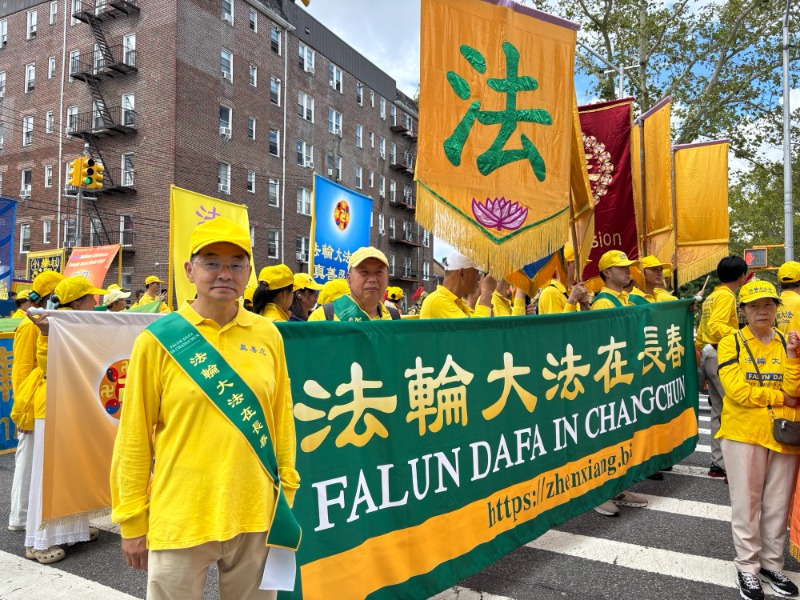 Guan Liantao at a Falun Gong march in Brooklyn, New York City, on Aug. 23, 2026. (Ruo Shui/The Epoch Times)
Another participant in the parade, Yu Zhenjie, from Mudanjiang, a city in northeastern China’s Heilongjiang Province, told NTD that Chinese authorities illegally detained 36 Falun Gong practitioners in her hometown on July 20.
“One of the Falun Gong practitioners has been persecuted to the point of becoming extremely emaciated, Yu said.
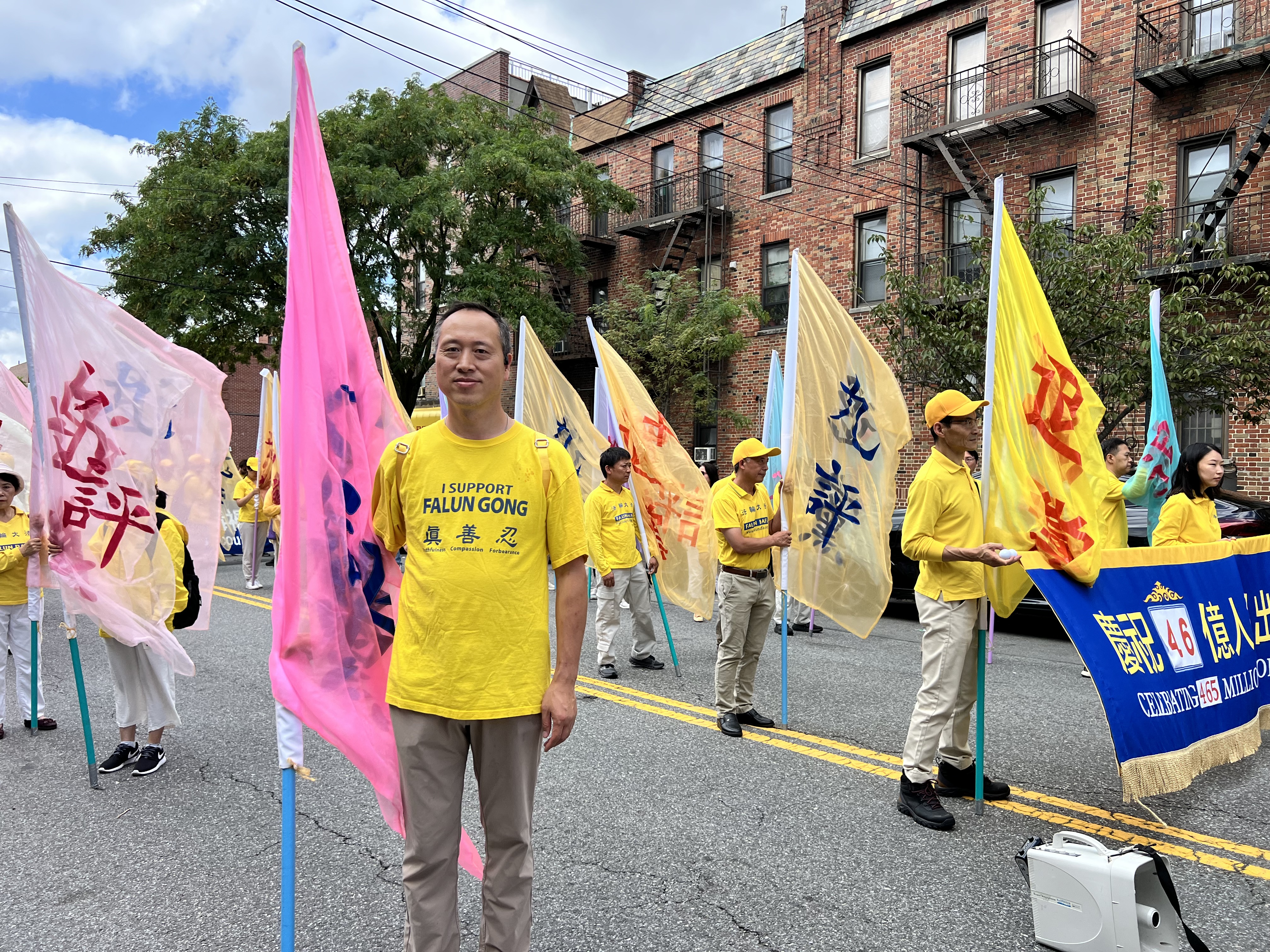 Gao Fei at a Falun Gong march in Brooklyn, New York City, on Aug. 23, 2026. (Cai Rong/The Epoch Times)
“In the early days, there weren’t as many people watching,” Gao said, noting that the number of spectators has grown, with many now pausing to take photos, record videos, and give a thumbs-up.
“To be able to truly speak up for the community and for justice, making a contribution [to raising awareness of the persecution]—this is an expression of compassion,” Gao said.
Cai Rong contributed to this report.
 Friends Read Free
Copy
Facebook
Tweet
Friends Read Free
Copy
Facebook
Tweet